
Few challenges facing the aggregates, concrete and cement industries are as consequential – or as misunderstood – as access to reserves.

Demand for construction materials continues to grow, driven by population increases, infrastructure investment, housing and industrial development. Yet across the country, the ability to produce these materials locally is becoming increasingly uncertain.
In Texas, this tension is playing out in real time. The state’s rapid growth has placed quarries and cement plants at the center of a difficult conversation about land use, community expectations and long-term planning. The outcome of that conversation will determine whether essential materials remain available where they are needed the most.
When growth meets geology
Aggregates are not manufactured where it is convenient. They must be mined where natural deposits occur.
In fact, Texas is taking an unprecedented look at precisely where the state’s natural resources are most abundant with legislation that encompasses four components: resource mapping, land-use analysis, public database access and legislative reporting.
Passed during the 88th Legislative Session, SB 2196 requires the Bureau of Economic Geology (BEG) to identify and map economically viable aggregate resource deposits (such as sand, gravel and crushed stone) throughout the state of Texas. The Texas Aggregates & Concrete Association (TACA) worked closely with legislative leaders and state agencies to provide the data and technical expertise that helped inform development of this measure.
The bureau is tasked with identifying existing land uses and local planning policies that might prevent the future recovery of these essential construction materials. BEG must maintain this information in a database accessible to local governments and political subdivisions to help them make informed planning decisions.
Additionally, the bureau must submit formal recommendations to the Texas Legislature on actions needed to preserve these resources for future infrastructure and residential projects.
The law anticipates that such assessments will help the state preserve and manage vital resource deposits as population growth and construction demand increase.
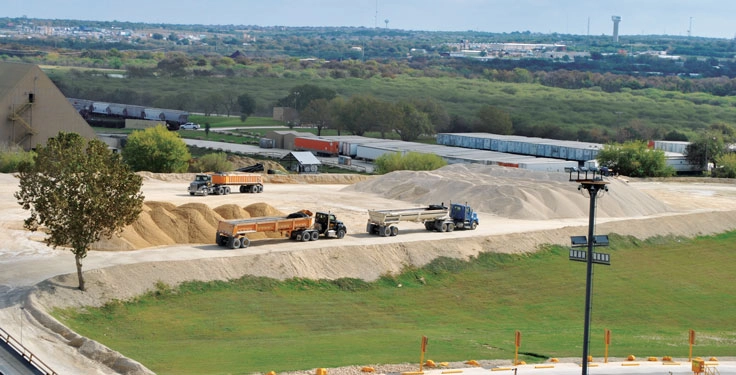
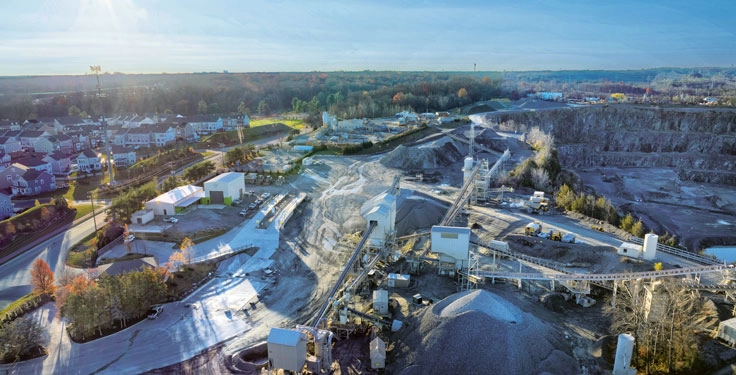
Historically, many quarries and cement plants were sited in rural or lightly developed areas, close to reserves and transportation corridors. Over time, however, intense growth followed. “Moving to the nuisance” is becoming a common phenomenon.
Today, housing developments, schools, commercial centers and industrial parks increasingly surround existing operations. What were once “edge-of-town” facilities now find themselves operating next to neighborhoods that rely on the very materials those facilities produce.
This encroachment creates challenges for operators and communities alike. Concrete, for example, sets quickly and must be delivered under specific timeframes to ensure the material does not set before it can be placed at its destination. This is particularly challenging in areas such as Houston, Dallas and Austin, where intense traffic can impede delivery times.
Increased scrutiny, zoning conflicts and calls for restrictions often arise – not because operations have changed, but because the landscape around them has.
In Texas, this pattern is especially pronounced. High-growth regions such as Central Texas, North Texas and the Gulf Coast are experiencing land-use conflicts that many states are experiencing or will soon face.
The lesson is clear: Growth without long-term planning for material supply carries real consequences.