
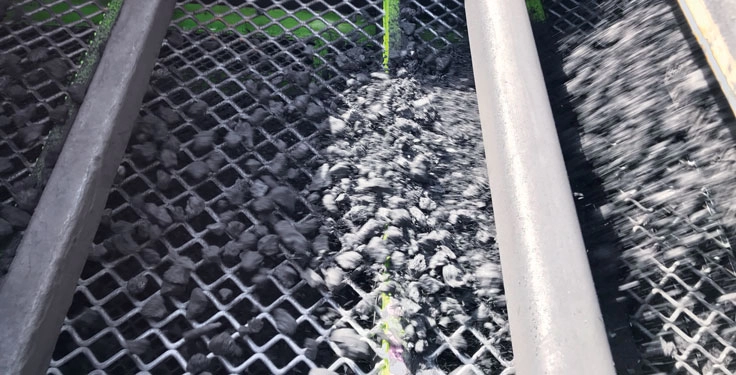
The type of screen media used on a screen deck directly impacts material throughput, equipment wear life and whether operations meet spec.
Most screen media operations still rely on woven wire for their traditional screening needs. But is woven wire still the right choice for aggregate operations?
Between cost-effective woven wire and high-efficiency tensioned screen media, each serves a specific purpose. Let’s explore the benefits and tradeoffs of each option to see how they fit today’s screening applications.
Traditional woven wire
Operations generally understand the benefits of woven wire screen media.
Most of the time, it’s a lower-cost option due to its set sizing options. This style sometimes wears out quickly, but its lower upfront cost can offset shorter wear life – particularly in less demanding applications.
When operations seek to produce a set amount of a product that doesn’t require perfect spec, woven wire makes sense. Woven wire screen media is also ideal for testing a new opening size before committing to more customized or longer-life screen media.
Product options include:
■ Square for general applications
■ Double weave for heavier applications
■ Slotted for removing more fines and providing more open area
■ Hyperslot to reduce blinding in sand
Meanwhile, accessories to prevent oversized materials from falling onto the next screen deck include:
■ Side seals for end-tensioned screen media
■ Overlaps for side-tensioned screen media
If the cost of a custom woven wire screen panel doesn’t meet the output, operations may evaluate tensioned or modular high-vibration screen media.
High-vibration tensioned screen media
Tensioned screen media enhances vibration on the screen deck surface. The high-vibration action – whether side tensioned or end tensioned – reduces blinding and pegging and improves efficiency.
Tensioned screen media can be used across industries – from coal mining to rock quarrying to asphalt recycling and beyond – with specialized adjustments based on the material being screened.
The main benefit of high-vibration screen media is the opening sizes, which are customized. This allows operations to more precisely target specification requirements.
Additionally, advanced polyurethane strips can be added to a screen media panel to extend the lifespan of the screen overall with a more chemically stable compound.
To prevent oversized material from falling onto the screen deck below, operations may use side seals for end-tensioned screen media and overlaps for side-tensioned screen media. And to stop the shroud on end-tensioned screen media from lifting, a hook seal can be used.
To slow material action on an inclined screen deck, dams and impact zone protectors are useful accessories.
Tensioned screen media also benefits from the crown curve, which can increase screening stratification when done correctly. To get the most out of tensioned screen media, the crown curve should be a high point between the rails. Material should hit this point first before dispersing evenly across the deck.
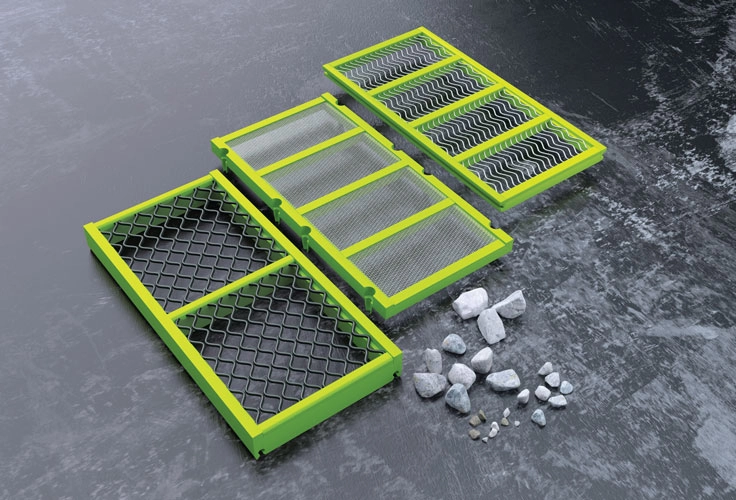
Modular screen media
The benefits of modular screen media really shine when considering screen media panel changeouts.
Maintenance costs can be reduced significantly if an operation sees uneven, concentrated wear in one spot on a screen deck. Instead of changing out the entire screen deck when wear happens in one spot, modular screen media allows operations to change out a specific spot, cutting back on downtime and increasing efficiencies.
Attachment styles include snap types (grooved or step) and pin types (pin and sleeve or pin and leg).
Operations should also keep in mind what type of screen media their vibrating screen is designed for. If an operation is already optimally set up for modular screen media, it can be expensive and lead to extended downtime to switch to tensioned screen media – or vice versa.
Making the right choice
Technology updates have made choosing the right screen media a challenge that quarry and mine management teams don’t have to take on alone.
While woven wire might be an older technology, that doesn’t mean it doesn’t have a place in the modern mine. It’s a good starting point, but tensioned and modular screen media can help improve throughput and ensure an operation consistently meets spec.
Serge Raymond is director of sales at Major.
Related: The real cost of screen media: Looking beyond the price tag