
The role of misinformation
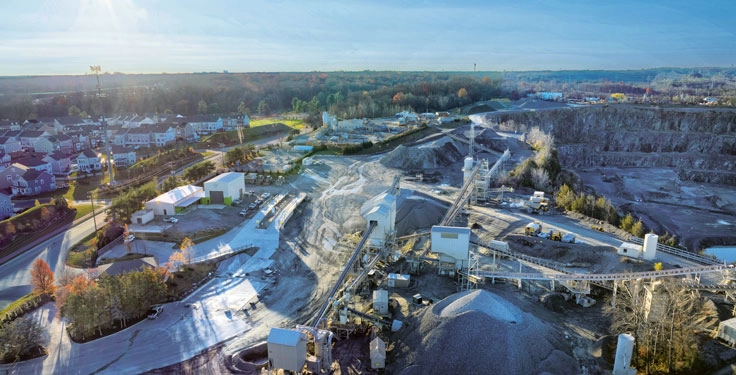
Local opposition to quarries and cement plants is often fueled less by firsthand experience than by misinformation.
Concerns about health, safety, noise, traffic and environmental impacts are frequently amplified by incomplete or inaccurate claims – sometimes spread rapidly through social media and neighborhood forums.
For example, recent media coverage across Texas has heightened public concern about crystalline silica, underscoring a widening gap between perception and established science. Much of the reporting centers on emotionally compelling testimony from local opponents, particularly focused on children and seniors.
However, peer-reviewed research and regulatory air-monitoring data consistently show that aggregate operations and concrete batch plants do not emit respirable crystalline silica at concentrations approaching levels known to pose a health risk to surrounding communities.
In fact, crystalline silica is one of the most common minerals on earth and occurs naturally in soil and sand – including on farms, beaches, golf courses, unpaved roads and playgrounds. What’s more, it can be found in a home’s mortar, brick, tile and countertops. More than 95 percent of the earth’s crust is made of minerals containing silica.
It is important to distinguish between common sand and respirable crystalline silica. Health concerns only arise when silica is processed into a microscopic dust (PM4), which is 100 times smaller than the sand found on a playground. This type of dust is created by high-impact activities like grinding or cutting stone – processes that generally do not occur at aggregate facilities.
While industries like granite countertop cutting are closely regulated to protect workers from these microscopic particles, aggregate sites typically handle larger materials that do not pose the same respiratory risk.
Continuous and early engagement matters
We need a fact-based dialogue – one that separates established science from understandable but unsupported fears.
When the industry is not present early and often in the conversation, these narratives can take hold. Once perceptions harden, it becomes far more difficult to replace fear with facts.
This dynamic is not unique to Texas, but the state offers a clear illustration of how quickly opposition can mobilize when communities feel uninformed or excluded. Importantly, many of these communities simultaneously support new roads, expanded schools, affordable housing and resilient infrastructure – without fully connecting those outcomes to local materials production.
In most cases, communities aren’t opposing infrastructure. They’re opposing facilities they don’t fully understand. When people see a new quarry or concrete plant proposal without context – without understanding modern dust controls, water management practices, traffic planning and state oversight – concern fills the information gap. That’s where education matters.
The most effective projects share a common trait: early, transparent engagement with local stakeholders. Waiting until a permit application is filed – or until opposition has already organized – puts both operators and communities at a disadvantage.
Early engagement allows operators to explain how modern quarries and cement plants function, how they are regulated and how impacts are mitigated through engineering controls, monitoring and operational practices. It also creates space to listen to legitimate concerns and address them before mistrust sets in.
Texas producers have seen measurable benefits from open houses, site tours, community advisory groups and proactive communication. These efforts do not eliminate opposition in every case, but they often shift the conversation from confrontation to collaboration.
The bottom line is that construction materials matter. People may bring their dreams to Texas, but they don’t bring their homes, their roads, their bridges, their churches or their schools. That’s where producers come in – safely, efficiently and ethically leveraging the critical minerals that states need to sustain their infrastructure and satisfy its demand for growth.
Andrew Pinkerton is president and CEO of the Texas Aggregates & Concrete Association (TACA), the leading advocate for the aggregates, concrete, cement and other associated industries in Texas.
Related: TACA chair Rich Szecsy discusses trends in Texas