

Load ejectors. Bottom-dump trailers. Water tanks.
These were among the equipment topics that took center stage for Philippi-Hagenbuch at ConExpo-Con/Agg. Interest in these products reflects shifting priorities, with efficiency, longevity and simpler maintenance driving producer decision-making.
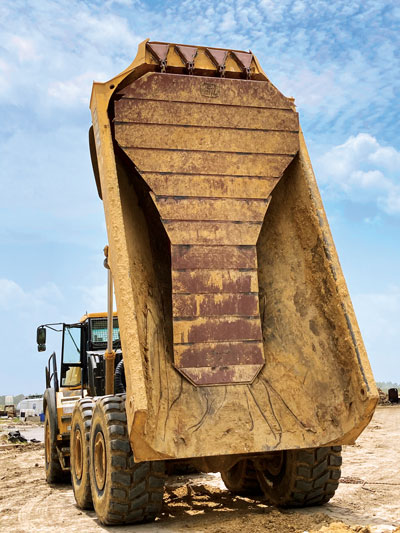
Philippi-Hagenbuch’s load ejectors, which help dislodge sticky material clinging to truck bodies, were one product that particularly drew interest at ConExpo-Con/Agg.
Of course, not every producer deals with sticky material. But those who do know it’s not easy to manage.
“That’s especially true in Texas, Florida, the Carolinas and Canada,” says Josh Swank, chief growth officer at Philippi-Hagenbuch. “Interestingly, those are the same regions where rear ejects are popular – plus Alaska. But the load ejectors perform really well.”
While load ejectors were one hot show topic for PHIL, Swank says bottom-dump trailers also generated tremendous attention. Philippi-Hagenbuch’s bottom-dump trailers are available in either clamshell-door or sliding-floor configurations.
“We don’t market bottom-dump trailers heavily because it’s such a niche, highly engineered product,” Swank says.
The advantage of bottom-dump trailers is efficiency, he adds.
“You have the same fuel burn as a truck, but a trailer can haul double the volume,” Swank says. “The rule of thumb is you can pull double what you can haul. If a Cat 775 hauls 70 tons, you can pull 140. It comes down to weight distribution and horsepower, along with rim pull and grade.”
Philippi-Hagenbuch calculates horsepower and braking surface area based on a producer’s maximum grade.
“Within OEM guidelines, you’re still only putting 70 tons on the truck, but you’re pulling 140 because of how the weight is distributed,” Swank says. “That’s the draw. You have less labor, which is huge given how hard it is to hire. There are fewer benefits to manage and fewer mechanical systems to maintain.”
Plus, with bottom-dump trailers, producers are maintaining trailers – not engines.
“There’s no oil to change, and wear is minimal,” Swank says. “We have a client in Lompoc, California, where we built four large trailers in 1993. They still look brand new. They’re moving from Cat 772s to 773s, and we’re updating the braking systems on 33-year-old trailers because they’re still in near-perfect condition. We over-engineer, and we don’t design for obsolescence.”
Body updates and materials
One update Philippi-Hagenbuch made in 2026 was upgrading the bottom plate, or floor, of its truck bodies to Hardox 500 Tuf.
PHIL previously used Hardox 450 across its bodies.
“Now, we’re improving abrasion resistance for higher-impact environments,” says Swank, who appears as a guest on Episode 62 of P&Q’s Drilling Deeper podcast. “The floor is the spine of the body. Once it’s compromised, it’s very difficult to recover.”