
One bad experience with a lower-quality conveyor component might drive an aggregate producer to seek a better solution.
And those looking for the very best available component – one they won’t have to service frequently – typically have another path toward premium options.
To simplify decision-making for producers at ConExpo-Con/Agg, Luff Industries touted its “good, better and best” approach to conveyor components.
“Typically, people go with the cheapest product,” says Roy Wilks, Canadian sales manager responsible for distribution at Luff Industries. “It’ll work – and it’s good – but if you want more durability, you move to ‘better.’ And if you want the ‘best,’ you go to a premium solution.”
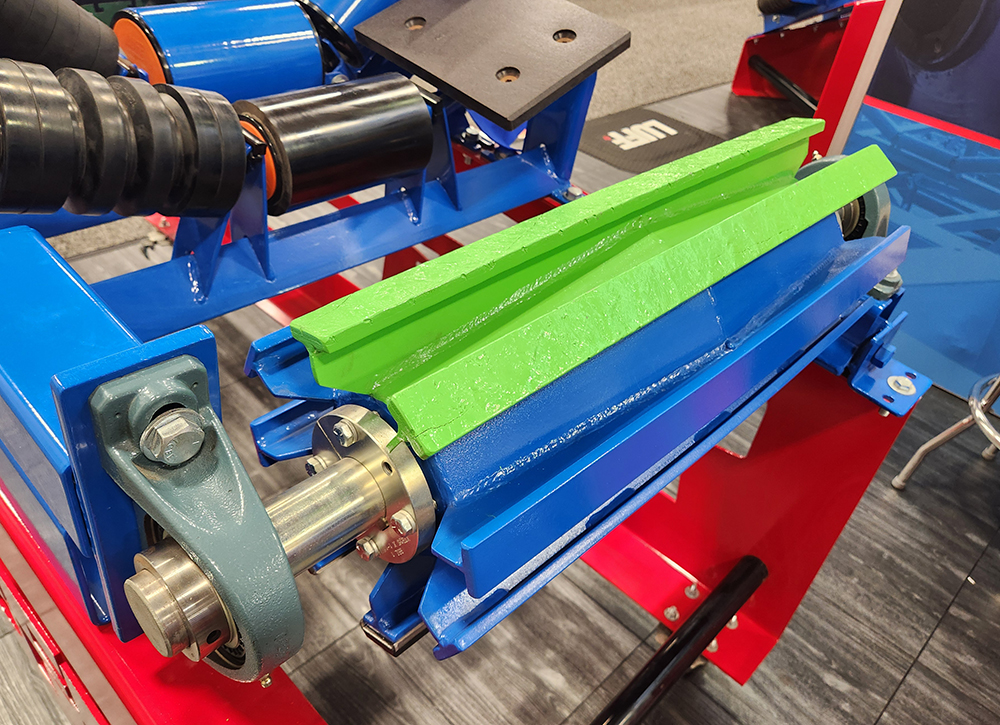
To illustrate his point about good, better and best solutions, Wilks points to Luff’s Wear Wolf wing pulley.
“If you want something more robust, you go to a mine-duty wing pulley,” he says. “But if you want the best, you go to Luff Industries’ Wear Wolf wing pulley. That’s where you get maximum durability.”
Luff created the Wear Wolf wing pulley for high-wear applications where standard wing pulleys don’t quite last. The company says the material blend used features wear properties four times better than AR plate.
“I had a frac sand customer notice the Wear Wolf pulley in the booth,” Wilks says. “He was reminded they bought one from us last year and how they have zero wear on it in one year.”
Wilks says Luff’s good, better, best approach applies to rollers, as well.
“When producers buy a belt conveyor, they often go with the cheapest product,” he says. “It’ll work, but keep in mind the belt is going to be rubbing over rollers. The dirty side of the belt is going to be touching rollers. It’s like sandpaper that’s going to abrade the surface.”
Like pulleys, Luff offers a “better” solution in rollers.
“That would be a rubber disc return roller,” Wilks says. “The rubber disc is a self-cleaning return roller. It has gaps in between. The belt goes over it, it cleans off the belt, and it doesn’t build up with material on the surface.”
Still, Wilks says Luff’s “best” option in rollers features urethane discs.
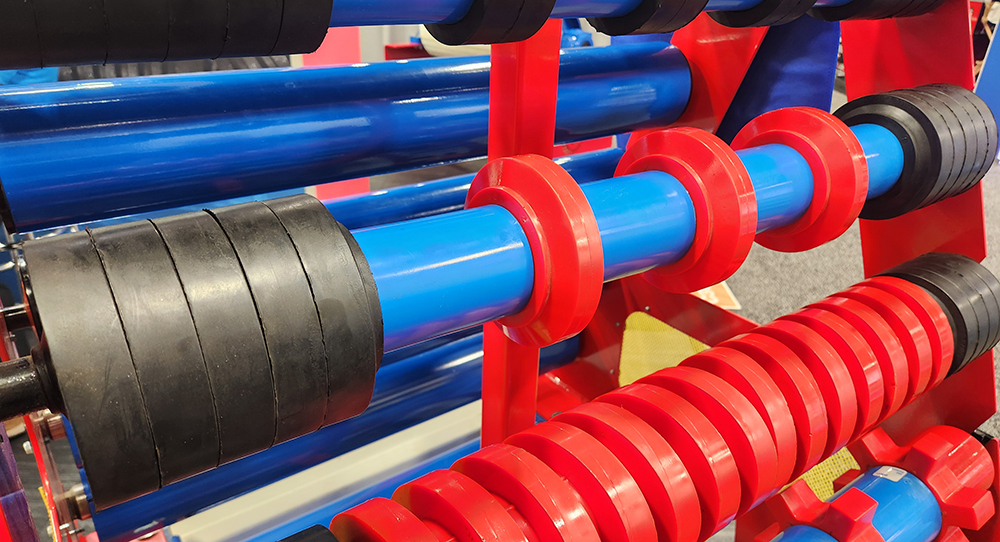
“These are more durable,” he says. “A lot of customers try steel rollers (the “good”), move to rubber disc rollers (the “better”) and then they wind up using the urethane disc returner (the “best”) because of their durability and wear resistance.”
Wilks says the urethane Luff uses has been tested and proven to outlast rubber disc returners from anywhere from four to five times.
Of course, Luff recognizes that producers have different buying approaches. While less expensive conveyor components are enticing to some, more durable or premium options are coveted by others.
“If you want the cheapest option, we’ve got something for you,” Wilks says. “But it’ll end up costing way more money. It’s like buying cheap tires. You’ll be replacing them every six months. When you buy a better value that might cost double upfront but lasts five times as long, what’s the better deal?”
Wilks spends most of his time in mining, where producers tend to be more interested in value than those in aggregates. Times are changing, though.
“Producers recognize more now that the reduced labor pool and reduced manpower are becoming a significant problem,” he says. “And how do you deal with that?”
Higher-quality components – ones that don’t need to be addressed as often – are one such approach.
“As Warren Buffett says, price is what you pay,” Wilks says. “Value is what you get.”