
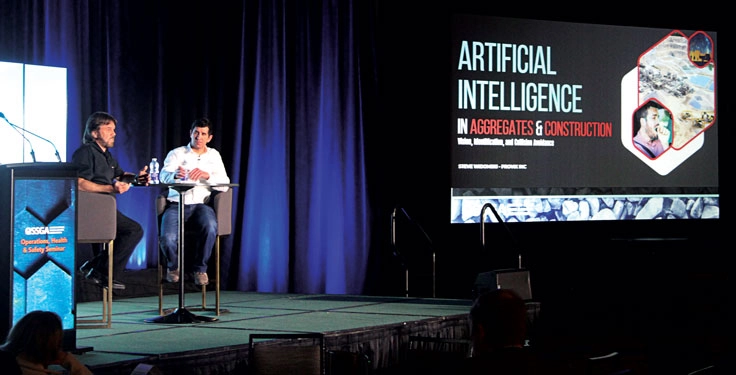
Artificial intelligence was a recurring theme at this year’s Ontario Stone, Sand & Gravel Association’s (OSSGA) Operations, Health & Safety Seminar.
AI came up in nearly every presentation during the Jan. 21-22 event in Toronto. And it took center stage when Provix’s Steve Widomski shared his industry experience with AI – and where he sees it heading in aggregate operations.
For Widomski, safety and security are the top areas where AI currently comes into play. The progress AI has made over the last two years suggests the technology is here to stay.

“This isn’t about taking somebody’s job,” says Widomski, who serves Provix as sales manager for construction, transportation and material handling. “We’re developing AI for safety and for management – not to replace people. If you’re scared of it or you don’t understand it, you might end up loving it once you learn it.”
Smarter cameras
When paired with cameras, Widomski argues AI is especially a gamechanger.
“We’re using AI in cameras,” he says. “Each camera has a processor inside, pretty much like what your cell phone has. That processing power is in each camera, and it’s smart enough to know the difference between a person and a dog, moving machinery, a barrel and a worker walking by. Once it interprets what it’s seeing, it can talk to you, warn you and even stop a machine.”
The next phase of AI and safety is already in the works, he adds.
“Moving into 2027, we’re developing things that can help in a lot of ways,” Widomski says. “Last year, we did 360-[degree] AI. It detects workers, can shut the machine down, records incidents, supports accident reconstruction and can notify the safety manager.”
Operator monitoring is on the way, too.
“Cameras can detect if you’re falling asleep, on the cell phone, distracted, stepped off the machine while it’s in gear – all kinds of things,” Widomski says. “It can alert the operator, and after a set number of alarms it can notify the safety manager. If you’ve been in an accident, it can notify the safety manager, as well.”
All the little advantages AI can offer operations are starting to show themselves.
“Here’s one,” Widomski says. “If you’re in a loader or rock truck, the back camera gets dirty. AI will recognize it’s dirty. How many people will back up their pickup truck today with a dirty camera? Probably most of you. AI can see the camera is dirty, then automatically squirt washer fluid and blow air to clean it – instead of you getting out and walking around the machine.”
Widomski says voice recognition can offer safety gains, as well.
“It can ask you a question,” he says. “[Say] you left your loader running for 15 minutes. [It’ll ask]: ‘Are you OK?’ That’s what we’re working on.”
Still, Widomski contends a fundamental question about AI remains.
“The question is whether the industry will accept it and whether operators will be OK with it,” he says. “Voice recognition is the next part. We have the visual now. We’re moving into voice, and with all this control and prompts, hopefully we can make operations safer.”
Beyond the seminar
For OSSGA, insights like Widomski’s are key to its annual seminar. They’re also part of the association’s broader, year-round education and training push.
While the Operations, Health & Safety Seminar is OSSGA’s signature event, the organization representing the province’s aggregate producers has evolved its educational offerings in other ways.
OSSGA now runs more than 40 programs each year, including Common Core, supervisor modules and confined space training.
“Workers at sites in Ontario are required to complete their base Common Core training,” says Julie Harrington, senior director of training and events at OSSGA. “Beyond this foundational training, workers may also be required to complete specialty modules. For example, anyone operating a front-end loader or a fuel truck has 12 months to gain knowledge and experience before being certified.”