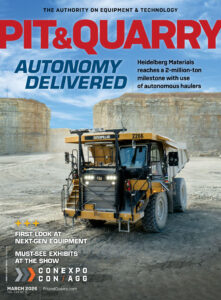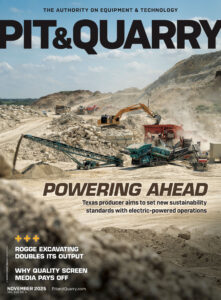

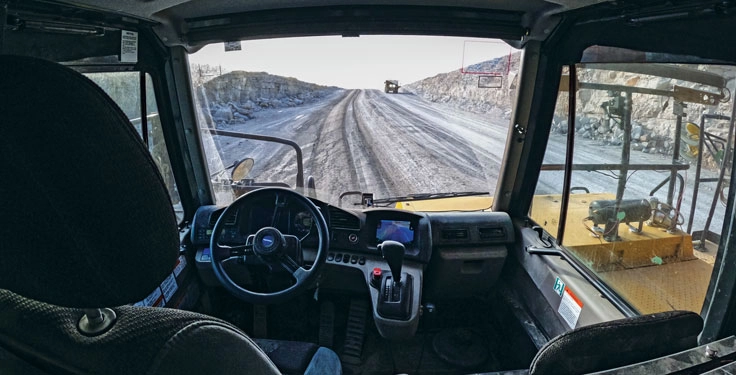
Heidelberg Materials recently reached a milestone in autonomous hauling, hitting the 2-million-ton mark at its Lake Bridgeport Quarry in Bridgeport, Texas. To discuss the achievement and what’s next in autonomy, P&Q caught up with Pronto CFO Christian Kurasek.
P&Q: What does Heidelberg Materials reaching 2 million tons hauled autonomously represent, and how significant is it for aggregates?

Kurasek: I think it’s hard to overstate. If you look at the history of autonomy in the broader industry, it’s been limited to ultra-class trucks and kind of two providers. The challenge was having the tech work on smaller trucks and having the economics work.
The benefits that were going to ultra-class trucks operating in massive mines were out of reach for the aggregates industry. This proves that’s no longer the case. You don’t have to spend tens or hundreds of millions of dollars. You don’t have to spend years deploying it.
When you do deploy it, you’ll quickly see an ROI – productivity improvements, doing better than humans, increasing safety. It’s a massive proof point that autonomy is here for the core industry – at this scale.
P&Q: What did it take to make the Heidelberg deployment successful, from pilot to production?
Kurasek: Once you have the AHS (autonomous haulage system), the hardest parts become connectivity and change management.
The change management piece is real – you’re fundamentally altering the core operation of moving material.
It does take partnership. Heidelberg’s been a phenomenal partner, very forward thinking and open to new ideas. Installation of our tech on a truck takes maybe two days, and then there’s testing and commissioning.
Historically it was two or three support technicians on-site, then after we’ve trained them up, day-to-day it’s Heidelberg running the autonomy, running the site – and that’s how it should be. Every time we do one of these, we learn, they learn, we share learnings and we’re seeing that faster deployment cycle.
P&Q: What gains has autonomy delivered so far?
Kurasek: Utilization, throughput, fuel savings, tire savings – all of that is incredibly real, and it scales down to quarry-scale operations.
If you’re going to sit in a queue for four or five minutes, why are you burning gas and putting strain on the suspension, brakes and tires? If you’re a robot and you know there’s a queue, you can slow down and save fuel, with no loss in cycle time.
With the data we’re collecting, this industry hasn’t had access to it before. We know fuel burn, brake force, exactly where the truck is every half second, how much weight is in the bin. It’s a digitization of the industry – and that’s the biggest unlock.
P&Q: Where is the industry now, and what misconceptions are still hold it back?
Kurasek: We’re in some degree of conversation – pilot deployed to still kicking the tires – with 18 of the top 20 aggregates producers. The biggest misconception is that the economics can’t work.
The second one is: It doesn’t work. This is hard.
We’re transparent. We’re not going to hit better than a human on Day 1. It takes time to tune the system to the site. Anybody who thinks it’s an iPhone you plug into the truck and hit play – it’s not. Do we hope we’re going to get there? Yeah.