
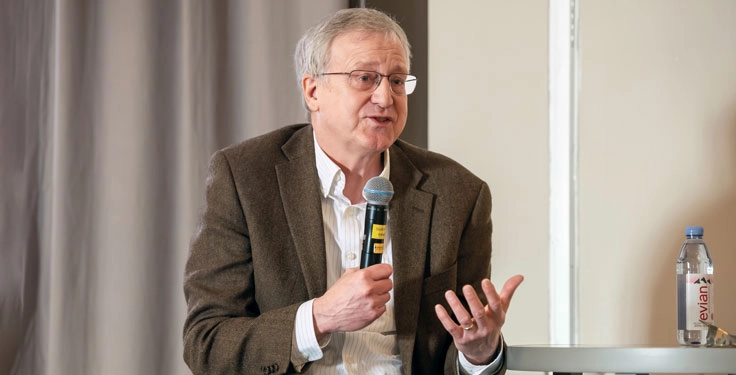
Bill Doran, shareholder of the Washington, D.C., office at Ogletree Deakins, is a regular contributor to Pit & Quarry whose practice is concentrated in safety and health law and litigation. Doran offered insights on MSHA during last month’s Pit & Quarry Roundtable & Conference, reflecting on Wayne Palmer’s tenure as assistant secretary thus far. He provided updates on the agency’s crystalline silica rule, shared the latest on significant and substantial (S&S) violation criteria, and discussed how MSHA might respond to an increase in mining fatalities.
The conversation here, which took place April 1, was edited for brevity and clarity.
P&Q: Two years into the current Trump administration, what do you see in terms of enforcement intensity at MSHA? How are they engaging producers?
Doran: It’s been two years, but that’s still a small sample size. Wayne Palmer, the new assistant secretary of MSHA, has only been there since October. Given that, we’ve already seen signs of what we’ve heard from Palmer – specifically, more cooperation and collaboration with mine operators.
He talked at ConExpo-Con/Agg about wanting to continue ‘calling balls and strikes’ – writing citations, but not for the purpose of padding stats. We have yet to see what that’s going to look like numbers-wise.
In 2024, we had 94,000 citations written throughout the country. It probably dropped in 2025 by about 7,000 to 8,000 citations, so there are fewer citations being issued. Civil penalty-wise, nationally, in 2024, there were $71 million in civil penalties, down to $64 million in 2025.
What that tells you, anecdotally, is that there have been fewer citations, but also less gravity in those citations. You’re not seeing as many high-negligence, unwarrantable-failure-type citations. From that standpoint, you’re seeing – at least in comparison to the previous administration – a little less enforcement in terms of gravity. They’re still out there, though. They’re still writing citations, and there’s still a lot of action going on.
The biggest change you can focus on is the administration’s view of the crystalline silica rule and its willingness to reopen it and address some of the industry’s concerns about how they’re going to comply. That shows a major shift in philosophy, although the process will take a long time to unfold.
P&Q: The industry has long wanted an MSHA assistant secretary with more experience and understanding of the metal/nonmetal world. Does Palmer fit this bill?
Doran: Palmer was the deputy assistant secretary at MSHA during the first Trump administration and, in the interim, worked in the metal/nonmetal industry. So, it’s nice to have someone at the top who has that metal/nonmetal background, because that hasn’t always been the case. Normally, it’s a coal person in the assistant secretary spot.
One of his goals, which is a constant concern for operators, is the consistency of action enforcement. He wants to address the fact that different districts interpret regulations differently and write different citations. One thing he’s committed to doing is centralizing the informal conference process so that, while you’ll still be working with a CLR (conference litigation representative) somewhere in your district, it will be managed by headquarters. The goal is to ensure things are a little more consistent.
P&Q: With enforcement of the crystalline silica rule currently paused, where do we currently stand with the rule?
Doran: We’re in a wait-and-see period at this point. The industry challenged the rule in court, and enforcement has been stayed. During that process, however, MSHA leadership announced they were reopening the rule and would make some changes.
Wayne Palmer was present at a National Stone, Sand & Gravel Association (NSSGA) Health & Safety Subcommittee meeting, and everyone tried to get him to give some idea of what they were planning on doing. They’re keeping it very close to the vest and not telling us exactly what the changes are.
The scuttlebutt is that they will make some changes with respect to things like administrative compliance. Can you still rotate people? Can you use PPE as part of your compliance program? Everyone is waiting to see those things.
It sounded like Wayne Palmer’s goal was to have a new rule proposed in the spring or the beginning of the summer. Usually, though, you can add four or five months to those estimates. We’re a long way from operators having to think about an inspector writing citations under the new standards.
The other thing you need to remember is that once this new proposed rule is out, there’s a very real possibility of legal challenges on the labor side. So, we could be looking at this rulemaking process for a long time.
P&Q: Is there anything operators should be doing to prepare for a potential rule?
Doran: You don’t want to get locked into a compliance program that might change because of something the agency is going to put out. But I think it makes sense for operators to be doing some testing to find their problem areas and look at the areas that are going to have an impact in terms of their actual level or the PEL (permitted exposure level).
The PEL (50 micrograms per cubic meter of air) is not going to change – that’s the assumption, at least. It makes sense to know where your problems might be so that when you do have to shift into gear and get ready to go with compliance, you know what you’re going to have to focus on and be in the best position moving forward.
P&Q: Are there any updates on the S&S (significant and substantial) violations front?
Doran: What happened in Secretary of Labor v. Consol Pennsylvania Coal Co. is that the Mine Safety & Health Review Commission, which is normally a five-person commission, had only three at that point. Two members decided to change the S&S criteria, and it wasn’t briefed. Neither party was asking for it, but they did it.
Now, you don’t look at the type of injury that could occur – it’s just whether or not someone was exposed. You don’t look at likelihood anymore.
S&S citations are the building blocks for more serious enforcement on more unwarrantable failure, pattern of violations (POV) and higher civil penalties. Right now, about 17 percent of all citations issued are S&S. The concern on the industry side is that this could lead to a much higher percentage of S&S citations and much more difficult enforcement.
Currently, MSHA isn’t enforcing under this new rule. They’re waiting for new criteria to be issued based on what happens in the D.C. Circuit. It’s a wait-and-see moment.
P&Q: Given the state of mining fatalities, do you expect any different approaches, initiatives or enforcement?
Doran: Right now, MSHA hasn’t indicated any initiatives. Last year was a bad year – there’s no question about it. March was not a good month either, with five fatalities on the metal/nonmetal side. It’s certainly gotten MSHA’s attention.
Typically, MSHA’s response to fatality spikes has been to ratchet up its impact inspection regimen. Wayne Palmer and his leadership team, however, have indicated that they’re stepping away from impact inspections.
Regardless of what the enforcement focus is – be it more aggressive or less aggressive – if there is a sustained fatality spike, you can throw politics out the window. Tougher enforcement is going to happen.
Related: Pit & Quarry Roundtable addresses policy, safety and markets