
The Pit & Quarry University Handbook is an educational resource that offers comprehensive lessons covering the entire aggregate production process from start to finish, highlighting new technologies and enhanced procedures within each branch/category of the aggregates industry.
FULL HANDBOOK
Chapter 1: Industry Overview
Chapter 2: Geology & Site Selection
Chapter 3: Drilling & Blasting
Chapter 4: Excavating & Loading
Chapter 5: Hauling
Chapter 6: Crushing & Hydraulic Breaking
Chapter 7: Screening
Chapter 8: Washing & Classifying
Chapter 9: Conveying & Material Handling
Chapter 10: Loadout & Weighing
Chapter 11: Safety & Health
Screening is one of the most important processes in aggregate production.
It’s the step that separates crushed rock into specific sizes, sending on-spec material to stockpiles while oversize and undersize are recirculated for further processing.
Because the accuracy and efficiency of this stage directly impact both quality and profitability, screening is often referred to as the “cashbox” of the plant.
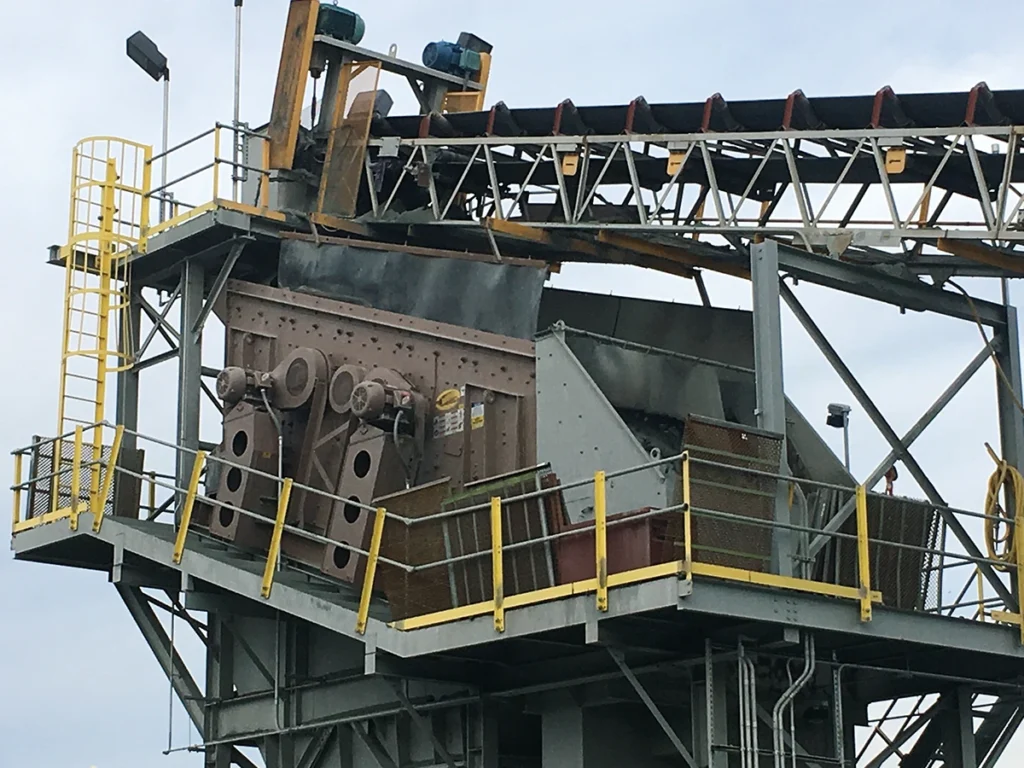
At its simplest, a screen is a vibrating box fitted with one or more decks. Each deck contains screen media with precisely sized openings that either pass material through or carry it over. By adjusting these openings, producers can tailor their output to meet the requirements of common construction materials such as base stone, concrete aggregates and asphalt mix.
Many quarries also adjust setups to produce niche sizes for specific local markets. In this way, screens not only keep production on target but provide flexibility to respond to changing demand.
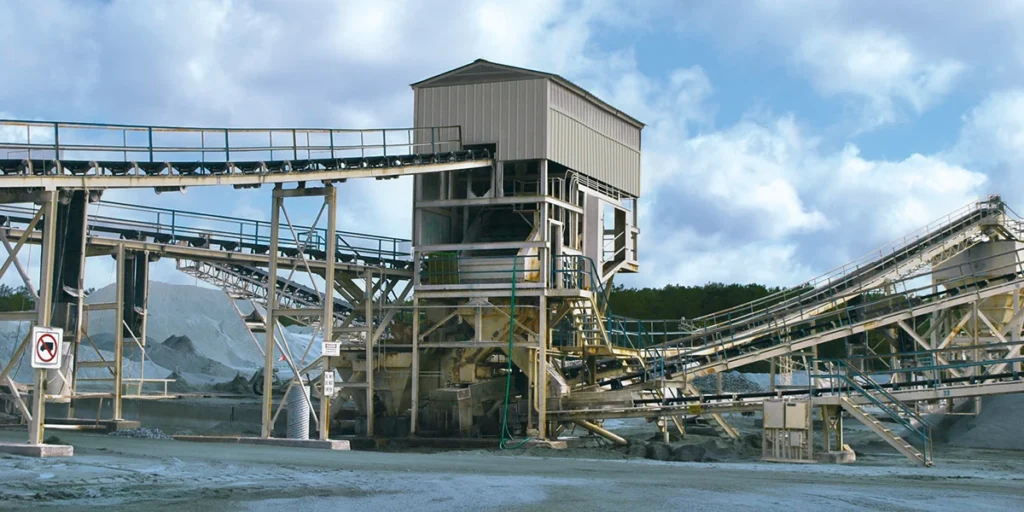
The screening process is straightforward. Material moves from the crusher onto conveyors that feed the screen tower, where rock drops into the feedbox at the top deck. From there, vibration carries the load across successive decks, with each level making a finer separation.
A three-deck screen, for example, might scalp oversize on the top deck, separate a mid-range product on the second and allow fines to pass through the bottom. What emerges is either directed to stockpiles as saleable product or returned for further reduction.
&uuid=(email))
Types of Screens
While the role of screening has remained consistent over the decades, equipment itself comes in a range of designs to suit different applications.
Stationary operations often rely on large incline screens set at a fixed angle, while portable plants may use flat horizontal designs to meet height restrictions. Multi-sloped or “banana” screens add another variation, engineered to quickly pass smaller particles at the feed end while giving near-size material more time to separate toward discharge.
Regardless of the setup, the purpose is the same: to size material accurately, keep the plant running efficiently and deliver products that meet specification.
Inclined versus horizontal screens
Most aggregate operations rely on one of two basic screen types: inclined or horizontal.
Inclined, or sloped, screens take advantage of gravity, requiring less stroke and lower g-force to move material down the deck. Horizontal screens, by contrast, operate without gravity’s assistance and depend on longer stroke and higher g-forces to achieve proper separation.
Screen Motion & Principles
The way a screen moves has a direct effect on how efficiently it separates material. Different motion patterns, along with the interaction of stratification, separation, speed and stroke, determine whether a screen delivers clean, on-spec products or struggles with carryover and inefficiency.
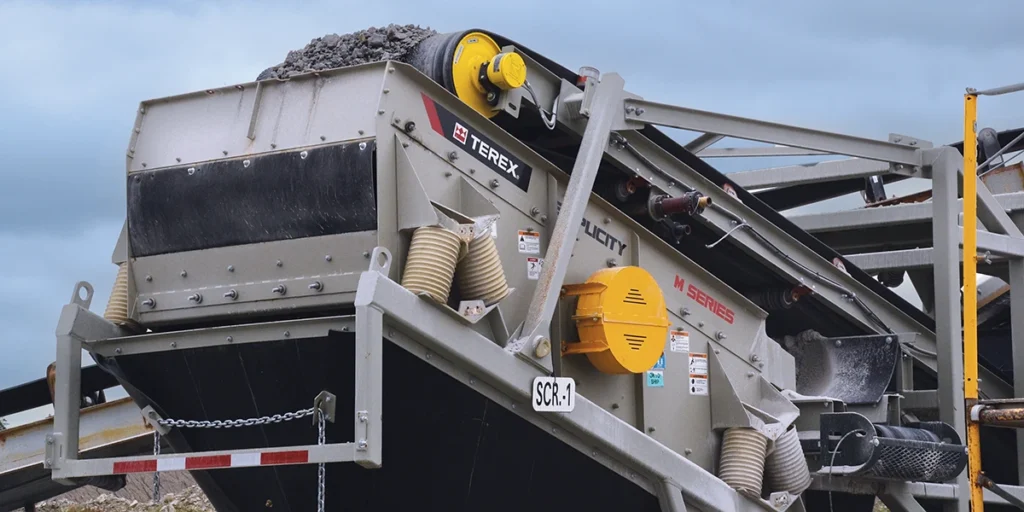
Types of screen motion
Another key ingredient to effective screening is motion. There are three types of motions screens make:
- Circle throw. This motion is commonly associated with inclined screens. This is a lower-energy motion that uses gravity to move material down the screen. It is also resistant to plugging. Still, blinding can become a problem due to lower stroke.
- Straight line (reciprocating). This motion is usually used in horizontal screens. While this motion can be more efficient and accurate, plugging can become a problem.
- Oval stroke (elliptical). This motion can provide high efficiency and accuracy and is common in horizontal mounting. The high-energy motion helps loosen fines, creating a high resistance to pegging and blinding.
Stratification and separation
Two actions must occur for effective screening: stratification and separation.
Stratification happens first, as vibration allows finer particles to sift through the bed of material until they reach the screen surface. Separation follows, depending on whether a particle is small enough to pass through the opening.
For efficient stratification, producers should follow a basic rule of thumb: at the discharge end of the screen, bed depth should be no more than four times the screen opening size. Beyond this limit, fines cannot reach the deck efficiently and carryover increases.
Both speed and stroke influence stratification and separation, making them key parameters to monitor during screening.
Speed and stroke
Speed is measured in revolutions per minute and is determined by motor speed and sheave size.
Because speed can drift over time, periodic testing is necessary to confirm that the screen is operating at its designed rate. Running at higher speeds can improve carrying capacity, increase acceleration and move material more quickly across the deck. The tradeoffs, however, include added stresses on the machine, shorter bearing life and the risk of reaching a critical frequency that disrupts performance.
Stroke, or throw, measures the vertical distance a screen travels. It is controlled by counterweight placement on the shaft.
If the throw is too long, material may overshoot openings and bypass the screen surface. If it is too short, particles can clog openings and restrict throughput.
To avoid these issues, operators can measure stroke with a stroke card in all four corners of the screen. Increasing stroke generally enhances carrying capacity, acceleration and stratification while reducing plugging and blinding.
Still, greater stroke also adds stress to the machine, shortens bearing life and can reduce efficiency if material begins bouncing rather than passing through an opening.
PRO TIP
Adjust speed and stroke strategically: Increase stroke for coarse separations and raise speed for finer cuts to balance efficiency and wear.
Screen Media
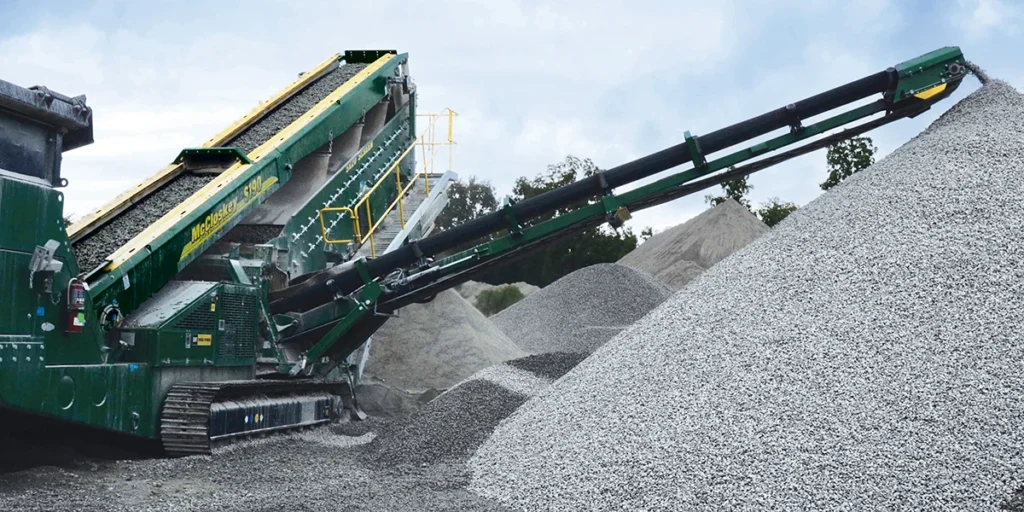
Screen media is the working surface of a vibrating screen, and it is one of the most critical decisions an operator makes.
The media is what directly interacts with material, controlling efficiency, wear life and, ultimately, whether a plant produces consistent, on-spec product. The more opportunities a particle has to encounter an opening, the greater its chance of passing through. For this reason, open area, hole shape and media design are central considerations.
Definition
Open area: The percentage of surface on a screen deck that consists of openings available for material to pass through.
Common media options
- Woven wire cloth. This is a traditional and still-widely used option. Wire cloth offers the highest open area, making it effective for high throughput. Its tradeoff is shorter wear life, and heavier-gauge wire, while stronger, reduces open area. Square openings are most common, but slotted or rectangular openings can increase capacity for elongated particles. Round or diamond-shaped openings can help reduce plugging in difficult applications.
- Rubber panels. These panels provide long wear life and excellent impact resistance. They are common on top decks handling large, abrasive rock. The tradeoff is lower open area, which limits throughput. Operators must also account for the added weight of rubber panels, which can influence machine stroke and deck support requirements.
- Polyurethane panels. Polyurethane is common in wet or abrasive applications. It is flexible, resistant to pegging and blinding, and provides longer wear life than wire.
Open-cast polyurethane, poured in molds, can last up to twice as long as injection-molded panels. Like rubber, its drawback is reduced open area. - Hybrid designs. Some producers choose hybrid media that combine woven wire and polyurethane strips. These provide more open area than rubber or polyurethane panels while extending wear life four to seven times beyond wire alone. Hybrids are especially valuable on mid-decks where access is limited.
- High-vibration wire media. These engineered screens suspend wires in polyurethane strips, allowing them to vibrate independently under material contact. This secondary vibration reduces pegging and blinding, accelerates stratification and improves separation. High-vibration screens can operate at 8,000 to 10,000 cycles per minute – 13 times higher than the vibration of the screen box itself. This design can increase open area up to 30 percent compared with woven wire and 50 percent compared with polyurethane or rubber panels. Some producers even reduce water use in wash circuits by adopting high-vibration screens that remove fines more effectively.
Modular versus non-modular panels
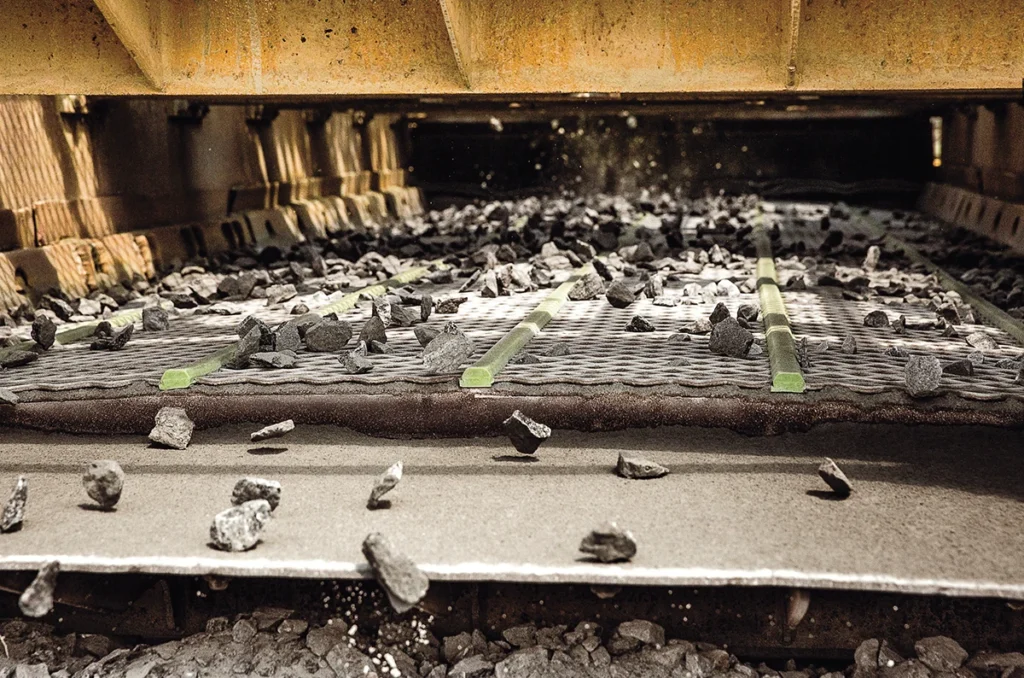
Media can be installed in full sheets or as smaller modular panels.
Modular panels (typically rubber or polyurethane) are easier and faster to replace, reducing downtime. They also allow producers to use different media types across the same deck. For example, impact-resistant panels at the feed end can transition to open-area panels near discharge.
Non-modular screens (like woven wire cloth) cover larger areas with fewer seams and are often less expensive upfront. However, replacement requires handling larger sections, which can be more labor-intensive.
Deck configurations and screening phases
Material behaves differently as it moves across a screen.
At the feed end, material is thickly layered, and impact resistance is the top priority. In the middle, the material is stratifying, so open area becomes more important. At the discharge end, near-size particles require precise separation, so sharp, clean openings are essential.
Mixing media types across a deck addresses these needs. A deck configured with heavy-duty panels at the feed, self-cleaning wire in the middle and high open-area panels at discharge provides a balanced solution.
Special deck designs such as step decks and double-crown decks further improve stratification and throughput. Multi-sloped or “banana” screens accelerate fines at the feed end while giving near-size particles more time to separate downstream.
Self-cleaning media
When plugging or blinding is persistent, self-cleaning media is often the answer.
Harp, wave wire and piano wire screens use flexible wires that vibrate independently to shed near-size particles. These screens provide more open area than rubber or polyurethane and reduce downtime by minimizing manual cleaning. Their drawback is shorter wear life, but in applications where pegging is a chronic issue, the productivity gains can outweigh replacement costs.
PRO TIP
Switch to self-cleaning media in wet conditions: Replace standard wire or rubber with harp, wave or piano screens when blinding persists.
&uuid=(email))
Selection considerations
Media selection should always start with the application.
Material top size, shape, abrasiveness and moisture content all dictate performance. Granite requires durable surfaces while limestone allows for higher open area. Clay-rich material may demand self-cleaning media.
Cost must also be weighed against efficiency. Using the wrong media leads to increased downtime, contaminated stockpiles and higher maintenance expenses. Reviewing discarded panels in an operation’s “boneyard” often reveals the source of problems: broken wires point to excessive impact, pegging indicates improper hole shape, and blinding suggests the wrong surface type or moisture control.
PRO TIP
Audit discarded panels: Study broken wires, pegged holes or polished wear spots to diagnose root-cause issues in screening performance.
Installation and tensioning
Even the best media will fail if installed improperly.
Before changeout, the screen should be inspected for cracks, loose bolts, broken welds, worn crown bars, weak springs and bent clamping rails. Crown bar rubber must be replaced with each media change.
During installation, inner clamp bolts should be tightened first, then outer bolts, alternating sides to keep panels centered. A properly tensioned screen is tight “like a drum” and resists flexing when pressed. Loose panels vibrate against the deck, leading to noise, premature wear and failure.
FULL HANDBOOK
Chapter 1: Industry Overview
Chapter 2: Geology & Site Selection
Chapter 3: Drilling & Blasting
Chapter 4: Excavating & Loading
Chapter 5: Hauling
Chapter 6: Crushing & Hydraulic Breaking
Chapter 7: Screening
Chapter 8: Washing & Classifying
Chapter 9: Conveying & Material Handling
Chapter 10: Loadout & Weighing
Chapter 11: Safety & Health
Use the page numbers to continue reading, or select a section / chapter above.