

FULL HANDBOOK
Chapter 1: Industry Overview
Chapter 2: Geology & Site Selection
Chapter 3: Drilling & Blasting
Chapter 4: Excavating & Loading
Chapter 5: Hauling
Chapter 6: Crushing & Hydraulic Breaking
Chapter 7: Screening
Chapter 8: Washing & Classifying
Chapter 9: Conveying & Material Handling
Chapter 10: Loadout & Weighing
Chapter 11: Safety & Health
Flow Optimization
Efficient material handling is essential to produce high-quality aggregate products while minimizing unnecessary degradation or product loss.
The transfer points – where material moves from one conveyor or feeder to another – are especially vulnerable. Poorly designed transfers can lead to excessive wear, contamination, product segregation and safety hazards. Fortunately, several engineered components and systems are available to improve flow control and optimize these critical transitions.
Transfer points
Containment is key to avoiding spillage and dust. Fortunately, several components are designed for this purpose.
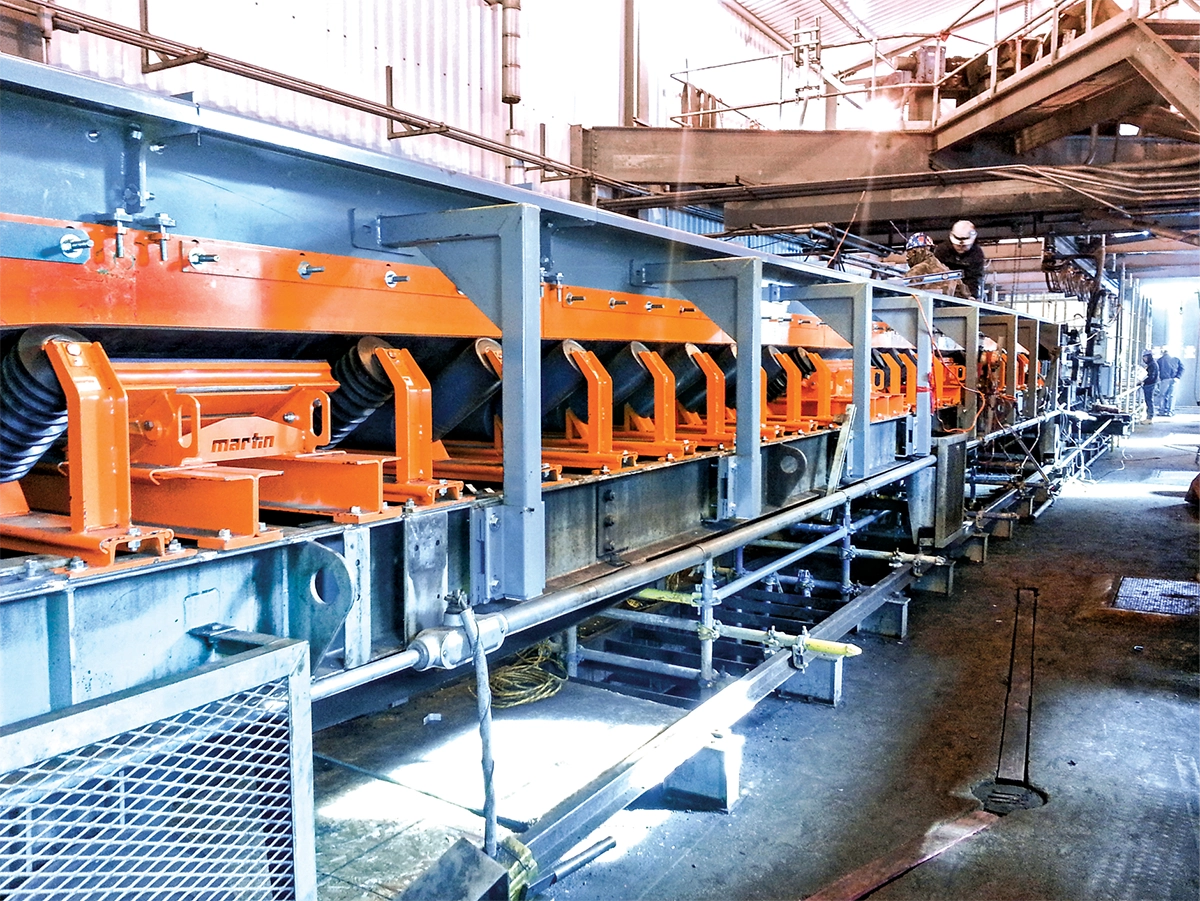
Although shaped transfer chutes and rock boxes direct the material flow to mitigate the concussion of material on the belt, most high-volume operations need one or more impact cradles to absorb the force of the cargo stream.
Heavy-duty impact cradles can be equipped with rubber or urethane impact bars with a top layer of slick UHMW plastic to minimize belt friction. Able to withstand impact forces as high as 17,000 pound-force and drop heights of up to 50 ft., support beams in the center of the cradle are set slightly below the receiving belt’s line of travel.
In this way, the belt avoids sustained friction when running empty. And yet it can absorb hard impacts during loading while still retaining a tight belt seal.
Within the settling zone – located after the impact cradle in the conveyor chute box – slider cradles can then create a troughed belt to center the cargo and reduce disruption quickly, aiding in dust settlement.
Slider cradles, located down the length of the skirted area, have several different functions. One is to create a trough angle that adequately centers the load. The trough angle also plays an important part in retaining a tight seal between the belt and the skirt.
Also, by utilizing track-mount idlers in between each cradle, a smooth belt path is created through the settling area. This can be easily maintained. A smooth belt path should have no gaps, minimizing disruption and promoting containment, allowing dust and fines to settle into the cargo stream prior to leaving the containment area.
Airflow
With a constant stream of material crashing on the impact point of the receiving belt, the transfer point can be extremely turbulent, and this turbulence must be contained.
By slowing the airflow in the skirted area, suspended dust is allowed to settle onto the cargo path. To contain the mixture of air and disrupted material, a stable, correctly supported belt is needed for the sealing components to function properly. Without a stable beltline, the belt will sag between idlers, and sealing components will not prevent air and fine material from escaping the resulting gaps, causing spillage and dust emissions.
Chute sealing
By closing gaps and keeping a tight seal on the belt, apron seals can also be attached to the chute walls to prevent fugitive dust and fines from escaping.
The external design requires minimal tools and no confined space entry to inspect, adjust or replace wear liners or skirts, and, in most cases, can be performed by a single worker. The low profile of the skirting assembly needs only a few inches of clearance, allowing installation and maintenance in space-restricted areas.
The design of these components drastically reduces scheduled downtime and the potential workplace hazards associated with replacement and adjustment.
&uuid=(email))
Dust filtration
In operations with limited space for a settling zone or especially dusty materials, dust bags and curtains may be essential components.
Providing passive relief via positive air pressure created at belt conveyor loading zones, dust bags prevent the escape of airborne particulates by venting the air and collecting dust at the same time.
Installed at the exit of the loading zone and mounted in the skirtboard cover, dust curtains can help create a plenum for dust suppression and dust collection. For additional dust control, an integrated air cleaner system can be installed at the point of emission, containing a suction blower, filtering elements and a filter cleaning system.
Skirtboards, impact beds and belt sealing
Skirtboards are vertical plates that run along the edges of a conveyor belt at the loading zone. Their purpose is to contain material and prevent it from spilling over the sides during transfer.
However, skirtboards alone are not enough. Without proper support underneath the belt, heavy loads can cause sagging, which creates gaps where material can escape.
That’s where impact beds come into play. These are rigid frames with energy-absorbing bars that provide a stable surface under the belt at the loading zone. They cushion the belt from heavy loads, reduce belt sag and extend equipment life.
To further control dust and fines, belt sealing systems – also known as skirting systems – are installed along skirtboards. These use flexible, wear-resistant rubber or polyurethane blades that press lightly against the belt surface to prevent material leakage.
Flow control gates and feeders
Controlling the rate at which material enters a conveyor – or crusher, for that matter – is key to maintain consistent production and prevent overload. Flow can be managed using devices like:
- Flow control gates. These are simple mechanical systems installed at the base of a hopper to regulate discharge volume.
- Belt feeders. These use a short, variable-speed belt to meter material from a hopper or bin to the next stage of the process.
- Apron feeders. They’re typically used for heavy, coarse material and consist of overlapping steel pans that carry material along a chain-driven system.
- Vibrating feeders. These use vibration to move material forward at a controlled rate, and they’re ideal for fine, dry material or situations where flow consistency is critical.
Each of these options presents benefits depending on the application. Belt and apron feeders tend to offer higher capacities and handle larger material, while vibrating feeders excel in gentle handling and consistent flow control.
Wear liners and abrasion protection
Transfers often include drop chutes or transfer points that experience high wear due to the velocity and volume of material. To protect this equipment, wear liners – made from materials like hardened steel, rubber, ceramic or composite – are installed inside chutes and bins. These liners absorb the brunt of the impact and abrasion, reducing maintenance costs and downtime.
Modular liner systems allow for quick replacement when sections wear out, instead of replacing an entire chute structure.
Minimizing segregation and degradation
When material is transferred – especially during stockpiling – it can undergo segregation, where coarse particles roll away and fines concentrate in the center or bottom of the pile. This uneven distribution leads to inconsistent product gradation and reduced quality.
Likewise, degradation occurs when material breaks apart due to excessive impact or handling. This is particularly problematic with friable aggregates or when producing spec-specific products like concrete sand.
One of the most effective ways to combat both issues during stockpiling is to use telescoping radial stackers. Unlike fixed or standard radial conveyors, telescoping models can extend and retract, as well as rotate in an arc, allowing for layered and windrowed stockpile building. This motion reduces the height from which material falls and ensures even layering across the pile, limiting segregation and minimizing degradation caused by impact.
In addition to telescoping stackers, other methods include installing chute liners, rock ladders and baffle plates to slow material down during transfer. Curved or stepped chute designs also help reduce fall velocity, and blending chutes promote better material mixing.
Ultimately, reducing fall height, improving flow control and choosing equipment designed to minimize particle impact are all essential strategies to preserve product integrity from crusher to stockpile.
PRO TIP
Optimize stockpiling: Use telescoping stackers to build layered piles that maintain spec consistency and reduce loader rehandling.
Maintenance, Troubleshooting & Belt Cleaning
Common failure points
Three of the most frequent conveyor problems include belt mistracking, belt wear and pulley slippage.
1. Mistracking. This occurs when a conveyor belt veers off its intended path. If left uncorrected, mistracking can damage the belt edges, pulleys, structural steel and even spill material. It’s typically caused by improper belt tension, misaligned idlers, material buildup or damage to components.
2. Belt wear. Belt wear tends to occur from either abrasive material contact, material spillage accumulating under the return side or incorrect loading techniques. Regular inspection of both the carrying and return sides helps operators identify wear patterns early, allowing for adjustments before a belt is compromised.
3. Pulley slippage. This problem can be the result of excessive belt tension, worn lagging or improper drive alignment. Slippage not only affects performance, but it generates heat, which can degrade the belt and reduce service life.
Predictive maintenance and condition monitoring
Preventive maintenance schedules are valuable, but they’re even more effective when paired with predictive tools that allow teams to identify emerging issues before they become failures.
Vibration sensors, temperature monitors and belt tracking sensors can be used to detect early signs of mechanical issues. For instance, increased vibration at a head pulley could indicate bearing failure, while a shift in belt alignment data might reveal developing mistracking.
More advanced setups integrate condition monitoring systems that continuously track conveyor parameters like belt speed, motor load, oil temperature in gearboxes, and bearing condition. These systems help maintenance teams prioritize actions based on data rather than assumptions.
Routine visual inspections should still be scheduled. Trained technicians often spot issues like frayed belting, buildup on return idlers or improperly tensioned take-ups that sensors may miss. Combining real-time monitoring with hands-on checks provides the most complete picture of conveyor health.
PRO TIP
Invest in condition monitoring: Use vibration sensors, thermal imaging and belt tracking devices for predictive maintenance rather than waiting for failures.
Belt replacement strategies
Timing belt replacements correctly is key to reduce unplanned shutdowns. The best practice is to monitor belts over time and identify performance thresholds – such as declining tracking behavior or significant cover wear – that trigger pre-planned replacement.
Some operations standardize a threshold of 80 to 85 percent of expected belt life before replacement to minimize the risk of failure during peak production. Others use belt thickness gauges to measure actual wear and forecast remaining life. Keeping spare belts or pre-cut belt sections on-site is another time-saving tactic, particularly for critical conveyors.
If only a portion of a belt is worn (i.e., in the load zone), sectional replacements can be a cost-effective alternative. But ensure that splices and fasteners are installed correctly, as improperly installed connections often become failure points themselves.
PRO TIP
Standardize belt replacement: Define measurable thresholds to avoid unplanned downtime from unexpected failures.
Safe access for maintenance
Conveyors may seem accessible, but they pose real hazards during inspection and service work. Safe maintenance begins with energy isolation protocols, such as procedures, to prevent unexpected startup.
Personnel should only access conveyors via designated platforms, catwalks or ladders – and never by climbing on the belt or frame. Proper lighting, fall protection and safe clearance zones are essential for inspections conducted at height or over extended lengths.
For larger systems or overland conveyors, remote inspection technologies (i.e., drones or belt-mounted cameras) can offer safer alternatives to in-person walkthroughs.
In some plants, maintenance platforms integrated into the conveyor structure allow technicians to service key components like head pulleys or belt scrapers with reduced risk. When combined with real-time condition monitoring and organized maintenance records, these platforms are part of a broader strategy to improve both safety and equipment longevity.
Belt cleaners
The need for conveyor belt cleaning is well established.
Excessive fugitive material can reduce component and belt life by as much as 30 percent, while a multiple-belt cleaner system contributes less than 5 percent to overall belt wear, delivering a significant benefit. Further, the effect of a properly adjusted cleaner on the belt is far less than one that is under- or overtensioned and allows material buildup to contribute to increased wear.
For operators who can’t find a cleaner that works, it could be that the problem isn’t the equipment but rather the maintenance. A managed service relationship may be a solution.
It’s no secret that belt cleaners require frequent inspection and adjustment to perform at a level that meets or exceeds expectations. The optimum solution must include the right belt cleaners that are mounted in the correct positions and proactively serviced to deliver a positive cost benefit month after month.
Definition
Belt cleaner: A component mounted on a conveyor to remove carryback material from the belt surface, reducing buildup and extending belt life.
Correctly installed and maintained belt cleaners reduce direct costs by reducing cleanup labor and indirect costs by improving safety, minimizing dust emissions and increasing component life.
A basic question related to all conveyor systems is whether maintenance personnel are trained to select the proper belt cleaning system, install it correctly, what to look for on inspection, and how to set the proper cleaning pressures. It may sound elementary, but there is a great deal of knowledge and skill required to tune a belt cleaning system to work under varying material – and in environmental and belt cover conditions – while still operating effectively and economically.
Belt cleaner manufacturers know if their equipment is not maintained, the blame typically falls on their components and not on a lack of proper service by in-house maintenance crews. As a result, the money spent on belt-cleaning equipment is often wasted. When performance falls to a level that can no longer be tolerated, the equipment is scrapped and another supplier’s cleaners are installed – only to have the cycle repeat itself.
In contrast, some manufacturers provide factory-trained direct service personnel and replacement parts, delivering expert maintenance for optimum performance and component life. A few will even supply free remote monitoring and reporting equipment.
These managed service technicians are often the answer to common belt cleaning problems. For these technicians, who spend every day assessing and servicing belt conveyors, maintenance and repairs become more of a precise science than a judgment by rule of thumb.
The number and style of belt cleaners required depend on balancing many factors. First, the level of cleaning required for the application must be established.
Definition
Carryback: Material that adheres to the conveyor belt and is carried past the discharge point, often leading to buildup, spillage and maintenance issues.
Aggregate mining can often tolerate more carryback accumulation, because an acceptable level of cleanup can be done with mobile equipment and minimal manual follow-up to keep conveyors operating.
Once the level of cleaning is established, the next task is to determine the type and number of cleaners needed to do the job. Open pit aggregate mining may achieve acceptable performance with a single cleaner.
The trend in belt cleaning, regardless of application, is to plan for two or more cleaners per discharge. In addition to better cleaning from multiple cleaners, there is a redundancy factor that can provide a longer service interval window.
With the level of cleaning and the number of cleaners established, the appropriate materials of construction for the frame and tensioner are evaluated and the best blade for the application is selected.
The Conveyor Equipment Manufacturers Association specifies cleaning locations as primary, secondary and tertiary.
The most desirable location for belt cleaners is on or very close to the head pulley in the primary position, so the material can fall with the main flow of material and reduce buildup on dribble chutes.
If cleaning must be done away from the head pulley, cleaners are preferably mounted in the secondary position. If the secondary position is not accessible, cleaners may be mounted in the tertiary position. But this may require a second dribble chute or collection pit.
Many conveyors are designed without much consideration for belt cleaner location, despite the critical role they play in meeting production goals. Poor conveyor head designs often have the structure obscuring the optimum mounting location or simply not enough room at the head to install or access them so they can be serviced.
When faced with these restrictions, just one cleaner or installing it “any old way” isn’t good enough. Facilities should seek out a supplier partner that can make a best decision on equipment and location for their specific situation.
Some manufacturers offer conveyor inspections and cleaner maintenance as part of a managed service relationship.
Their monitoring systems can track component wear and update the service technician and operations personnel about upcoming service needs. There are some new systems that can even adjust belt cleaner tension automatically. The technology will send an alert through a mobile app in the event of upset conditions.
PRO TIP
Track maintenance: Keep detailed records of inspections, belt changes and component wear to identify recurring problems and optimize replacement cycles.
Factory-trained service technicians provide an added set of eyes on conveyors, traveling to and from the equipment to be serviced and logging details in their reports. Because they see so many different applications, they can often alert to problems that maintenance personnel don’t see – or ones they’ve become accustomed to ignoring.
With factory-direct managed service, the responsibility for maintenance falls on the manufacturer, allowing the staff to focus on other priorities.
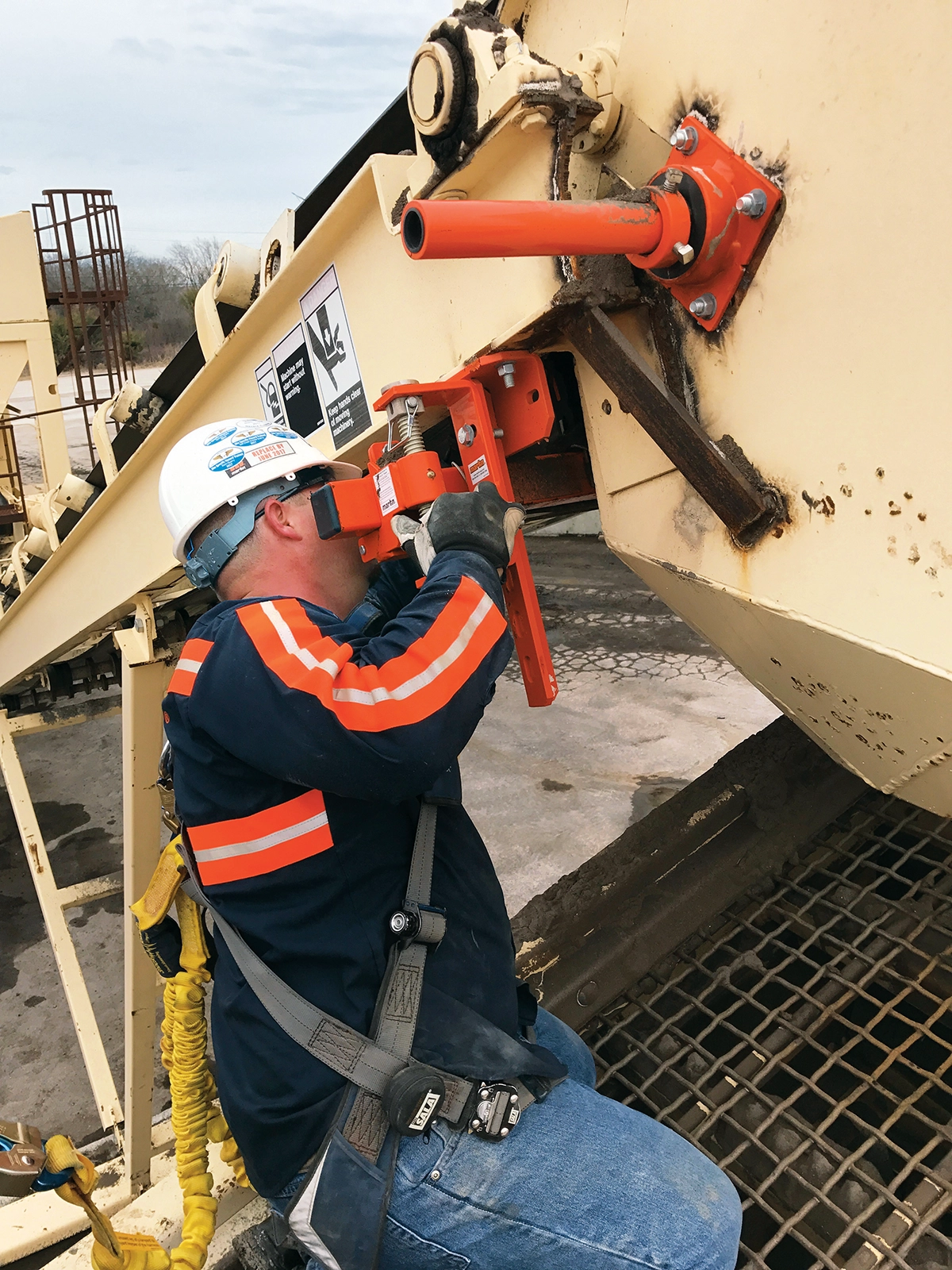
A trained belt cleaner service technician is aware of hazards involved with maintaining belt cleaners.
The indirect costs of an injury or accident can be significant. In-house maintenance and cleaning are two job classifications that are exposed to significant potential for muscular or skeletal injuries. These tasks are typically involved in more than half of reportable lost-time accidents. Having a trained provider that focuses on safety – but at the same time is more productive than in-house maintenance – can be a significant benefit.
Additionally, keeping a shutdown to a minimum is important to meet process availability goals. There are specialized systems to service belt cleaners – ones where a belt runs 24/7 and cannot be shut down, yet virtually all other cleaner maintenance must be performed following lockout/tagout/blockout/testout procedures.
&uuid=(email))
A “run ‘til broke” philosophy means more than broken machinery. It can exacerbate financial issues and affect worker morale, too.
In the rush to patch things together, maintenance workers are tempted to take shortcuts and work around established procedures, exposing themselves to greater potential for injury.
When calculating the return on investment for professionally installing and maintaining belt cleaners, an analysis can be done over the life of the belt cleaner assembly using a net present value calculation. Many spreadsheet apps have a net present value function.
For example, if the cost of capital is 10 percent, the initial investment is $5,000, cleaning labor savings is $6,000 per year, and service and parts are $2,000 per year, then the net present value of the cash flow (discounted by the cost of capital) is $15,163. Subtracting the initial investment and the managed service cost, this example generates more than $10,000 in free cash flow over the life of the equipment without considering all other potential savings.
A typical belt cleaner assembly should last five years with minimal frame or tensioner repairs. Inspections should be done regularly, and any problems should be addressed immediately. Some manufacturers with factory-direct service offer free replacement and upgrades of frames and tensioners as part of their managed service offerings.
Blade wear will vary based on the blade material and abrasiveness of the bulk materials, along with several factors such as correct cleaning pressure. Belt wear from the cleaner is typically about 2 percent per cleaner, so concerns over blade type and cover wear are usually unfounded.
The cost of safety is minimized by reducing the frequency and hours of manual cleaning and, therefore, the exposure to injuries.
FULL HANDBOOK
Chapter 1: Industry Overview
Chapter 2: Geology & Site Selection
Chapter 3: Drilling & Blasting
Chapter 4: Excavating & Loading
Chapter 5: Hauling
Chapter 6: Crushing & Hydraulic Breaking
Chapter 7: Screening
Chapter 8: Washing & Classifying
Chapter 9: Conveying & Material Handling
Chapter 10: Loadout & Weighing
Chapter 11: Safety & Health
Use the page numbers to continue reading, or select a section / chapter above.