
FULL HANDBOOK
Chapter 1: Industry Overview
Chapter 2: Geology & Site Selection
Chapter 3: Drilling & Blasting
Chapter 4: Excavating & Loading
Chapter 5: Hauling
Chapter 6: Crushing & Hydraulic Breaking
Chapter 7: Screening
Chapter 8: Washing & Classifying
Chapter 9: Conveying & Material Handling
Chapter 10: Loadout & Weighing
Chapter 11: Safety & Health
Primary Transport, Overland & Stackers
Conveyors in aggregate operations, of course, serve a range of roles.
For primary transport, conveyors move raw feed from the primary crusher to secondary processing equipment. These are typically shorter, fixed conveyors with heavy-duty components to handle heavy, abrasive material.
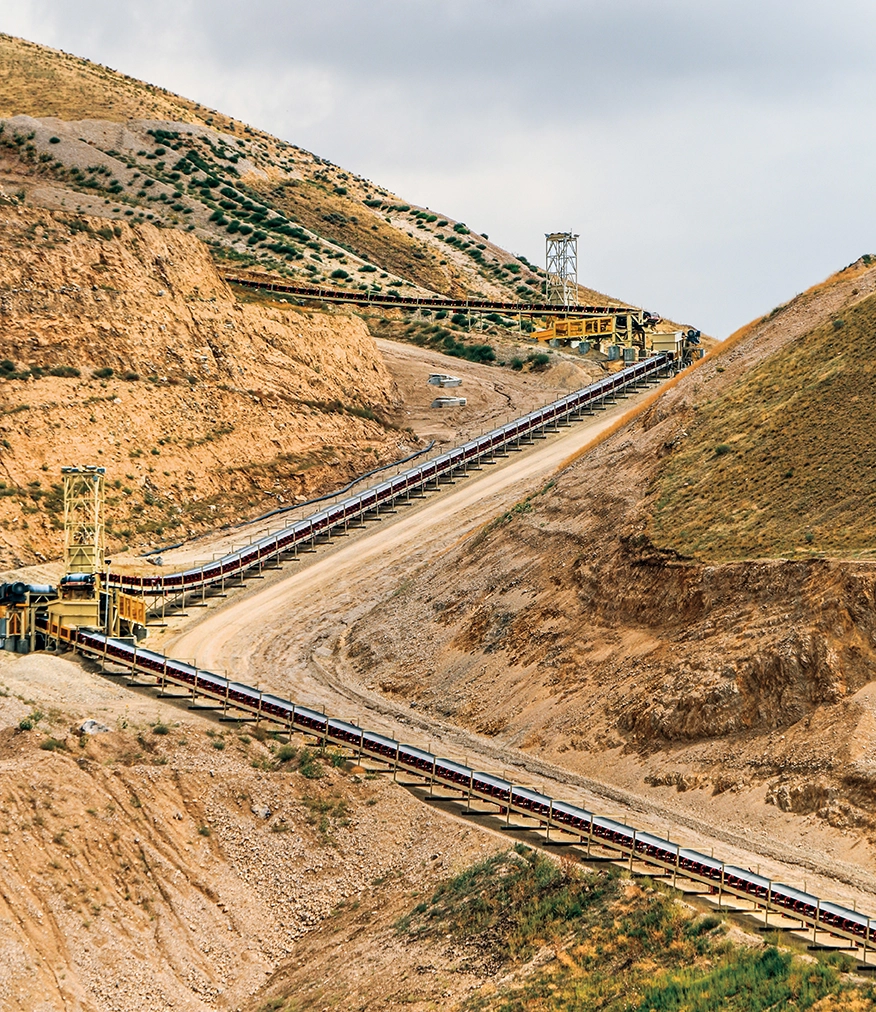
Overland conveyors are used for long-distance material transfer, often replacing haul trucks when moving material across large quarries or between processing stages. These can stretch for thousands of feet, with truss frames and engineered ground support to manage terrain and elevation changes.
Definition
Overland conveyor: A high-capacity conveyor engineered to transport bulk material over long distances, often replacing or supplementing haul trucks.
&uuid=(email))
Transfer conveyors play a vital role in material handling for aggregate operations, as they are designed to move crushed stone, sand, and gravel from one piece of processing equipment to the next. While they may not be as large or specialized as overland conveyors, transfer conveyors play a key role in maintaining continuous, efficient production.
Stackers are mobile conveyors used to build material stockpiles efficiently. They come in tracked, wheeled or radial designs and help minimize loader use and stockpile compaction while maximizing storage volume.
Telescoping stackers, meanwhile, add efficiency by layering material evenly and reducing segregation.
Whether fixed or portable, truss or channel, conveyors must be matched to the specific material flow, mobility needs and site layout. A thoughtful approach to selection can optimize performance, minimize downtime and reduce material handling costs over time.
Overland conveyors
As aggregate operations grow and material sources move farther from processing areas, many producers evaluate how they transport bulk material over long distances.
Traditionally, haul trucks have been the standard, but the rising costs of fuel, labor, maintenance, emissions compliance and permitting are driving a shift toward more economical alternatives.
Overland conveyors are increasingly viewed as a practical solution. Designed to cover distances from a few thousand feet to several miles, these systems allow for continuous material movement with fewer interruptions and significantly lower operating costs per ton. While haul trucks offer flexibility and can handle variable terrain, they are less efficient when used to transport material across long, fixed routes.
By contrast, overland conveyors excel in steady, repeatable transport – especially in operations that run around the clock.
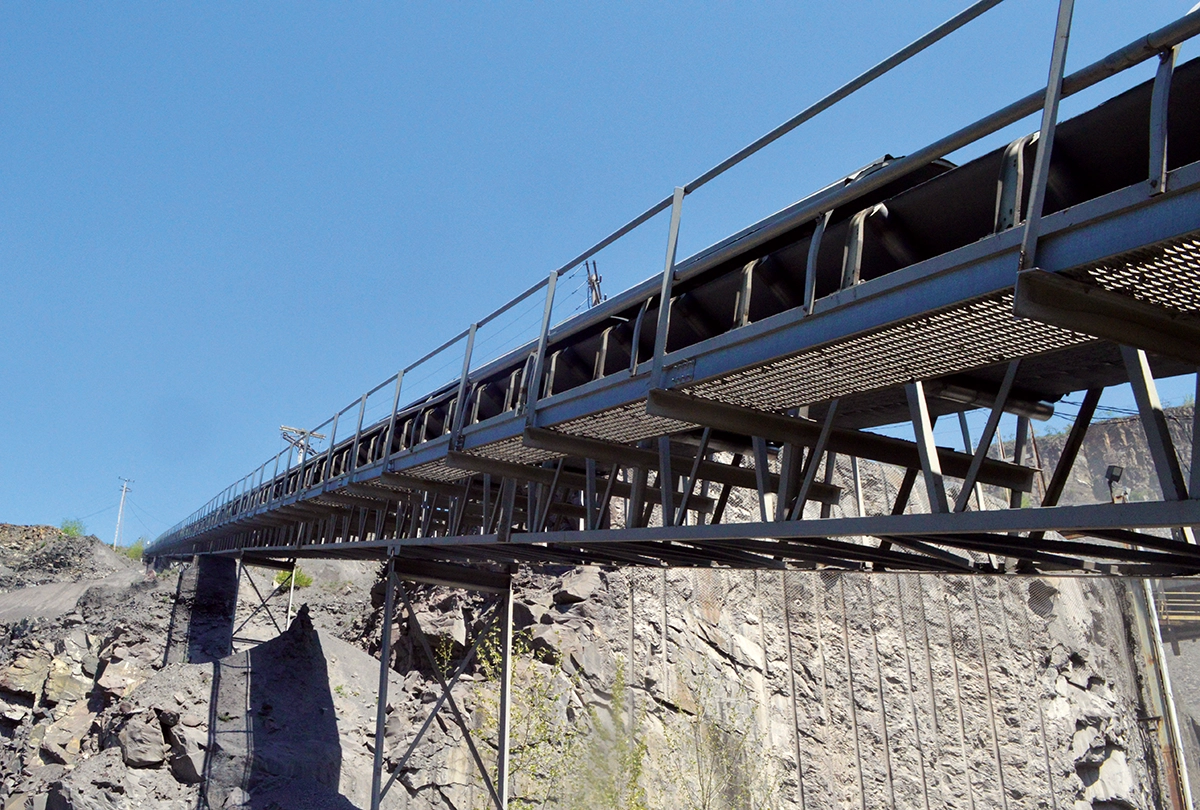
In some applications, conveyors completely replace haul trucks. In others, they supplement them, reducing the distance trucks must travel and limiting their use to short hauls between the face and a primary crusher. This hybrid approach helps lower equipment wear and cuts down on labor hours and emissions.
Environmental concerns are also a driver in this trend. Conveyors produce less noise, dust and traffic than haul fleets, making them more acceptable to neighboring communities and regulatory agencies. In some projects, such as urban construction or airport expansions, overland conveyors have proven instrumental in meeting strict environmental and logistical requirements.
With modern engineering, conveyors can handle inclines up to 35 percent, provide capacities from hundreds to tens of thousands of tons per hour, and operate reliably for decades. For many producers, a detailed cost comparison reveals that the long-term benefits of overland conveyors often outweigh the initial investment.
Transfer conveyors
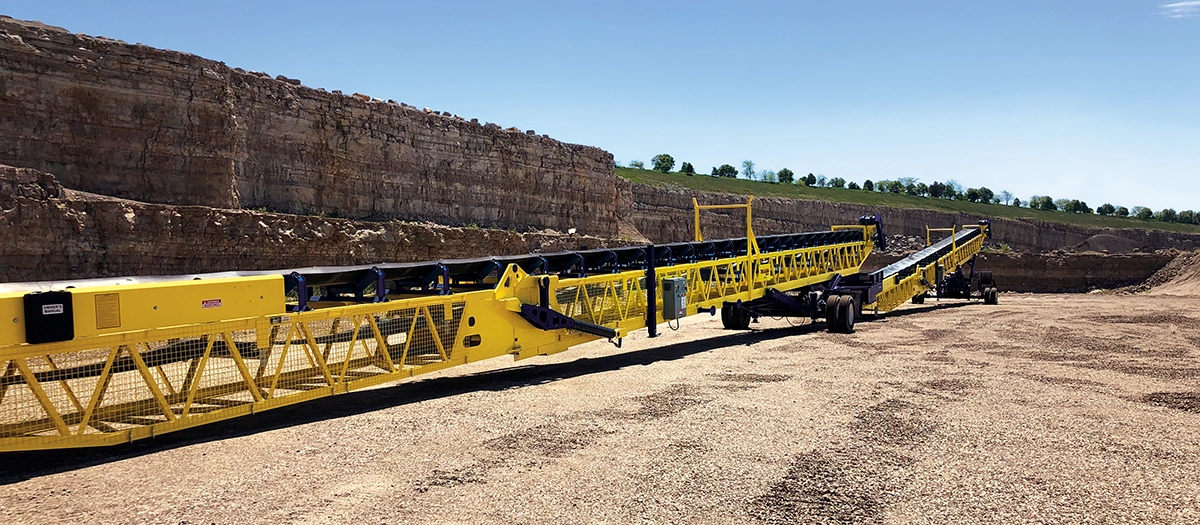
In a typical operation, transfer conveyors efficiently transport material between the crushing, screening, washing and stockpiling stages, helping to reduce the need for loaders or trucks to move material manually. This not only cuts labor and fuel costs but minimizes material spillage and degradation.
Transfer conveyors can be mounted on skids, wheels or tracks, or they can be installed in a fixed position – depending on the layout of the plant and how often it changes.
Material drops onto the conveyor belt from an upstream source – such as the discharge of a primary crusher or a screen deck – and the transfer conveyor carries it across a set distance to a downstream machine, such as a secondary crusher, wash plant or stockpile conveyor.
Transfer conveyors are often configured in series, allowing for a seamless material flow. For example, after material is crushed, it may fall onto a transfer conveyor that feeds it into a vibrating screen. Once screened, another conveyor might carry the clean stone to a radial stacker, while a separate transfer conveyor sends fines to a washing system.
One main advantage of transfer conveyors is their flexibility, as they can be added or repositioned to accommodate production changes or modifications in equipment layout. This is especially valuable as part of a portable or modular aggregate plant system, which is often used in smaller or temporary operations.
SAFETY TIP
Control dust and spillage: Use skirtboards, belt sealing and dust suppression to improve visibility, reduce slips and protect worker health.
When configuring transfer conveyors within a plant, by reducing the distance material needs to fall and controlling the direction, these conveyors can help protect against material segregation and dust creation – which is especially important in applications such as manufactured sand or washed aggregates. Some systems include hoods, skirting or covers to further reduce dust and protect material from wind or rain.
In essence, transfer conveyors are the arteries for material transport between stages in aggregate operations. By efficiently moving material from crushers to screens to washers and beyond, they help to ensure consistent flow, reduce manual handling and support high-volume aggregate production while lowering operating costs.
Radial stackers
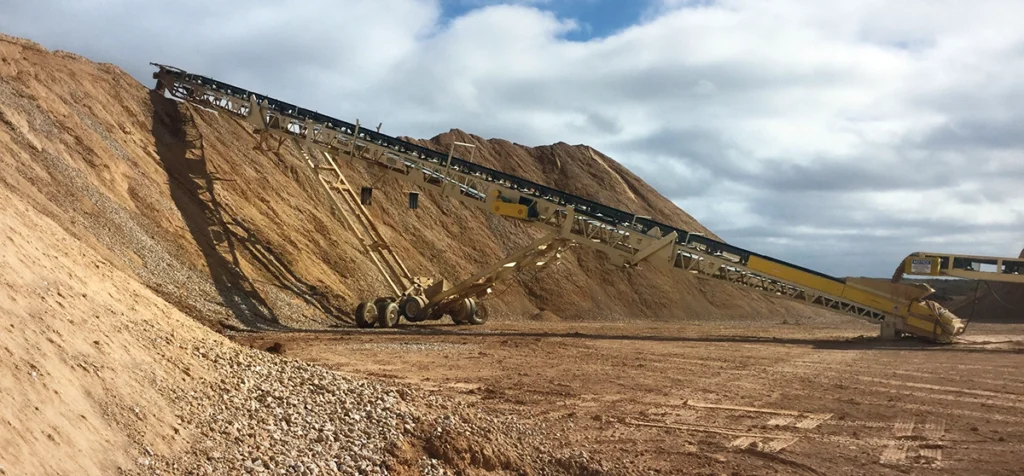
Radial stackers, meanwhile, are a type of conveyor that stockpiles material in a controlled and efficient manner.
Typically mounted on a wheeled base, this conveyor type features a pivot point at the base allowing the discharge end to rotate in an arc, or “radial” pattern, around the base to create large, uniform stockpiles. These machines are commonly found in aggregate operations where bulk material needs to be stored temporarily prior to processing or transport.
In a crushed stone or sand and gravel operation, radial stackers play a crucial role by automating the movement and organization of stockpiled material while minimizing the need for loaders or trucks to repeatedly move material. Radial stackers can improve operational efficiency by helping to reduce labor and fuel costs, as material is conveyed to the stacker from a crusher or screen and then distributed into stockpiles – without interrupting upstream processes.
Radial stackers can create several types of stockpiles, each with specific advantages and limitations:
- Conical stockpiles. These formed when stackers remain stationary, as material discharges and results in a cone-shaped pile. This type of stockpile is simple to build, and it works well for small volumes.
When building larger-volume piles, however, conical stockpiles can create material segregation, where larger particles roll to the base as finer particles remain near the center and top. Segregation can compromise product consistency for spec aggregate material. - Windrow stockpiles. These are formed with radial stackers by manually repositioning stackers along a linear path. The material is deposited in rows, reducing segregation as compared to conical piles. Still, this method can be labor intensive, and the windrowed stockpiles take up more area or ground space.
- Radial stockpiles. Also called “layered” or “kidney-shaped” piles, these are created by rotating the stacker back and forth in a continuous arc around the base as it discharges material. This method results in evenly layered piles, reducing material segregation and offering optimal space usage.
Radial stockpiles are most efficient for large-scale operations, and they’re preferred when material spec consistency is a priority.
In general, radial stackers are an effective tool for aggregate production, helping to streamline stockpiling, improve material quality and reduce operating costs.
Telescoping conveyors
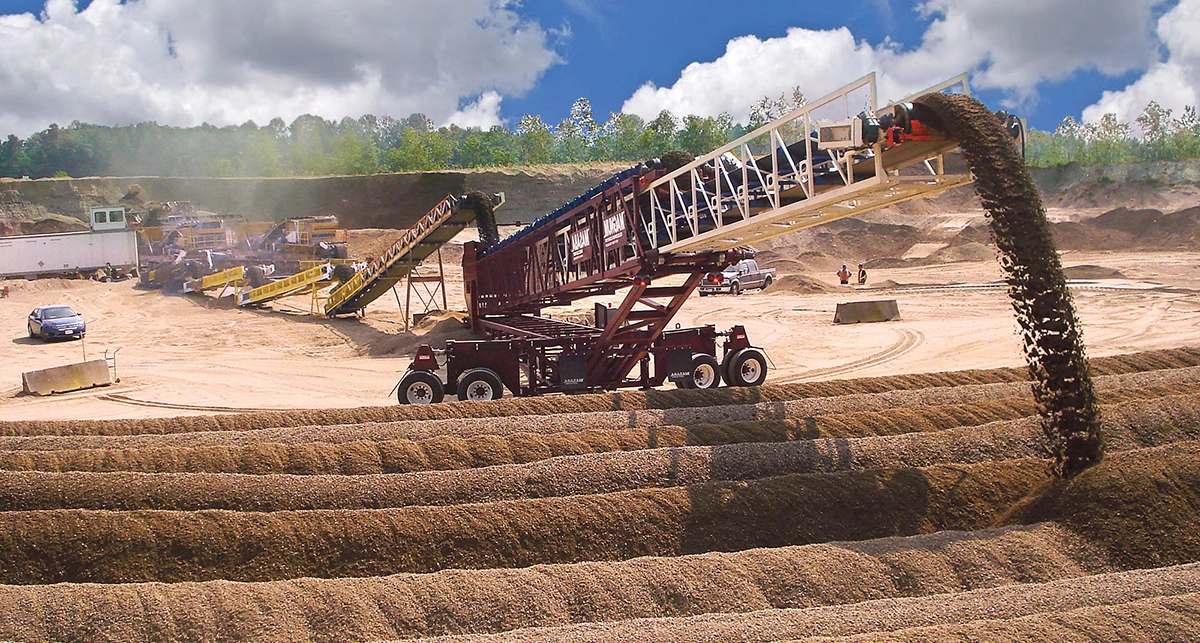
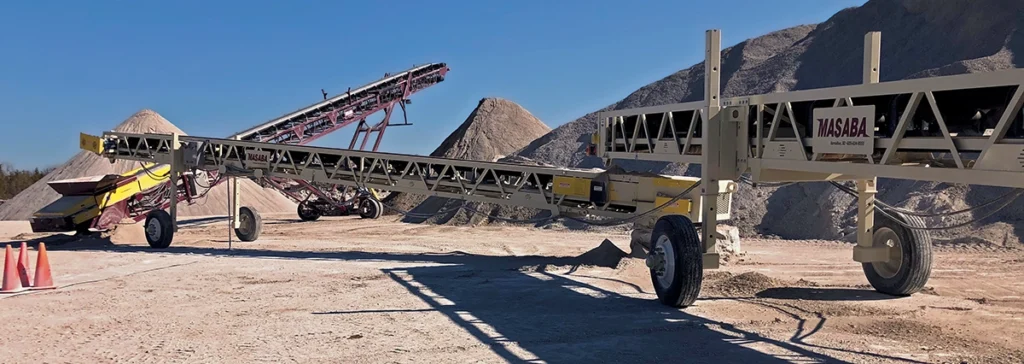
Telescoping conveyors, often referred to as telescoping radial stackers, are advanced material handling machines that create large, well-formed stockpiles while minimizing material segregation and maximizing storage space.
These conveyors feature a telescoping or extendable section at the discharge end – called a “stinger” – that allows the discharge point to move outward and inward as the stacker raises and lowers. It moves in an arc, creating layered stockpiles with greater uniformity and efficiency than traditional fixed-length stackers can create.
A telescoping conveyor works much like a standard radial stacker – with the key difference being the extendable stinger. The stinger is a nested conveyor section that slides in and out either hydraulically or mechanically.
Definition
Telescoping conveyor: A stacker with an extendable section that allows precise layering of material to minimize segregation and maximize stockpile capacity.
Related
Telescoping stackers
As material moves toward the end of the conveyor, the stinger will extend or retract, while the stacker also rotates in a radial arc (sometimes called “slewing”). The stacker also can raise or lower the discharge point (known as “luffing”). This three-way mobility – radial, telescopic and luffing – enables precise control over how and where material is deposited.
In aggregate operations, telescoping conveyors are used to build large, consistent stockpiles of aggregate materials – after they’ve been through multiple stages of crushing, screening and washing. The telescoping conveyor is typically the final step in this process, placing finished spec material into storage for later sale or use.
&uuid=(email))
One of the primary advantages of telescoping conveyors is their ability to reduce material segregation. When aggregates are stockpiled using a traditional stacker that stays in one position, larger particles tend to roll to the bottom and edges of the pile, while finer material stays in the center and on top. This “coning and quartering” effect results in inconsistent material quality.
Telescoping conveyors combat the effect by evenly layering material across a broader area and minimizing fall height, thus reducing particle separation. By building the stockpile in layered windrows, which grow both horizontally and in vertical layers with the telescoping, slewing and luffing action of the conveyor, the material stays in spec.
PRO TIP
Minimize fall height: Reduce drop distances at transfer points to limit material degradation, dust and segregation.
Additionally, telescoping conveyors improve space efficiency, allowing operators to build taller, more tightly packed piles without compromising access or stability. This is especially valuable in operations with limited space or high production volumes.
Telescoping radial stackers can be operated manually or automatically. Manual operation is more labor intensive, as the operator must reposition the conveyor by hand or by remote control.
Definition
Radial stacker: A mobile conveyor with a rotating base that builds conical, windrow or layered stockpiles in a controlled arc to reduce loader use and material segregation.
In contrast, automated radial stackers are equipped with programmable controls, sensors and sometimes GPS or PLC systems that enable the stacker to move in slewing, luffing and telescoping patterns. They can adjust height and angle automatically to build consistent, high-capacity stockpiles with minimal segregation.
Additionally, automation reduces labor requirements, improves safety and allows the machine to run unattended for extended periods. The caveat is that automated stackers incur higher capital costs and may require more complex maintenance and troubleshooting.
Telescoping conveyors often used a winch-and-cable system for extending and retracting the stinger. A safer method utilizes a hydraulically driven rack and pinion, comprising cylindrical pin hubs, toothed rails and support rollers, and using a hydraulic drive to smoothly extend and retract the stinger.
FULL HANDBOOK
Chapter 1: Industry Overview
Chapter 2: Geology & Site Selection
Chapter 3: Drilling & Blasting
Chapter 4: Excavating & Loading
Chapter 5: Hauling
Chapter 6: Crushing & Hydraulic Breaking
Chapter 7: Screening
Chapter 8: Washing & Classifying
Chapter 9: Conveying & Material Handling
Chapter 10: Loadout & Weighing
Chapter 11: Safety & Health
Use the page numbers to continue reading, or select a section / chapter above.