
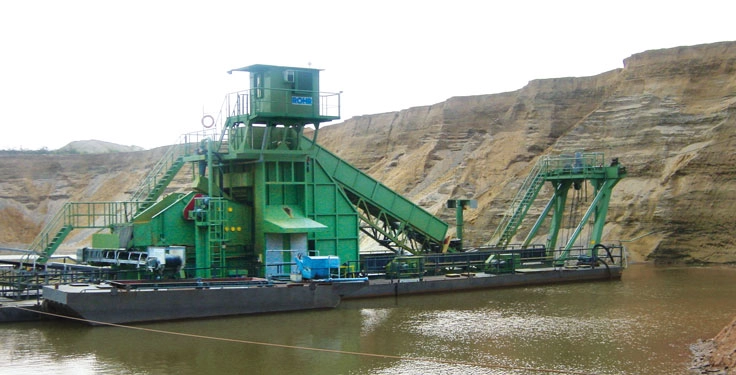
Rohr LLC has supplied the aggregate industry in the U.S. with mechanical dredging equipment for more than 40 years. With more than 70 installations now operating across the U.S. and Canada, president and CEO Jochen Rohr has a unique perspective on the trends, innovations and priorities shaping today’s dredging landscape.
As 2026 gets underway, what major dredging trends are you seeing across the North American aggregate industry?

Rohr: With deep-dredging methods now widely adopted and proven, the industry’s focus has shifted to maximizing resource recovery across an entire property. Producers are working to extract reserves to their full potential, which introduces new operational challenges. Steep pit slopes, clay layers, boulders and conglomerate formations are increasingly common and require more robust equipment and refined mining strategies to manage safely and efficiently.
Which of today’s innovations are having the biggest impact on dredging efficiency and uptime?
Rohr: Automation has always been essential in dredging due to the inherently ‘blind’ nature of underwater mining. Over the years, these systems have been significantly refined to reduce dependence on the operator. Today, many dredging sequences are fully automated or near autonomous.
That said, challenges remain as operations move deeper. GPS and sonar technologies, combined with real-time monitoring of active mining tools such as buckets or cutterheads, have become indispensable for maintaining efficiency, safety and uptime at greater depths.
Some producers are pushing into deeper deposits and more challenging geology. What operational or engineering challenges does this present, and how is the industry addressing them?
Rohr: As dredging depths increase, the risk of burying a bucket, cutterhead or ladder becomes substantially greater. These risks make real-time underwater monitoring absolutely critical. Operators need comprehensive situational awareness below the waterline, supported by advanced sensing and control systems.
The industry is responding by integrating improved monitoring technologies and automation tools that give operators the best possible insight into underwater conditions.
When you look at your recent dredging projects across North America, what common themes or needs are emerging from today’s producers?
Rohr: Greater operating depth is clearly one of the defining trends. In recent years, we have built and retrofitted multiple dredges capable of working at depths of up to 400 ft.
Another consistent theme is the growing importance of collaboration. Close coordination between the producer and the equipment manufacturer – particularly during mine planning – has become more critical than ever to ensure long-term success and operational safety.
As dredges age, producers must decide between rebuilding, upgrading or purchasing new equipment. How would you guide these producers?
Rohr: We delivered dredges to U.S. producers as far back as the 1980s, and I’m proud to say that every one of those units has been successfully upgraded with modern technology and remains in operation today.
A dredge is much like an aircraft airframe: with proper maintenance and periodic upgrades, its service life can far exceed original expectations. While new equipment is often preferred, it can be financially out of reach for smaller producers.
In those cases, rebuilt or upgraded dredges represent a highly reliable and cost-effective alternative.