
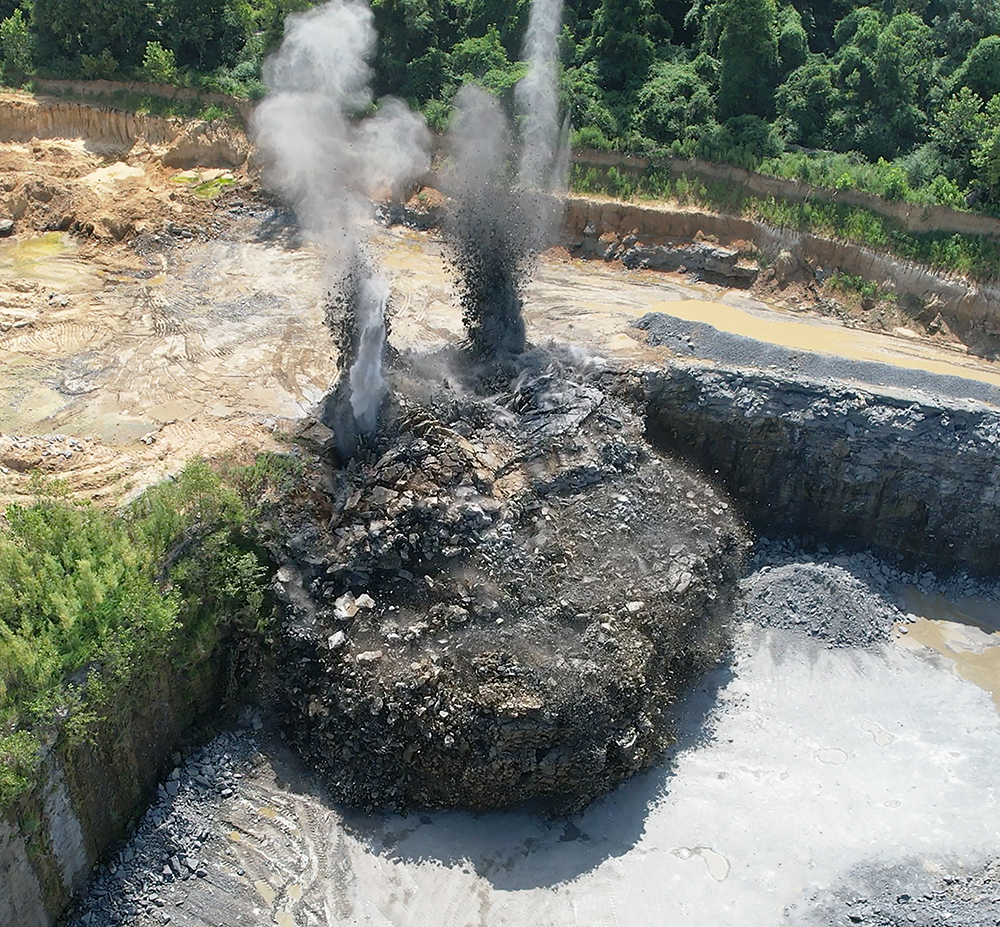
With more than 30 years of management experience in technical and operational roles, Dyno Nobel’s Mike Kotraba has no shortage of insight into what makes a blast most effective. P&Q recently tapped into his expertise to explore the factors driving optimal fragmentation, as well as the missteps standing in the way of a successful blast.

From your perspective, what aspects of drilling and blasting have the biggest influence on fragmentation outcomes, and why?
Kotraba: As much as I’d like to say there is a silver bullet in drilling and blasting that has the biggest influence on fragmentation outcomes, there is no singular component that is the key to success.
It truly is a combination of a detailed understanding of the geology of your ore body, combined with the three legs of the blasting triangle that work together to contribute to the desired fragmentation outcome: the right energy level (product selection), with the right energy confinement (pattern timing/stemming) and the right energy distribution (pattern design/accurate drilling). They all play a vital role in the fragmentation outcome achieved by the blast.
The real key is to know the desired blast outcome that fits your downstream processing circuit and gives you the lowest unit cost overall. A defined outcome allows you to adjust the three main parameters to continue to achieve that outcome on every shot. Our experience has shown that most operations cannot articulate the desired outcome from their drill and blast program that best fits their downstream processes and achieves the maximum yield of saleable product at the lowest cost. This should be the main driver when designing and planning your next blast.
How do you assess whether fragmentation is helping or hindering downstream processes such as loading, hauling or crushing?
Kotraba: The best way is by gathering data relative to each downstream process on a shot-by-shot basis. A plant manager I once worked for used to say: ‘In God we trust; everyone else needs to bring data.’
Having measured data related to each step in the value chain allows you to make informed decisions on whether the fragmentation achieved is helping or hindering the downstream processes. It is critical to keep in mind the outcome you are targeting.
Using a data-driven approach, we typically see that changes improving blast fragmentation cascade down the value chain and lead to improved loading, hauling and crushing outcomes.
At the end of the day, it all boils down to an improved unit cost of the commodity sold, as that is what generates revenue.
When designing a blast, what factors or constraints tend to have the greatest impact on the decisions that follow?
Kotraba: Each blast should have a defined primary goal or outcome. Once defined, those should have the greatest impact on the decisions that follow.
Shot goals could include production, fragmentation, vibration, wall control, overspill control and infrastructure protection. Each goal requires a different design to execute to the desired outcome.
In the end, each blast design is an effort to balance the desired goal or outcome with the constraints of the mining environment you’re working in.
We use a variety of tools that we find effective for measuring fragmentation in the field. Each tool has its own inherent strengths and weaknesses that must be taken into account prior to using them:
• Drone flight fragmentation data. This provides quick PSD feedback. However, our experience using this technology shows that it is, at best, directionally correct, but it is not precise.
• Shovel/loader camera data. This is similar to drone flight data, but it has a bit more accuracy and precision in the midsize particle size range. It does, however, need to be consistently maintained.
• Muckface or muckpile photo fragmentation. This is more accurate and precise than the methods already mentioned, but it requires more work to gather and process the data.
• Belt camera data (pre- and/or post-crushing). This is more accurate and precise than all the methods already mentioned, if consistently calibrated. It is also a bit more expensive than the options already discussed.
• Physical screening of blasted material. This is the most accurate and precise method of all, but it is also the highest cost and most labor-intensive process.
It’s important to note that all of these methods are prone to error due to sampling bias and geologic variability. Image analysis techniques are also prone to distortion due to lighting, shadows and dust, and are only accurate down to a specific particle size depending on the technology and application.
How do you balance blasting priorities like cost control, safety and fragmentation quality that sometimes compete with one another?
Kotraba: Safety is non-negotiable. Without safety, you are out of business. There should never be a priority that competes with safety.
Cost control, production and fragmentation are always a juggling act, but all need to be weighed against the desired outcome. Industry data shows that spending incrementally more in drilling and blasting leads to significantly higher returns as the material moves down the mining value chain. It can offer two to 10 times the return in loading and hauling; two to 10 times the return in crushing; and eight to 20 times the return in grinding and milling.
Drilling and blasting efforts should be focused on moving the operation into what we call the “Goldilocks Zone,” where drilling and blasting costs are optimized to yield the best unit cost downstream. Being in the drilling and blasting Goldilocks Zone yields the lowest unit cost and the highest revenue overall.
What trends or changes in drilling and blasting practices do you think will matter most over the next decade?
Kotraba: Several major trends are already emerging and will likely continue over the next decade. These include:
• The increased use of smart drilling data, combined with variable density loading and software-assisted loading to allow a move from pattern-by-pattern loading designs to individual hole-by-hole loading and optimization within each pattern.
• Drill-to-mill, drill-to-leach and seam-to-stone initiatives that incorporate blast designs targeting the downstream effects of the material blasted.
• Automation in drilling that brings higher levels of precision to the drill pattern, reducing pattern variability and making each blast more predictable.
• Mechanistic fragmentation models to allow for improved accuracy and precision in the prediction of fragmentation outcomes prior to the shot being drilled.
• Advanced VOD and explosive performance diagnostics to gather real-time measurements of the actual explosive performance during the blast. This will help validate designs and give more confidence in achieving the outcome desired.
• ESG initiatives that will drive reduced carbon emissions, reduced vibration impacts to neighbors and more environmentally friendly blasting products.
• AI-driven blasting where designs are no longer static but use the data collected and outcomes from prior blasts to be adaptive. Each pattern learns from and optimizes based on the results of the last pattern to attain the desired outcome.