
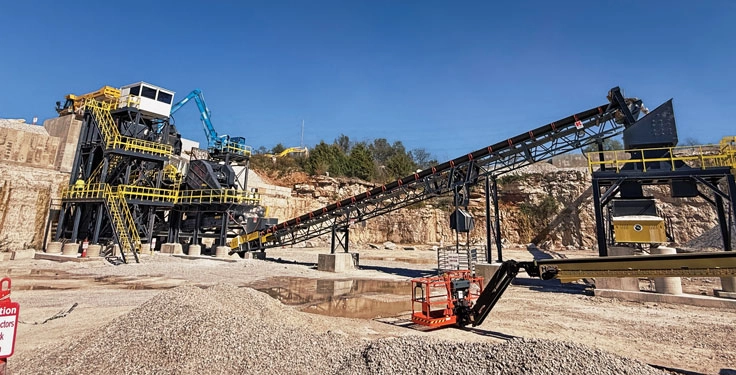
Capital Aggregates’ Ozark Quarry received a facelift in 2025 that was years in the making.
Thanks to a nearly $30 million investment from its parent company, Farmer Companies, the quarry in Ozark, Missouri, was outfitted with a new asphalt plant and a new crushing plant. Ground broke on the asphalt plant in September 2024, with operations beginning in April 2025. Construction on the crushing plant ran from December 2024 until October 2025, when full production got underway.
These upgrades came at the perfect time for Capital.
“Overall, 2025 has been crazy,” says Chris Williams, vice president of operations at Capital Aggregates. “Across our aggregate companies, we’re going to have record or near-record years. We’re fortunate in the places we operate that there is a lot of infrastructure investment.”
Stuart Yoder, hot-mix asphalt operations manager at Capital, echoes Williams’ sentiments. He is hopeful both the asphalt and crushing plant can serve their communities for years to come.
“Construction has been a viable industry for a long time in Missouri – especially in aggregates,” Yoder says. “The director of MoDOT (the Missouri Department of Transportation) [Ed Hassinger] is invested in the state’s roads. When traveling through Missouri, the quality of our highways is evident. That [Farmer Companies] is willing to invest that kind of funding says they’re confident in our economy here in Missouri and confident that we’re going to maintain our budgets for roads and other projects.”
Crafting the crushing plant
Capital Aggregates purchased the Ozark Quarry site from Leo Journagan Construction Co. in early 2021. After acquiring the 1 million-tpy quarry, the company encountered site constraints and infrastructure limitations that led it to request a new plant.
“After acquiring the site, we purchased the adjacent property to the south,” Williams says. “Between existing operations and the new adjoining property is a maze of utility infrastructure, including service and transmission overhead power lines and an underground natural gas pipeline. We decided our existing pit wouldn’t be able to grow into the new property, and it wasn’t big enough for another standalone pit. So it made sense for us to use that area as a finishing plant and stockpile property.”
From there, the company determined it needed a larger crushing plant to capitalize on growth potential in the new market. The existing plant produced about 450 tph. An increased production rate and operational efficiency were top goals for the new plant.
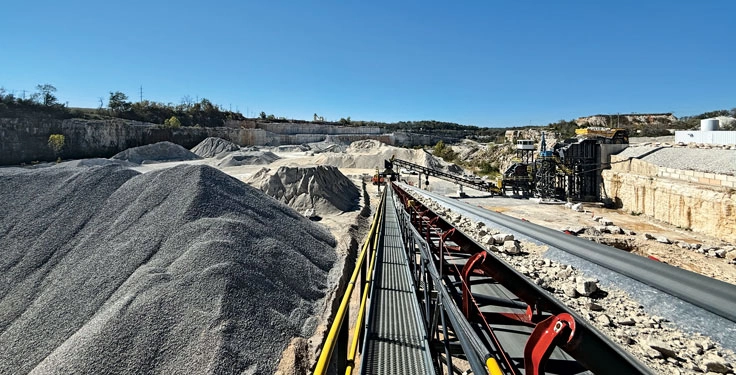
“The existing plant required two haul trucks to feed, but it also required four stockpile trucks to transport finished products to the stockpiles on the surface,” Williams says. “By increasing production, we would need at least three haul trucks to feed the plant, but we would only need one stockpile truck to carry finished product. All other material will be stockpiled by stackers.”
In the preliminary concept for the new plant, Capital knew it needed new structures and fixed conveyors to ensure longevity and support layout customization. However, after several acquisitions, the company had several pieces of equipment that weren’t being utilized across its footprint.
Capital took its plan to Kemper Equipment, outlining how it sought to repurpose owned equipment, as well. Kemper took it from there.
“Aaron Becker and his team at Kemper took our concept and developed an amazing finish plant circuit that is beyond anything we could have hoped for,” Williams says. “They were wonderful to work with, and they worked with us on the reused equipment. All of our crushers, screens and stackers are equipment we already had. All the layout, bins, structures and conveyors came from Kemper.”
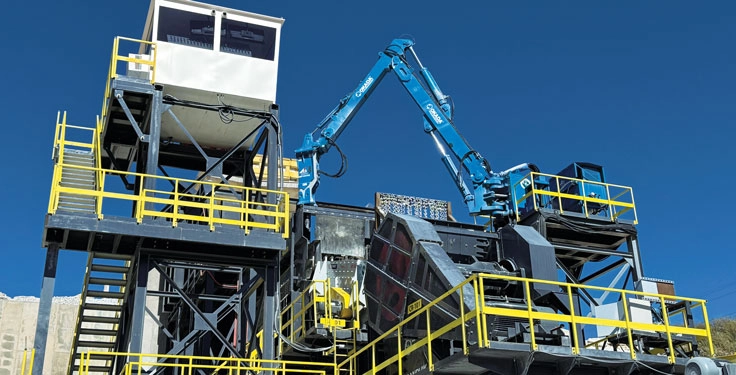
The final configuration of the pit includes a 150-ton rock box, a feeder, a scalping screen and a primary Sandvik CJ615 jaw crusher. The pit circuit is connected to the finish plant via a conveyor that runs through a tunnel beneath the haul road. Material is then transported via overland conveyor about 1,000 ft. up a hill.
Williams says this combination can exceed its 750-tph target.
“We expect to make well over that production rate while keeping the primary crushed material mostly smaller than 6 in.,” he says. “This balance of feed rate and feed size works well with the repurposed crushers at the surface.”
Addressing the asphalt plant
Like the Ozark Quarry’s new crushing plant, the new asphalt plant was also years in the making.
According to Yoder, discussions about a new plant had been ongoing at Capital for two or three years following the purchase of the Journagan Construction site.
“The plant we had was OK, but it needed enough upgrades that it didn’t necessarily make sense to move it,” Yoder says. “So, after several years of conversations and meetings back and forth, we finally decided to purchase the plant. After that, we probably spent the better part of six to eight months nailing down which vendor route we were going with and how the plant was going to be formatted.”
Yoder says many factors were considered when deciding on vendors – including bin capacity, tons per hour and number of AC tanks and loadout lanes. The company ultimately decided to go with an Astec asphalt plant.
It broke ground in September 2024, took delivery of the plant and started the installation during the winter of 2024-25.
Yoder praises the vendor and Capital team for bringing the plant online in seven months.
“Obviously, we had to deal with some elements during the winter but, overall, we were able to put together the site pretty fast using our internal crew, which was also extremely helpful,” Yoder says. “We had quite a bit of experience in dirt work and concrete work within our network, so we were able to make our own schedule and not wait on outside vendors for that.”
Prior to the upgrade, Yoder says Capital operated the existing on-site plant. After a couple of seasons, though, electrical issues and an outdated controls system made operation more challenging.
“Without blending controls, you have no mix,” Yoder says. “So that was a pretty high priority and something we spent a bit of money on just to get through another season before we ordered the new plant.
“Thinking about the way Capital approaches a business model versus a smaller, family-owned company, we probably spend more money upfront in capital expenditures every year, knowing that’s going to keep us ahead and running,” he adds. “Downtime is obviously a really bad thing. Uptime is how you win the game. Always having mix available for the customers has been a huge win this year.”
Yoder says operation has been strong since the plant began production in April.
“We had a few hiccups here and there, but it went really smoothly overall,” he says. “We’ve run close to 275,000 tons out of there [in 2025]. It was a good season for the asphalt plant in Ozark. We have a lot of big years ahead of us with some big projects coming.”
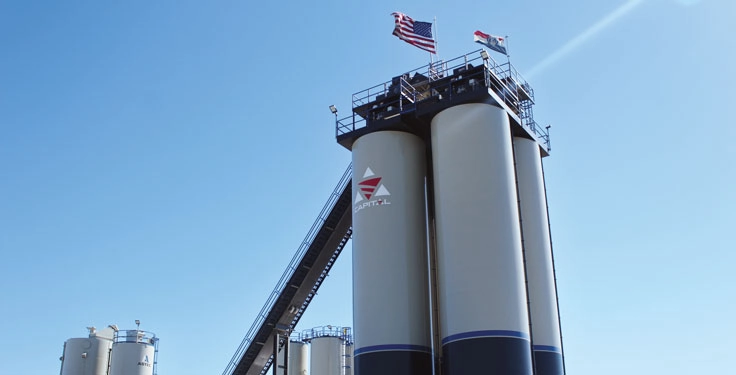
The plant features four long-term storage silos across two loadout lanes, ensuring the site is ready for whatever demand it’s facing.
“Asphalt doesn’t have a shelf life,” Yoder says. “We can store hot-mix for up to four days in those silos. We have 1,200 tons of storage in the air, and we have two loadout lanes. So if we have a large job going during the day, we can, at the same time, service that external customer without them seeing a delay in loadouts. I don’t think it’s out of the picture for us to see several 400,000- to 500,000-ton years out of here in the years to come.”
Capital Aggregates VP on Drilling Deeper
P&Q’s Jack Kopanski visited Capital Aggregates’ Ozark Quarry to get a firsthand look at the company’s new crushing and asphalt plants. Check out the conversation with Capital vice president of operations Chris Williams on Episode 53 of P&Q’s Drilling Deeper podcast at drillingdeeperpodcast.com – or wherever you get your podcast.
Related: Capital Aggregates makes acquisitions in Missouri, Arkansas