

FULL HANDBOOK
Chapter 1: Industry Overview
Chapter 2: Geology & Site Selection
Chapter 3: Drilling & Blasting
Chapter 4: Excavating & Loading
Chapter 5: Hauling
Chapter 6: Crushing & Hydraulic Breaking
Chapter 7: Screening
Chapter 8: Washing & Classifying
Chapter 9: Conveying & Material Handling
Chapter 10: Loadout & Weighing
Chapter 11: Safety & Health
Weigh-In Motion Systems
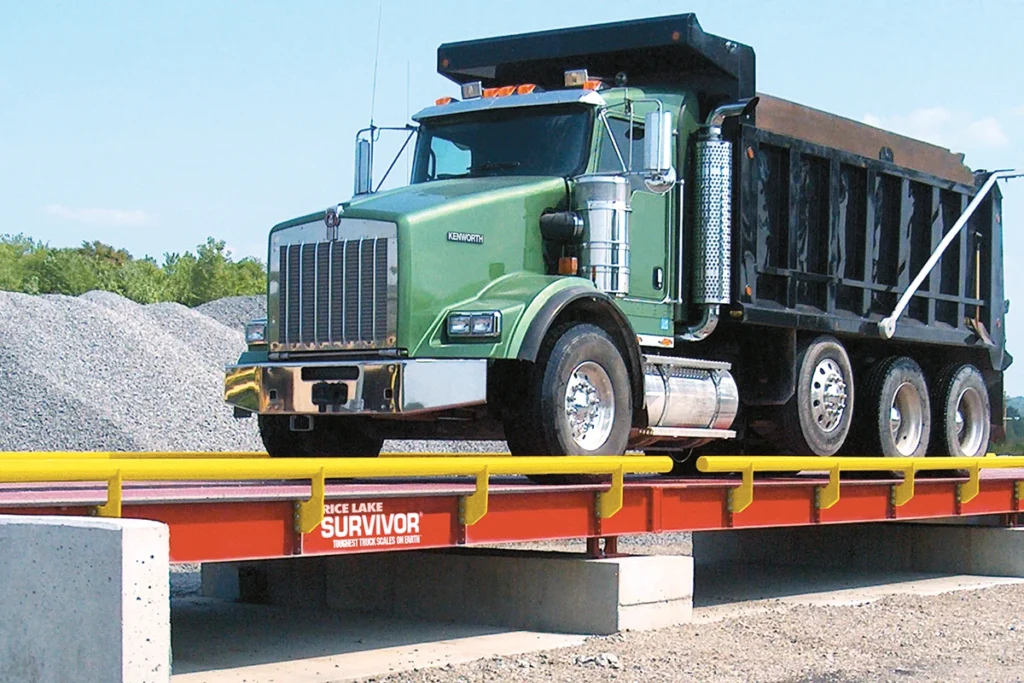
For many years, aggregate producers selling materials by weight were limited to static truck scales – with trucks having to stop completely for a certified weighment.
That began to shift when the National Conference on Weights & Measures (NCWM) incorporated provisions into “Handbook 44” to permit certain full-length, single-draft weigh-in-motion (WIM) systems to be used for legal-for-trade transactions.
Because this allowance is relatively new, adoption and field experience are still developing. Nonetheless, guidance exists for producers to consider where WIM may fit into a weighing strategy.
Definition
Static truck scale: A legal-for-trade platform where trucks must come to a complete stop to be weighed.
&uuid=(email))
What changed and why it matters
The 2022 edition of “Handbook 44” added provisions for single-draft, full-length WIM systems to be used in commercial weighing. These systems are subject to the same tolerance and certification requirements as static truck scales.
In practice, a WIM system must meet all the requirements of a legal-for-trade static scale, with the in-motion capability added as an approved function. Because trucks do not need to come to a complete stop, operations can reduce bottlenecks, and drivers can remain in their vehicles – cutting congestion and improving safety.
Full market acceptance will depend on site layout, cost of installation and how quickly state and local jurisdictions implement the NCWM model code.
How WIM systems operate
As a truck drives across the scale deck at low, controlled speed, sensors record axle weights and compute a total gross weight.
The system must precisely synchronize data as axles enter and leave the deck to capture an accurate reading.
The only WIM format currently approved for legal-for-trade use is full-length, single-draft. In this case, the entire vehicle is weighed in one pass. Multi-draft or axle-by-axle systems remain limited to non-legal applications.
Benefits and practical impacts
The decision to install a WIM system is often driven by the day-to-day gains it can deliver.
Although WIM scales must meet the same accuracy standards as static truck scales, their true value lies in the operational efficiencies they create. From improving site traffic to supporting safer working conditions, WIM offers advantages that go beyond simple measurement – gains such as:
- Higher throughput. Even modest time savings per truck accumulate significantly when hundreds of loads are processed daily
- Improved safety. Drivers stay in their cabs, reducing pedestrian movement near the scale house
- Legal-for-trade accuracy. Approved WIM systems must meet NCWM tolerances. Accuracy is achievable when systems are properly installed, maintained and calibrated
- Reduced idle time. Less stopping and starting at the scale reduces emissions and wear on equipment
Constraints and infrastructure needs
While weigh-in-motion systems promise efficiency and safety advantages, they also come with important limitations that producers must weigh carefully before making an investment.
These constraints involve both technical requirements and regulatory considerations, as well as higher site-prep demands compared with traditional static truck scales. Understanding these factors will help determine whether WIM is a practical option for a given operation:
- Compliance. WIM systems must meet NCWM/NTEP tolerances – the same as static scales
- System type. Multi-draft platforms are not recognized for trade use under current code
- Installation demands. Requirements are greater than for static scales. Adequate level approaches on both sides of the deck are required. Deck construction and road surfaces must minimize vibration, and site preparation and civil works often raise costs compared to a conventional static scale
- Regulatory acceptance. While NCWM has approved provisions, state and local weights-and-measures authorities are implementing them at different paces. As of 2025, adoption remains uneven, with some states fully certifying WIM for trade while others still restrict it to pilot programs or non-legal applications
- Adoption outlook. WIM is expected to complement – not replace – static scales. Static systems will remain common where space, budget or traffic levels make WIM impractical.
Decision considerations
When evaluating WIM, producers should also weigh:
- Traffic volume. High-throughput sites gain the most efficiency
- Site feasibility. Layout, approach lengths and soil stability affect installation success
- Future flexibility. New builds may be designed with provisions for retrofitting WIM capability
- Local regulations. Confirm that WIM is accepted by the relevant state or county authority
- Budget and ROI. Consider the higher upfront costs of civil works, control systems and certification relative to static scales
Why WIM matters
Legal-for-trade weigh-in-motion scales mark an important evolution in weighing technology.
They are unlikely to replace static scales across the board, but they give producers a new option to improve truck flow, safety and operational efficiency. For high-volume operations, the benefits may justify the investment – while for others, planning with WIM capability in mind may help future-proof new scale installations.
Loader Scales & Onboard Weighing
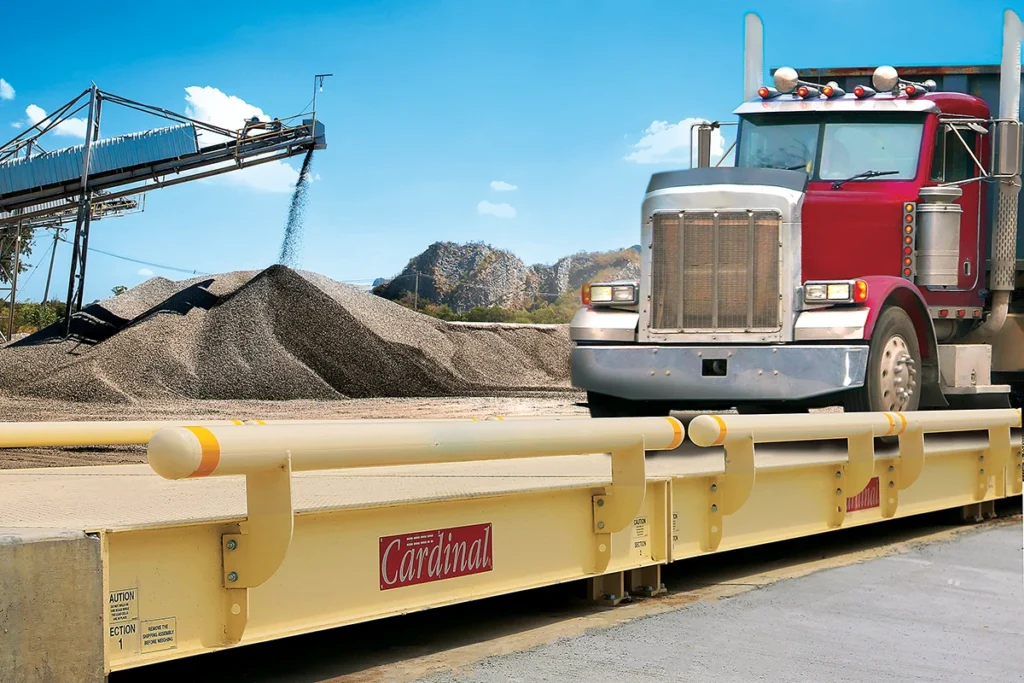
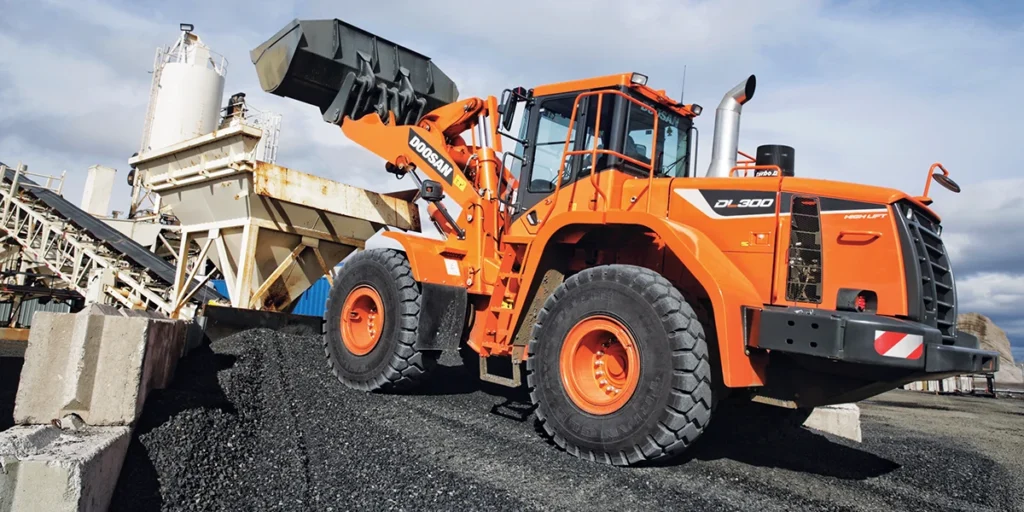
Beyond fixed truck scales and WIM systems, many producers are turning to onboard weighing technology to improve accuracy and efficiency at the loading stage.
Loader scales and similar systems are no longer just optional add-ons. They’ve become integral tools that complement truck scales, reduce bottlenecks and provide the data that underpins modern digital loadout strategies.
PRO TIP
Use digital diagnostics: Modern scales detect failing load cells before downtime occurs.
Coming of age
Loader scales have become increasingly important in aggregate operations.
Once valued mainly for measuring payloads, today’s systems deliver far more. They enhance safety, track stockpile inventory, provide real-time feedback to operators and integrate seamlessly with truck scales and dispatch systems.
As technology improves, accuracy, connectivity and usability continue to climb – and customer expectations rise with them.
Modern loader scales achieve margins of error as tight as ±1 percent. This level of precision means fewer overloads, fewer trips back to the stockpile and more confidence in every load leaving the yard.
Connectivity and data integration
A key evolution in onboard weighing is connectivity.
Built-in GPS and Wi-Fi allow loader scales to feed production data directly into centralized dashboards, giving managers visibility across multiple sites. Data sharing between machines and operators provides real-time production tracking and supports mid-shift adjustments that can quickly translate into thousands of dollars in gains.
Rather than functioning as standalone devices, loader scales now act as part of a broader business intelligence network. Managers can analyze productivity by operator, machine or site, helping to identify bottlenecks and fine-tune performance.
Operators, in turn, receive instant payload feedback in the cab, helping them hit targets consistently without under- or overloading.
Definition
Overload: A truck or trailer carrying material in excess of legal or rated capacity.
&uuid=(email))
Return on investment
The financial case for onboard scales is clear: Without them, loader operators often underload trucks to avoid the risk of sending them back from the scale house to tip off excess material.
A 20-ton truck underloaded by three tons represents a 15 percent shortfall in utilization. Over the course of hundreds of hauls, that translates into significant lost revenue.
Conversely, accurate onboard weighing eliminates rework, speeds truck turnaround and maximizes productivity. A missed loadout cycle can add three to four minutes per truck – a 30 percent increase in turnaround time.
With accurate onboard scales, those minutes are saved and trucks stay moving. Studies and field reports suggest producers can expect ROI improvements of up to 15 percent or higher when paired with digital dispatch or e-ticketing tools through reduced costs, increased throughput or a combination of both.
Definition
Onboard scale: A weighing system mounted on loaders, haul trucks or conveyors to measure material as it is moved.
Choosing the right system
When evaluating loader scales or other onboard weighing systems, producers should consider:
- Accuracy. Pinpoint accuracy is the foundation of productivity gains. Small percentage improvements quickly add up when thousands of tons are moved daily
- Stakeholder requirements. Weighing data must serve operators, site managers and accounting teams alike. Systems should provide in-cab feedback, as well as aggregated reports
- Integration. Look for solutions that communicate with truck scales, conveyors and fleet management systems. Cross-platform compatibility ensures smoother operations
- Ease of use. Clear, dedicated displays and intuitive controls keep operators focused. Multi-language support may also be essential for diverse workforces
- Connectivity. Real-time data sharing via GPS and Wi-Fi ensures managers and operators have the same view of production status.
- Lifecycle planning. Systems should be scalable, with the ability to extend across loaders, excavators, haul trucks and conveyors as technology investment grows.
The bigger picture
The latest onboard scales go beyond weighing to support broader site optimization.
Machine-to-machine communication gives excavator operators visibility into truck payloads before the final bucket is loaded. Managers, meanwhile, can view consolidated data from across fleets and sites to guide daily decisions and long-term planning.
By centralizing and analyzing loadout data, onboard weighing systems are helping producers move from simple measurement toward enterprise-wide intelligence. This shift enables proactive adjustments, better asset utilization and improved customer service.
Looking ahead
Onboard loader scales will continue to evolve alongside digital platforms and site connectivity.
Faster networks, smarter sensors and easier integration mean producers can expect even more value in the years ahead. For operations striving to maximize every cycle, these systems are no longer optional – they are a core component of efficient, modern loadout.
PRO TIP
Automate ticketing: Reduce errors, paperwork and lost tickets with digital tools.
FULL HANDBOOK
Chapter 1: Industry Overview
Chapter 2: Geology & Site Selection
Chapter 3: Drilling & Blasting
Chapter 4: Excavating & Loading
Chapter 5: Hauling
Chapter 6: Crushing & Hydraulic Breaking
Chapter 7: Screening
Chapter 8: Washing & Classifying
Chapter 9: Conveying & Material Handling
Chapter 10: Loadout & Weighing
Chapter 11: Safety & Health
Use the page numbers to continue reading, or select a section / chapter above.