
FULL HANDBOOK
Chapter 1: Industry Overview
Chapter 2: Geology & Site Selection
Chapter 3: Drilling & Blasting
Chapter 4: Excavating & Loading
Chapter 5: Hauling
Chapter 6: Crushing & Hydraulic Breaking
Chapter 7: Screening
Chapter 8: Washing & Classifying
Chapter 9: Conveying & Material Handling
Chapter 10: Loadout & Weighing
Chapter 11: Safety & Health
IN THIS CHAPTER
In The Community
Mining aggregates is an industrial land use, but rapid urban and suburban expansion – made possible by access to construction aggregate resources – presents challenges to every operation.
Before a company can begin producing aggregates, extensive requirements such as comprehensive land-use plans, zoning ordinances and regulations must be met.
It’s in the interest of the community to have construction aggregates close to the market, but this ideal can put aggregate producers in the midst of increasingly populated areas. Fortunately, significant strides have been made over the last 40 years in site planning and beautification.
As greater populations surround mines – even in historically rural areas – the industry has become more visible. Consequently, citizen input has had a positive impact on operational land-use decisions because more people are involved in the process.
Progressive communities find that prohibition of aggregate mining eliminates neither the demand for construction material nor the conflicts associated with mining. It simply creates a different set of problems due to increased trucking from more remote areas. Longer hauling distances mean more trucks, more fuel consumption, more wear on roads and more conflicts with urban land uses because the market remains within the urban area.
PRO TIP
Engage your community early: Participate in councils, schools and partnerships to strengthen public trust and ease permitting challenges.
&uuid=(email))
Rather than eliminating mining from urban areas, communities are getting involved in setting operational and reclamation performance standards jointly with aggregate producers. Such partnerships assure compatibility with adjacent land uses – both existing and future.
The industry competes with others to secure specific parcels of land that can produce quality aggregates and supply enough to justify the capital investment required to produce material. In fact, several states and communities facing significant shortages have policies and legislation protecting these resources so they remain available to future generations.
Of course, the industry hasn’t been wholly successful in securing rights to produce aggregates. This is partially due to an assumption on the public’s part that aggregate operations are nuisances during and after the active land use.
However, current land use and other environmental controls – many of which producers initiate – have served to illustrate the industry’s acceptability in the communities where they’re located. The success these producers experience is the result of two important factors:
- Improved technology in the mining and processing of material
- The pre-planning of sites for new and productive use of properties following resource extraction
Still, the industry continues to struggle to secure the right to produce aggregates because of the dual sets of requirements of local zoning ordinances and state acts affecting the industry’s surface mining activities. Such provisions usually require securing permits from two levels of government, and they’re frequently vague in their specific requirements.
Also, unlike other industrial uses, permits are frequently restricted to a limited period of time, requiring extensive and expensive renewal procedures by producers – with no assurance that permits will be renewed.
Thus, the substantial capital investment required for a modern sand and gravel plant becomes a hazardous undertaking for producers. Leading aggregate producers, however, recognize the legitimate concerns of the public and its demand for effective environmental controls.
Aggregate operations are industrial by nature. They use heavy machinery, involve a process and use rail lines, trucks and barges to ship products. These are areas the industry has in common with most industrial land uses.
The aggregate industry is different from others, though: It is self-consuming. The longer producers operate at any one location, the shorter the remaining life of the mine. Thus, unlike most other industrial uses, aggregate operations represent a transitional use of land that makes important contributions to the economy.
The industry is in a unique situation as far as land development is concerned. The industry uses heavy earthmoving equipment and often has large volumes of material that’s unsuitable to market for creating functional landforms. Because it’s necessary to move this material – overburden, clay, silt and fines – to mine aggregates, it becomes a matter of manipulating that material with the equipment at hand in a manner that will achieve the most desirable land areas for development.
The underlying principle of conservation means using resources wisely. Aggregate producers at-large are in full agreement with that principle and recognize their responsibility as stewards of the land.
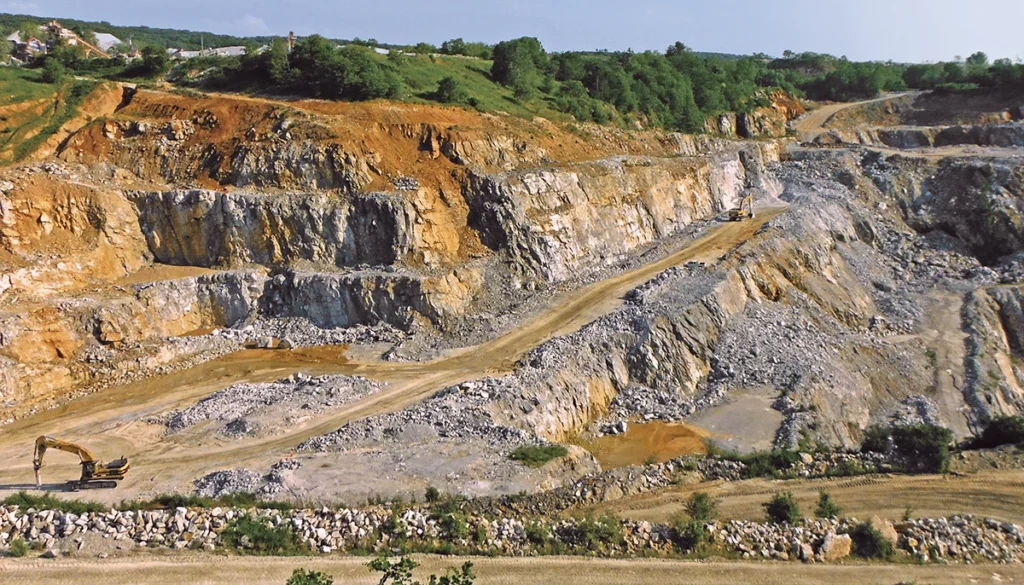
Still, producers can only be land stewards when they have the opportunity to use the resource deposits naturally occurring at locations that are conveniently located in or near communities. Because of the size of most operations, quarries present tremendous opportunities for preserving open space and wildlife habitats, benefiting both the environment and the community.
Wildlife is common on properties where aggregate operations reside. Often, a fully developed, managed wildlife program is of tremendous value to the community. Woodlands and meadow restoration, companion crop use for revegetating areas, and alternative runoff management are just a few examples.
Significant portions of most mining sites sit idle and exist either as dedicated buffer areas or properties held for future development. These unused areas represent opportunities to create and restore habitat critical to wildlife.
While large, contiguous parcels are most beneficial, isolated plots and small greenways devoted to wildlife are ecologically valuable. Employees at crushed stone operations are committed to these programs. Employees and neighbors join in these projects and guard their sites’ wildlife personally and protectively. Special vegetation plantings, food plot establishment, nest box placement and species-specific enhancement are typical at some sites today.
In today’s aggregate operations, there are many examples of exceptional site improvements that demonstrate how operations can successfully fit into the community during and after mining. In some instances, site aesthetics and environmental impact mitigation plans can be integrated into pre-mine reclamation planning. Site beautification involving screening, dust and noise control, landscaping, truck routing and special quarry entrance designs are incorporated into existing operational programs.
PRO TIP
Think long-term on reclamation: Begin planning land restoration at startup, ensuring mined sites can transition into parks, housing or wildlife habitat.
&uuid=(email))
Many outstanding and varied developments occur as a result of property reclamation. They range from state and local parks to wildlife areas and exclusive golf courses, housing projects, office parks and prime agriculture land. Careful planning for an aggregate property’s next use is in the producer’s best interest for several reasons. Higher property values are obtained if the land is reclaimed for an enhanced purpose.
While mining alters the shape of the land – and sometimes dramatically – it often provides a reconfigured parcel that’s of more interest and value than it was in its original state. In addition, few other land uses present opportunities to create new and productive wildlife habitats, marshes and wetlands that exist through mining.
The image of the industry is contorted by the past and by a poor understanding of its potential as a shaper of landscapes. But mining is an essential and integral part of the total land-shaping process.
It is often the very characteristics of the quarry that evolve into the most attractive and valuable features of the end use. Irregular topography, vertical stone walls, rock outcroppings and, of course, fresh water lakes are landscape characteristics sought after and valued by the public.
America’s aggregate industry has a continuing commitment to make its operations compatible with the neighborhoods where they reside. Providing jobs and paying local taxes, aggregate producers contribute to building their communities in a variety of ways, from producing the stone to developing needed infrastructure and donating time and money to local causes.
Communities across the U.S. depend on construction aggregates. Likewise, aggregate producers depend on their reputations as environmental stewards, community leaders and as producers of quality construction materials for their success in meeting community needs – today and in the future.
SOURCES
The American Society of Civil Engineers (ASCE)
asce.org
National Stone, Sand & Gravel Association (NSSGA)
nssga.org
Phoenix Center
phoenix-center.org
U.S. Geological Survey
usgs.gov
The Pit & Quarry University Handbook is an educational resource that offers comprehensive lessons covering the entire aggregate production process from start to finish, highlighting new technologies and enhanced procedures within each branch/category of the aggregates industry.
FULL HANDBOOK
Chapter 1: Industry Overview
Chapter 2: Geology & Site Selection
Chapter 3: Drilling & Blasting
Chapter 4: Excavating & Loading
Chapter 5: Hauling
Chapter 6: Crushing & Hydraulic Breaking
Chapter 7: Screening
Chapter 8: Washing & Classifying
Chapter 9: Conveying & Material Handling
Chapter 10: Loadout & Weighing
Chapter 11: Safety & Health