
FULL HANDBOOK
Chapter 1: Industry Overview
Chapter 2: Geology & Site Selection
Chapter 3: Drilling & Blasting
Chapter 4: Excavating & Loading
Chapter 5: Hauling
Chapter 6: Crushing & Hydraulic Breaking
Chapter 7: Screening
Chapter 8: Washing & Classifying
Chapter 9: Conveying & Material Handling
Chapter 10: Loadout & Weighing
Chapter 11: Safety & Health
Off-highway trucks are critical to most aggregate operations, providing a production link between the loading face in the pit and the primary crusher or processing plant.
Efficient haulage is important to meet production targets and manage costs. Proper selection and sizing of trucks, efficient operation and timely maintenance, as well as well-designed and maintained haul roads, are keys to productive and low-cost haulage.
Rigid Haul Trucks
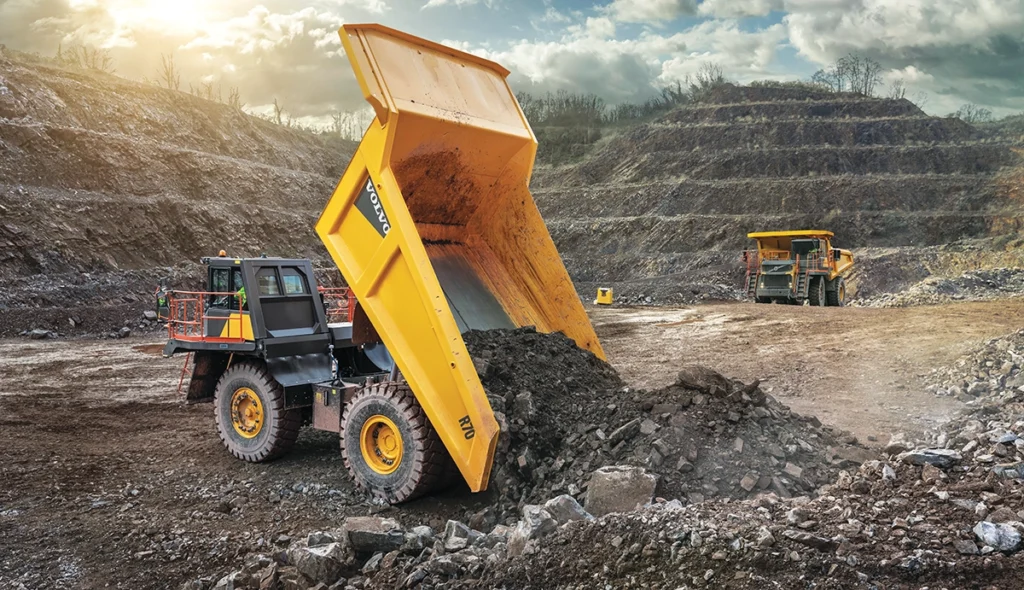
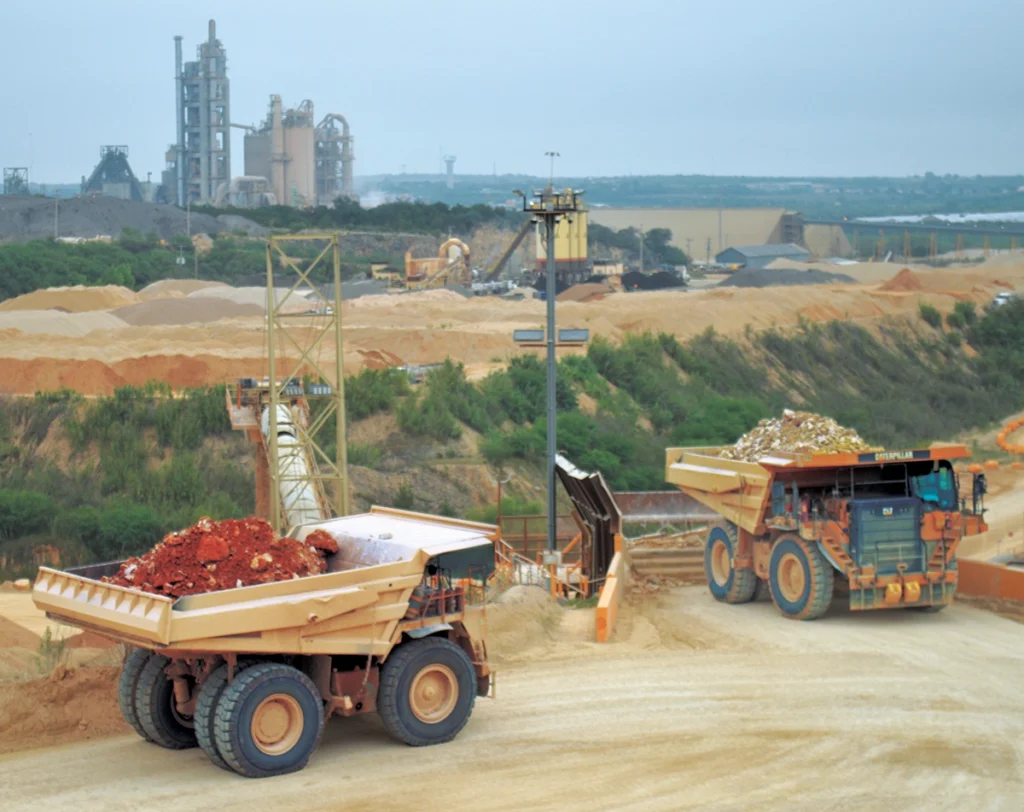
Rigid haul trucks are among the largest off-highway machines used in mining and quarrying. They are designed specifically for transporting bulk material efficiently over long distances and at high volumes.
A rigid haul truck, also called a rigid hauler or mining truck, is built on a non-articulated frame. The chassis and dump body are fixed together, and steering is achieved by turning the front wheels – similar to on-road vehicles, but on a much larger scale. This rigid design makes them less maneuverable than articulated haulers but allows them to carry much greater loads.
Operating conditions
Rigid trucks are most often used in large-scale operations where high production volumes are consistently required. They perform best on long, straight hauls across well-maintained, stable haul roads with moderate grades. Their efficiency comes from their ability to move enormous amounts of material in a single pass, often working in conjunction with large shovels or wheel loaders capable of filling their beds in only a few passes.
Payload capacity and advantages
The primary advantage of rigid haulers is payload capacity. These trucks can carry far larger loads than articulated haulers, with models ranging from 40 tons to ultra-class machines capable of hauling more than 400 tons. This high capacity results in a lower cost per ton in operations designed to support their size. Their robust construction is intended to withstand the stress of continuous heavy loads over long periods, making them suitable for the most demanding hauling applications.
Definition
Payload capacity: The maximum material load a truck is designed to carry safely. A key factor in determining cost per ton and fleet productivity.
&uuid=(email))
Performance characteristics
On well-designed haul roads, rigid haulers can also achieve relatively high speeds, which shortens cycle times and increases productivity. However, they are less effective in confined work areas or on winding roads, and their performance is reduced in soft or uneven ground conditions.
Sizing and selection
Rigid haulers are manufactured in a range of sizes to meet different operational requirements. Selecting the appropriate size depends on overall production targets, the capabilities of loading equipment such as hydraulic shovels and excavators, and the geometry and condition of haul roads. Matching truck size to loader capacity ensures efficient loading cycles and maximizes productivity.
Rigid haul trucks, therefore, remain the preferred choice for high-volume, long-haul applications in quarries and mines. When supported by suitable haul roads and loading equipment, they provide cost-effective hauling of the largest material loads in the aggregate industry.
Articulated Haulers
Articulated haul trucks are another common sight in quarries and play an important role in moving material efficiently from extraction areas to processing plants, stockpiles and loading zones.
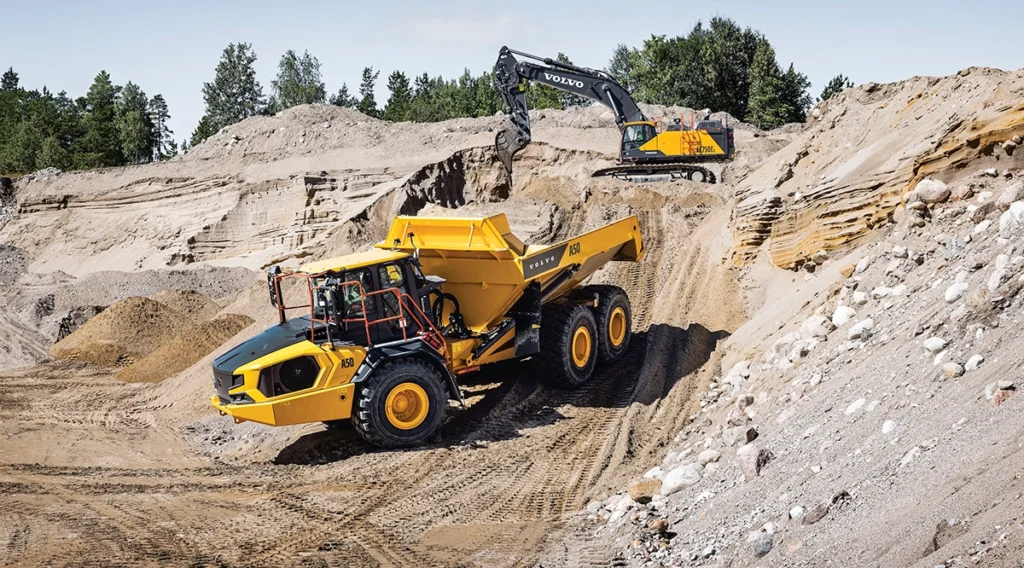
Also known as articulated dump trucks (ADTs), articulated haulers or off-road haul trucks, these machines are designed specifically for transporting material across rough and uneven terrain.
Definition
Articulated dump truck (ADT): A two- part off-road truck with a tractor unit and trailer connected by a pivot joint. The articulation allows steering in the middle, giving superior maneuverability and consistent ground contact.
Design and steering
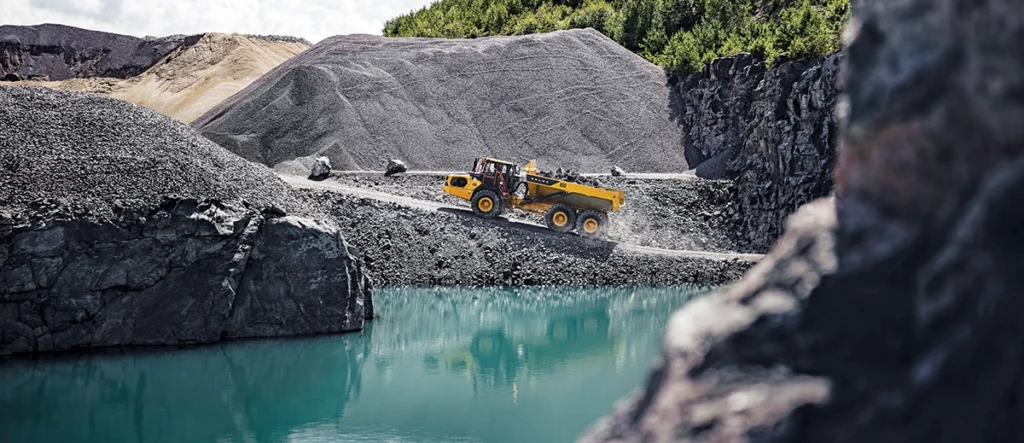
The term “articulated” describes the truck’s two-part design: a tractor unit at the front and a trailer unit at the rear, connected by a pivoting joint. This articulation allows the truck to steer by bending at the joint, giving it excellent maneuverability and enabling all six wheels to maintain ground contact even on uneven surfaces. The design makes articulated haulers particularly well suited to quarries with challenging layouts, variable ground conditions and confined work areas.
Advantages
Articulated haulers are widely used to move overburden, blasted rock and aggregates such as crushed stone, sand and gravel. Their versatility allows them to operate effectively in early site preparation stages, in active pits and on haul roads that may not yet be fully developed.
Key advantages of articulated haulers include:
- Superior maneuverability. The articulation joint provides a tight turning radius, allowing these trucks to work in confined areas and to navigate corners more easily than rigid-frame haulers.
- Excellent off-road capability. With all-wheel drive, high ground clearance and heavy-duty suspension, ADTs perform well on uneven, soft or slippery surfaces where rigid-frame trucks may struggle.
- Lower ground pressure. Wide tires and distributed weight reduce ground pressure, helping to minimize road damage and enabling trucks to work in softer soils without becoming stuck.
Comparison
In contrast, on-road dump trucks are built to comply with size, weight and safety regulations for highway use and are best suited for paved surfaces. Articulated haulers, however, are engineered exclusively for off-road environments such as quarries and construction sites. They feature more robust construction, drivetrains designed for traction in loose material, and higher relative hauling capacities for their size.
The distinction can be compared to that between a highway delivery truck and an all-terrain vehicle: both move material, but one is designed for speed and efficiency on roads, while the other is designed for heavy loads across rugged ground.
Because of their ability to combine maneuverability with off-road performance, articulated haulers have become essential equipment in modern quarries. Their design enables continuous material flow even under difficult conditions, making them valuable assets for efficient and reliable aggregate production.
Hauling Operations
The number of trucks required in each operation is determined by the production target.
The objective is to maintain the correct balance of truck numbers and capacities so crushers and stockpiles are served continuously. An excess of trucks waiting on a loader or loaders waiting for trucks both reduce productivity and increase costs.
PRO TIP
Balance truck and loader fleets: Avoid bottlenecks by maintaining the right ratio of trucks to loaders. Too many or too few will reduce system efficiency.
Truck body design and matching
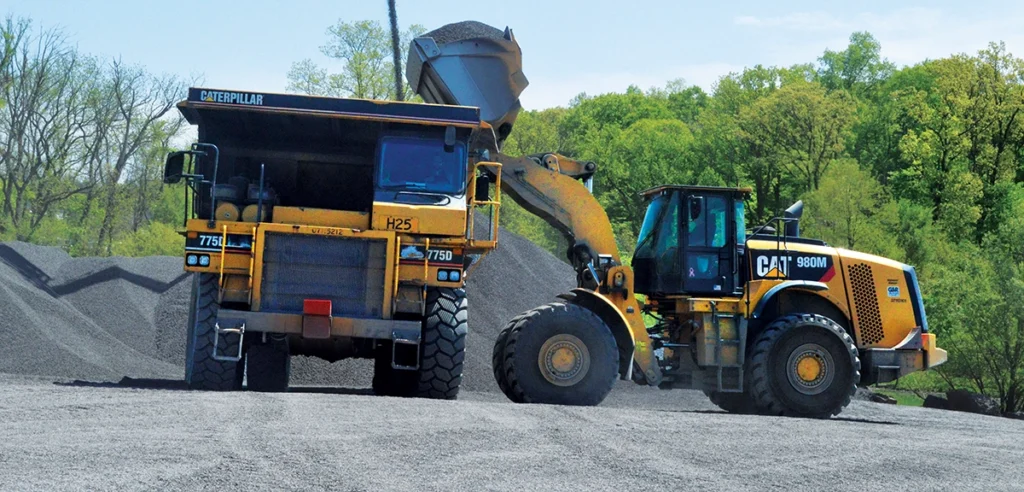
In addition to the number of trucks, the design of each truck body must be matched to the loading tool. Proper matching ensures quick spotting, efficient loading and even distribution of material within the body. Body rail height, width and length must be compatible with the loader’s geometry.
Rigid haulers can be equipped with a range of body designs and liners to suit material type and operating conditions. A flat-floor body, for example, is well suited for dumping into a hopper because it allows material to be metered. Dual-slope bodies, by contrast, help retain material on steep grades.
When handling poorly fragmented rock, a heavy liner is often required to absorb impact and extend body life. This added protection, however, increases body weight and reduces payload capacity. Hardened steel bodies resist wear without liners, while steel or rubber liners are effective against abrasive materials. Rubber liners also absorb impact energy, improving operator comfort and reducing noise.
Options for traction and control
Several options are available to improve performance in variable conditions. Traction-assist features for the rear axle are valuable where haul roads may become slippery. Mechanical systems operate like limited-slip differentials, while electronic systems monitor wheel rotation and selectively apply braking to transfer torque to the tire with greater traction. Electronic traction assist does not affect normal differential action or add stress to the drivetrain.
Comparing costs
Once production requirements are defined and candidate trucks identified, cost comparisons can be made. This process is not always straightforward, as specifications vary across manufacturers. Differences in body capacity, horsepower, torque curves and other ratings must be evaluated carefully.
Owning cost extends well beyond the purchase price. Fuel, lubricants, filters, belts, antifreeze, parts and repairs must all be considered over the machine’s lifetime. Even small differences in fuel use, payload or performance can significantly affect total cost. For this reason, projected lifetime cost should be a primary factor in truck selection, along with service requirements.
PRO TIP
Factor lifetime costs into truck selection: Compare not only purchase price but also long-term fuel, maintenance and tire expenses before committing.
&uuid=(email))
Service and maintenance
Routine service is simplified when lube points are clustered, filters and fill points are accessible from ground level, and modular components can be removed easily. Machines that allow service without removing major components reduce downtime and maintenance expense.
Trucks that are more complex, more difficult to access or more time-intensive to service present higher long-term costs and a greater likelihood that required maintenance will be neglected. As a result, producers increasingly rely on equipment dealers and maintenance contracts. Dealers today provide a variety of product-support options, including component rebuilding and replacement programs, monitoring and preventive maintenance plans, and guaranteed service agreements.
Definition
Hauler-loader compatibility: The practice of matching haul truck capacity with loader bucket size and reach to ensure efficient pass matching, even load distribution and reduced cycle time.
FULL HANDBOOK
Chapter 1: Industry Overview
Chapter 2: Geology & Site Selection
Chapter 3: Drilling & Blasting
Chapter 4: Excavating & Loading
Chapter 5: Hauling
Chapter 6: Crushing & Hydraulic Breaking
Chapter 7: Screening
Chapter 8: Washing & Classifying
Chapter 9: Conveying & Material Handling
Chapter 10: Loadout & Weighing
Chapter 11: Safety & Health
Use the page numbers to continue reading, or select a section / chapter above.