

FULL HANDBOOK
Chapter 1: Industry Overview
Chapter 2: Geology & Site Selection
Chapter 3: Drilling & Blasting
Chapter 4: Excavating & Loading
Chapter 5: Hauling
Chapter 6: Crushing & Hydraulic Breaking
Chapter 7: Screening
Chapter 8: Washing & Classifying
Chapter 9: Conveying & Material Handling
Chapter 10: Loadout & Weighing
Chapter 11: Safety & Health
IN THIS CHAPTER
The Plant
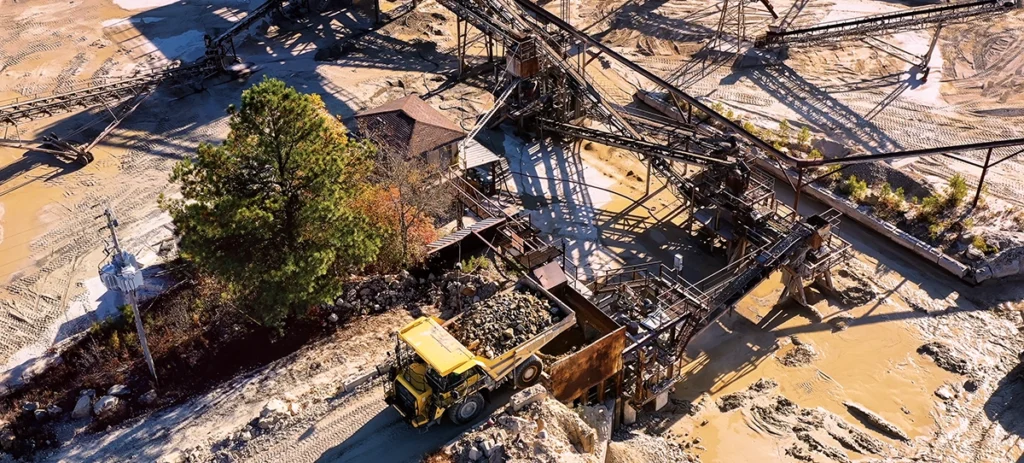
Once producers check the many boxes required to operate a mine site, they have many options regarding their plant’s configuration.
A mining plan can be simple or very complex, but it is vital in the process of designing a new processing plant. A formal mining plan forces an operation to look at several items that are sometimes overlooked – one that could cost considerably more money to correct in the future.
Among the items a mining plan should address are:
- Survey and evaluation of all material on the property
- Location of the highest-quality material
- Blending needs to achieve product specifications
- Water table assessment
- Quarry or pit development plan for the next three to five years
- Planned mining depth
- Primary crushing strategy (in-pit or fixed plant)
- Suggested locations for processing plant and support facilities
- Customer truck access routes
- Rail access considerations
- Settling ponds and water management (if required)
- Final reclamation plan and post-mining land use
&uuid=(email))
Plant type
The type of plant selected will generally depend on how long reserves will last. There are basically three types of plants.
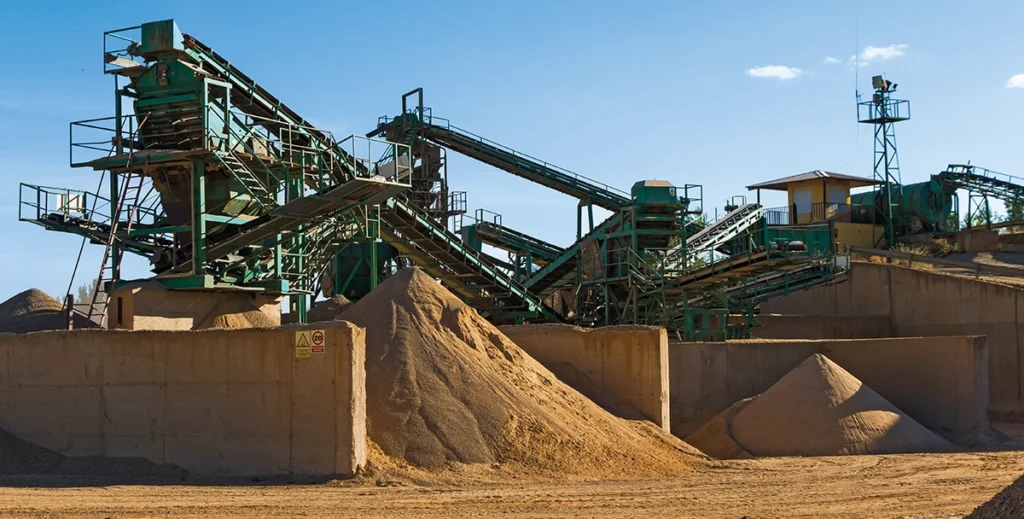
- Stationary plant. This type of plant is generally associated with quarried materials where the expected life of the quarry is more than 10 years. Large sand and gravel plants fall into this category.
- Semi-fixed plant. This type is associated with both quarried materials and sand and gravel where the expected life is less than 10 years.
- Mobile plant. This type is associated with both quarried materials and sand and gravel, where moving from site to site is essential. Mobile plants can be either wheeled or track-mounted.
A wheeled plant needs a semi-tractor to tow it, whether around the pit or on public roads. A track-mounted plant can move itself within the pit, but to travel on a highway it must be loaded onto a lowboy trailer.
Depending on how the property is mined, a track-mounted plant can follow the face and allows operations to transport crushed material by conveyor to the remainder of the plant. This eliminates the need for haul trucks.
Mobile plants can be moved from site to site, where their stay may be as short as several days and as long as several years. These plants can be used for shorter-term jobs where resale of the equipment is important at the job’s completion.
Process flow
Process flow can be defined as the combination of machines and techniques together to produce desired products. Process flow is one of the most important parts in defining how a new aggregate plant operates to make the products as economically as possible.
All aggregate plants have crushing sections or stages. Each crushing area can be defined as part of the plant that takes an input material of a given size and reduces it to a smaller size for the next crushing section or stage. Most crushing areas contain screens to remove the finer material before it goes into a crusher.
In many cases, a screening/sizing section or stage is part of the process flow. This is where material is only screened and not reduced in size by a crusher.
The selection of an appropriate processing circuit for a specific material is one of the most important decisions in the design of a processing plant. The importance is related to the fact that the capital and operating costs for the crushing and screening portion generally represent most of the overall plant’s costs.
Producers may determine there should be several approaches to their process flow, but the final analysis involves practical and economic considerations – with the result being a plant that can produce a quality product at a reasonable cost.
Understanding current or local practices in each area and learning why others approached their plant as they did is useful. This information may not be easily gained, but it can be used as a guide when developing the process flow to avoid costly mistakes.
Process flow starts with the plant feed material and ends when all products are been produced. A lot of work is required to define all the processing equipment needed for an aggregate plant. Once the initial pieces are selected, process-flow calculations should be done to determine if the equipment selected is correct.
&uuid=(email))
Plant layout
After the process flow is defined, it’s time to focus on fitting equipment into the designated area.
At this point, surge-pile capacities, stockpile capacities, minimum clearances under conveyors, minimum clearances around crushers and screens, and how stockpiles will be maintained are other considerations that must be defined.
Conveyor lengths are determined through these efforts, as well as the heights of all structures and the location of each piece of equipment. At this stage, it’s not uncommon to make a series of changes, as new information often comes to light that dictates the shape of the new plant.
SOURCES
David Hanratty
Jay Lukkarila
3M Industrial Minerals Product Division
3m.com
Brett McLaurin
Subhorizon Geologic Resources
subhorizonresources.com
NSSGA
nssga.org
Christopher Phillips
Jim Stroud
Subhorizon Geologic Resources
subhorizonresources.com
U.S. Geological Survey
usgs.gov
FULL HANDBOOK
Chapter 1: Industry Overview
Chapter 2: Geology & Site Selection
Chapter 3: Drilling & Blasting
Chapter 4: Excavating & Loading
Chapter 5: Hauling
Chapter 6: Crushing & Hydraulic Breaking
Chapter 7: Screening
Chapter 8: Washing & Classifying
Chapter 9: Conveying & Material Handling
Chapter 10: Loadout & Weighing
Chapter 11: Safety & Health
IN THIS CHAPTER
PROMOTED PARTNERS