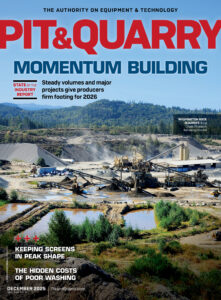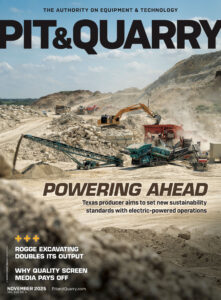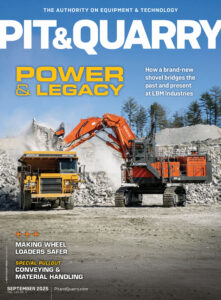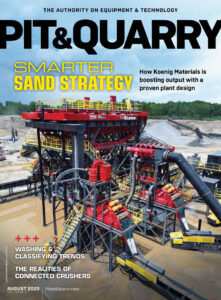


The Pit & Quarry University Handbook is an educational resource that offers comprehensive lessons covering the entire aggregate production process from start to finish, highlighting new technologies and enhanced procedures within each branch/category of the aggregates industry.
FULL HANDBOOK
Chapter 1: Industry Overview
Chapter 2: Geology & Site Selection
Chapter 3: Drilling & Blasting
Chapter 4: Excavating & Loading
Chapter 5: Hauling
Chapter 6: Crushing & Hydraulic Breaking
Chapter 7: Screening
Chapter 8: Washing & Classifying
Chapter 9: Conveying & Material Handling
Chapter 10: Loadout & Weighing
Chapter 11: Safety & Health
IN THIS CHAPTER
Geology
Rocks, which humans have used for millions of years, are geologically classified according to characteristics such as mineral and chemical composition, permeability, constituent particle texture and particle size.
These physical properties are the result of the processes that formed rocks. These events produce three general rock classes: igneous, sedimentary and metamorphic.
Crushed stone, sand and gravel are the main types of natural aggregates used in the U.S. Aggregates are used in nearly all residential, commercial and industrial building construction, as well as in most public works projects – including roads, highways, bridges, railroad beds, dams, airports, tunnels, and water and sewer systems.
The widespread use of aggregates results not only from their general availability but economic considerations.
Still, even though crushed stone, sand and gravel resources are widely available throughout the U.S., their accessibility is not universal. Some areas are devoid of sand and gravel while potential sources of crushed stone may be lacking or covered by overburden that’s too thick to allow for economical surface mining.
PRO TIP
Evaluate overburden early: Thick overburden can make otherwise high-quality deposits uneconomical to mine.
&uuid=(email))
Moreover, aggregates do not meet the physical-property requirements for certain uses in some areas. Or, they contain mineral constituents that react adversely when used in cement concrete.
Geologic processes ultimately formed crushed stone, sand and gravel. Volcanoes, glaciers, wind, rivers and seas took their shape and character of rock materials over millions of years.
The gravel used today may have been deposited thousands of years ago – just yesterday geologically. Hard, dense limestone may have been deposited as a limy ooze hundreds of millions of years ago. When a supply of aggregates is required, geological investigations can determine the location, distribution and nature of potential aggregates in an area.
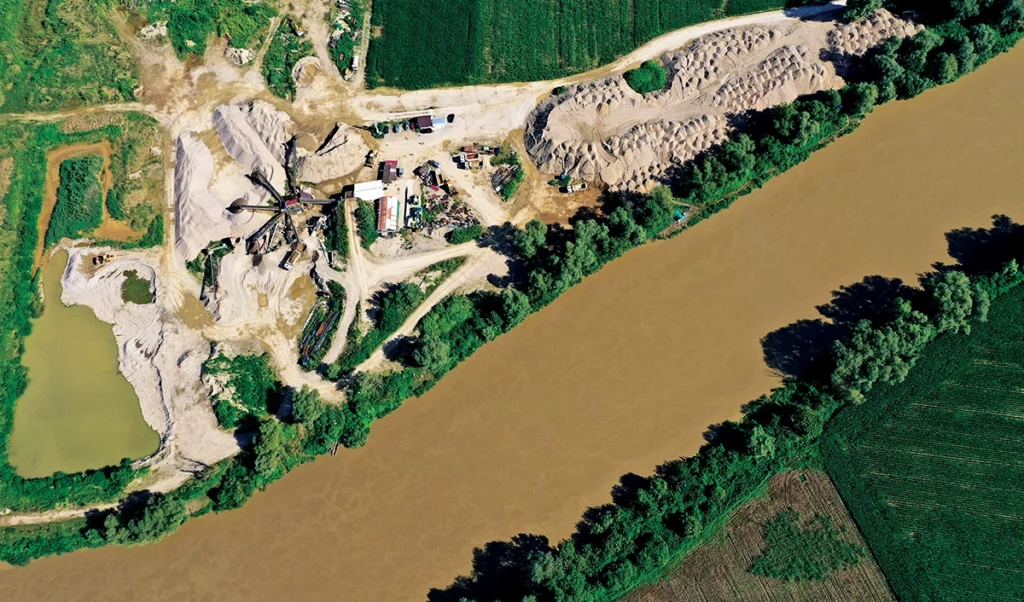
Sand and gravel deposits are products of bedrock and surface material erosion, as well as the subsequent transport, abrasion and deposition of the particles. The principle geological agent affecting the distribution of sand and gravel deposits is water. Consequently, gravel is distributed widely and abundant in glaciated areas, in alluvial basins and in, adjacent to or near rivers and streams. Windblown deposits are generally fine grained and rarely used for aggregates.
Definition
Terrace deposits: Sand and gravel left behind on former floodplains or stream levels as rivers cut downward, creating step-like landforms.
Sand and gravel deposited by rivers or streams is widely distributed throughout the U.S. as stream-channel or terrace deposits. In hilly or mountainous areas, bedrock is chemically and physically weathered and progressively broken into smaller particles. Less chemically resistant minerals are dissolved or altered into clay minerals, while more resistant minerals remain as rock fragments.
Depending on the composition and structure of the bedrock, climate, land cover and topography, the remaining soils may range in thickness from almost nothing to many tens of feet. They may also range in composition.
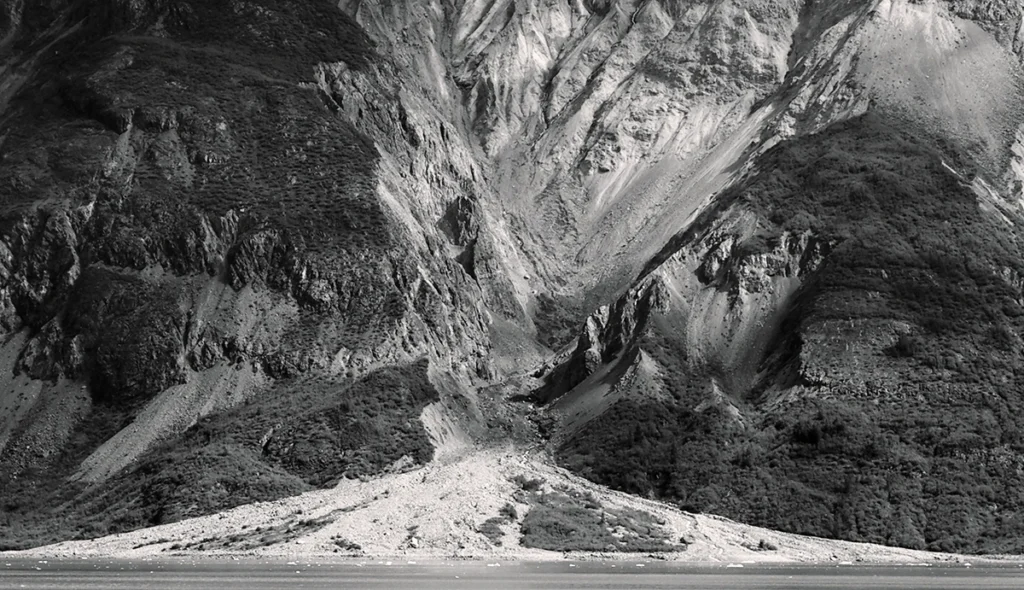
Gravity and sheetwash move some material downslope, where it forms a deposit called colluvium. Eventually, colluvium is moved into valleys of relatively high-gradient streams.
In stream channels, rock fragments are subjected to abrasion, rounding and sorting. The stream-transported material is deposited in channels and on floodplains, consisting of sand and gravel in some areas and silt and clay in others.
Erosion can alter an already established floodplain. If a river or stream incises its channel, the older channel and floodplain deposits are preserved as terraces. Repeated downcutting can result in the formation of a series of terraces or terrace remnants.
Definition
Collovium: Loose soil and rock material that moves downslope under the influence of gravity and collects at thebase of slopes.
Glacial deposits
Many of the extensive sand and gravel deposits in the northern and higher elevated parts of the U.S. are products of either continental or alpine glaciation.
As a glacier advances over a land surface, it erodes the surficial materials and underlying bedrock, depositing till, which is a non-sorted or poorly sorted mixture of clay-size to boulder-size particles.
As the ice melts, rock particles that had been crushed and abraded by the ice are transported by meltwater. As particles are carried along, they are further abraded and sorted. Angular fragments are rounded, and weak particles are broken into smaller pieces.
Finer materials are carried away and deposited in lakes and ponds, while coarser sand and gravel is deposited in and along stream channels.
Glacial erosion and deposition are complex dynamic processes. Hourly, daily and seasonal temperature changes and longer-term climatic changes affect the rate of melting and the volume of meltwater. The particle size of glaciofluvial deposits, therefore, varies greatly and deposits accumulate in diverse topographic settings.
Definition
Glacioflucial Deposits: Sediments carried and sorted by meltwater from glaciers, often containing sand and gravel suitable for aggregate use.
Alluvial-fan deposits
In the arid and semi-arid Western U.S., many valley basins contain thick deposits of unconsolidated alluvium. Alluvium is detrital material consisting of clay, silt, sand or gravel. It’s eroded in the adjacent mountains and transported to basins during infrequent but torrential floods – down steep gradient streams.
Upon reaching basins, water spreads out of the channel and infiltrates the ground. The sudden change in gradient and reduced transporting capacity causes deposition of sediment and produces alluvial fans.
Generally, the coarsest detrital material is deposited adjacent to mountains. Deposition becomes progressively finer in the alluvial valleys toward the center of the basins.
In time, the fans formed in adjacent valleys coalesce to form continuous, thick deposits of alluvium.
Definition
Alluvial Fan: A fan-shaped deposit of sediment formed where a high-gradient stream flows out onto a flatter plain, dropping coarse material near the mountains and finer material farther out.
Crushed stone
Bedrock is classified in three main groups based on its origin: sedimentary, igneous and metamorphic.
Sedimentary rocks – limestone and dolomite – make up about 71 percent of current crushed stone production. Igneous rocks, generally referred to as granite or traprock, make up 14 percent and 8 percent of all crushed stone, respectively. Metamorphic rocks such as gneiss, marble or quartzite are also used. Together with miscellaneous stone, they account for the remaining 7 percent of bedrock.
Sedimentary rocks were formed through the consolidation of loose sediment by chemical, biochemical or mechanical processes – or by direct chemical precipitation. Chemically or biochemically deposited sedimentary rocks, such as hard, dense limestones and dolomites are generally good sources of crushed stone. Some limestone and dolomite, however, are too soft, absorptive or friable to yield high-quality aggregates.
Chert and flint are silicate rocks that were precipitated in water by organisms such as sponges. These rocks can be crushed for aggregates, but they may cause adverse reactions such as cracking and scaling in cement concrete.
Clastic, or mechanically deposited, sedimentary rocks are classified according to the sizes of individual particles. Rock that consists mostly of pebbles and larger size fragments is conglomerate; rock that consists mostly of sand-sized particles is sandstone; and rock that consists primarily of silt- or clay-sized particles is siltstone or shale.
Of these rocks, hard, dense sandstone is the only type that is generally a source of crushed stone. In areas where no other material is available, sandstone is a major source of aggregates, but it constitutes less than 3 percent of all U.S. aggregate production.
&uuid=(email))
Igneous rocks solidify from a molten or partly molten state and are further classified by their origin. Intrusive igneous rocks solidify at depth within the earth and have coarse mineral crystals, owing to the slow cooling associated with deep burial. Light-colored, intrusive igneous rocks are commonly referred to as granite. Extrusive igneous rocks solidify at or near the earth’s surface and are generally composed of small or microscopic crystals formed by rapid cooling.
Such rocks are frequently referred to as traprock. Igneous rocks that are hard, tough and dense are commonly excellent sources of crushed stone. Still, some are very friable while others are very porous. Some siliceous igneous rocks react deleteriously when used as aggregates in cement concrete.
Metamorphic rocks form when existing rocks are subjected to heat and pressure within the earth. Common metamorphic rocks are slate, schist, gneiss, marble and quartzite. Of these, only gneiss, marble and quartzite are commonly used as aggregates.
Alternate sources
In areas where natural aggregates are not economically available, do not meet physical or chemical specifications, or are preempted by land use or regulations, other materials can be used as aggregates to avoid excessive transportation costs.
Natural materials such as shells, clinker and caliche can be substituted for crushed stone, sand and gravel. Aggregates can be manufactured from clay and shale expanded by firing. Additionally, some waste types can even be used as aggregates – including blast furnace slag, steel slag, ash, coal refuse, mine tailings, waste glass and shredded rubber tires.
Recycled concrete and asphalt is another increasingly viable alternative for natural aggregates. These can be both economically and environmentally beneficial.
FULL HANDBOOK
Chapter 1: Industry Overview
Chapter 2: Geology & Site Selection
Chapter 3: Drilling & Blasting
Chapter 4: Excavating & Loading
Chapter 5: Hauling
Chapter 6: Crushing & Hydraulic Breaking
Chapter 7: Screening
Chapter 8: Washing & Classifying
Chapter 9: Conveying & Material Handling
Chapter 10: Loadout & Weighing
Chapter 11: Safety & Health
IN THIS CHAPTER
Use the page numbers to continue reading, or select a section / chapter above.