
FULL HANDBOOK
Chapter 1: Industry Overview
Chapter 2: Geology & Site Selection
Chapter 3: Drilling & Blasting
Chapter 4: Excavating & Loading
Chapter 5: Hauling
Chapter 6: Crushing & Hydraulic Breaking
Chapter 7: Screening
Chapter 8: Washing & Classifying
Chapter 9: Conveying & Material Handling
Chapter 10: Loadout & Weighing
Chapter 11: Safety & Health
Mobile Equipment Safety
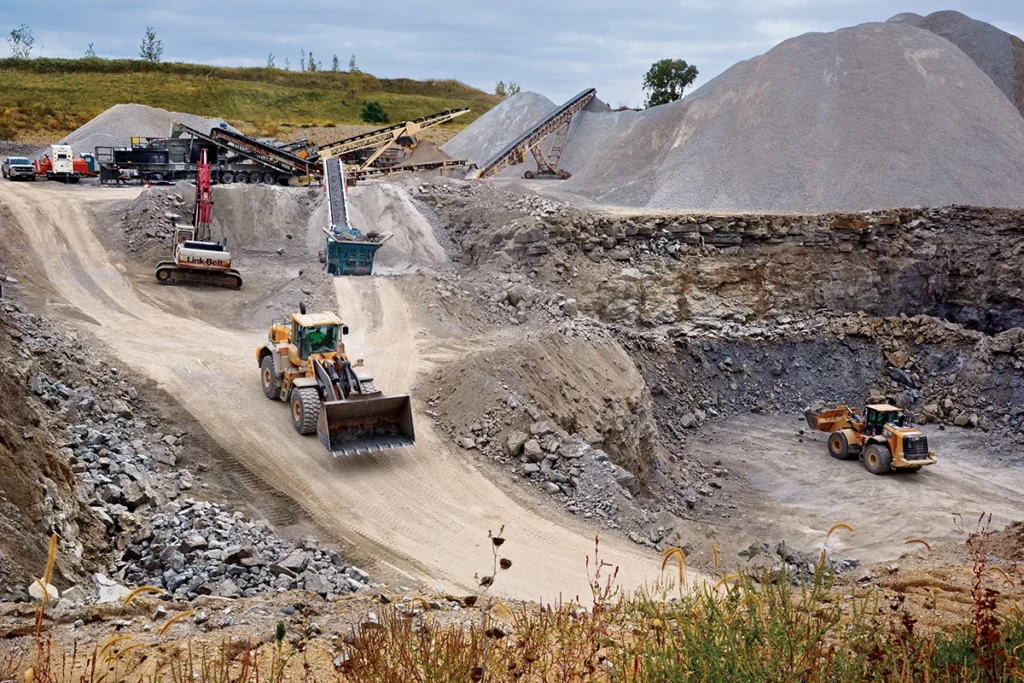
While vital to production, safety related to excavators and loaders should always be a priority for operators.
Fortunately, manufacturers have taken steps in recent years to make their equipment inherently safer – not only for those operating from within the cab, but for those working around machines.
The next few years should bring further safety enhancements to excavators and loaders. But the developments made of late have already done wonders to elevate site safety.
&uuid=(email))
Difference-making features
While seemingly simple by today’s standards, the addition of cameras has taken loader and excavator safety to new heights.
Some manufacturers offer rearview cameras as standard for excavators and wheel loaders. Sideview cameras are also now a safety feature on some equipment.
Some camera systems can cover even more ground. One newer safety development for excavators and wheel loaders is around-view monitoring, which provides added visibility for equipment operators. Such systems give operators greater confidence when operating or positioning machines in tight work areas.
The combination of cameras and radar presents new safety opportunities, as well. While cameras are increasingly being added to heavy equipment, some systems combine camera technology and radar detection systems to distinguish between objects and humans for a heightened level of awareness.
Today’s safety features come in other forms, as well. Wider footsteps and added safety rails are among newer developments to help operators more safely enter and exit cabs. Lighting addresses safety, as well, with some manufacturers offering options for equipment.
While manufacturers are doing their part to design safety features into equipment, some aggregate producers are still familiarizing themselves with the very latest advancements. Older technologies like rearview cameras are now second nature for many excavator and wheel loader operators while newer technologies like transparent buckets, AVM camera systems and proximity sensors take more time for operators to make use of. It’s important for operators to know about and understand how these technologies work.
SAFETY TIP
Adjust seats before operation: Poor seat positioning leads to strain and slower reactions. Operators should set seats for easy pedal reach and proper visibility.
What’s next?
In the coming years, excavators and loaders should get even safer as manufacturers further invest in technology.
The next-generation iteration of object detection, for example, is moving object detection. If something is moving near a machine, it can, for example, appear with a triangle on the moving object, with the system following it.
Operator fatigue is another area of focus today, with some manufacturers aiming to develop features that address this accident cause.
Dredging
Dredges, which are used for underwater operations, are another means of mining materials aside from excavating and dredging.
The removal, transport and placement of dredged sediments are the primary parts of the dredging process. In design and implementation of any dredge, each part of the dredging process must be closely coordinated to ensure successful operation.
Dredging involves the removal of sediment in its natural or recently deposited condition, using either mechanical or hydraulic equipment. After sediment is excavated, it is transported from the dredging site to a placement site or disposal area.
In many cases, the dredge itself manages this transport operation. Transport can also be done with equipment such as barges, scows and pipelines with booster pumps.
Once dredged material is collected and transported, the final step in the dredging process is placement in either open-water, near-shore or upland locations – or processing as aggregates. The choice involves a variety of factors, including environmental acceptability, technical feasibility and economic feasibility.
The dredging equipment, techniques used for excavation and transport of the material, and the disposal alternatives considered must be compatible. The types of equipment and methods used vary considerably throughout North America.
Dredging equipment and operations resist precise categorization. Because of specialization and tradition, many descriptive – often overlapping – terms categorizing dredges have emerged.
For example, dredges can be classified according to the basic means of moving material (mechanical or hydraulic); the device used for excavating sediments (clamshell, cutterhead, dustpan and plain suction); the type of pumping device used (centrifugal, pneumatic or airlift); and others.
For the purposes of this section, though, dredging is basically accomplished by only two mechanisms:
- Hydraulic dredging. Removal of loosely compacted materials by cutterheads, dustpans, hoppers, hydraulic pipeline, plain suction and sidecasters – and usually for maintenance dredging projects
- Mechanical dredging. Removal of loose or hard compacted materials by clamshell, dipper or ladder dredges – either for maintenance or new-work projects
Definition
Hydraulic dredge: A barge-mounted pump system that removes underwater sediments and transports slurry.
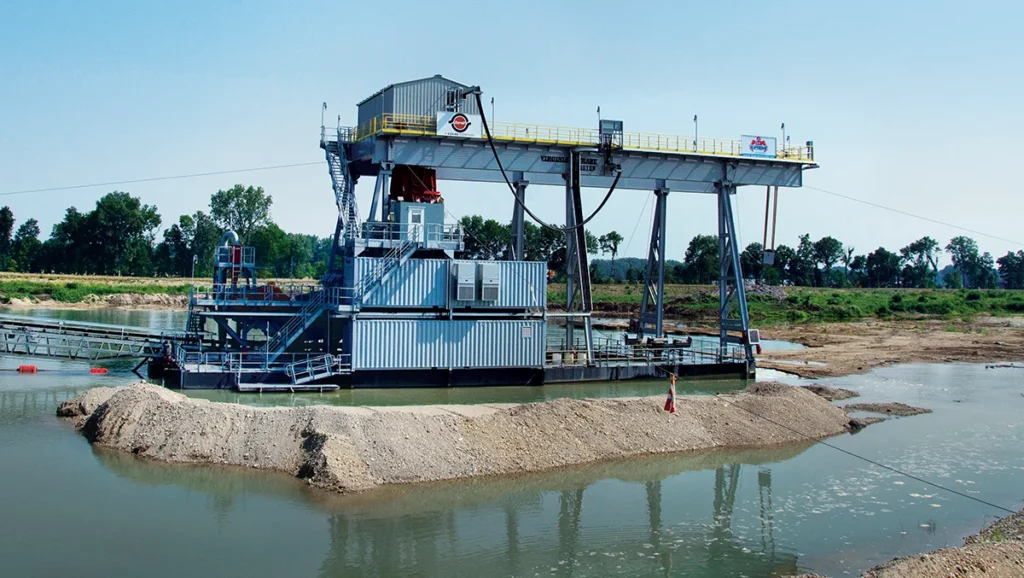
Hydraulic dredges remove and transport sediment in liquid slurry form. They’re usually barge-mounted and carry diesel or electric-powered centrifugal pumps with discharge pipes ranging in diameter from 6 to 48 in.
The pump produces a vacuum on its intake side, forcing water and sediments through the suction pipe. The slurry is transported by pipeline to a disposal area.
Hopper dredges are included in the hydraulic dredges category – even though the dredged material is simply pumped into the self-contained hopper on the dredge rather than through a pipeline. It is often advantageous to overflow excess water from hopper dredges to increase the sediment load carried, but this may not always be acceptable owing to water quality concerns near a dredging site.
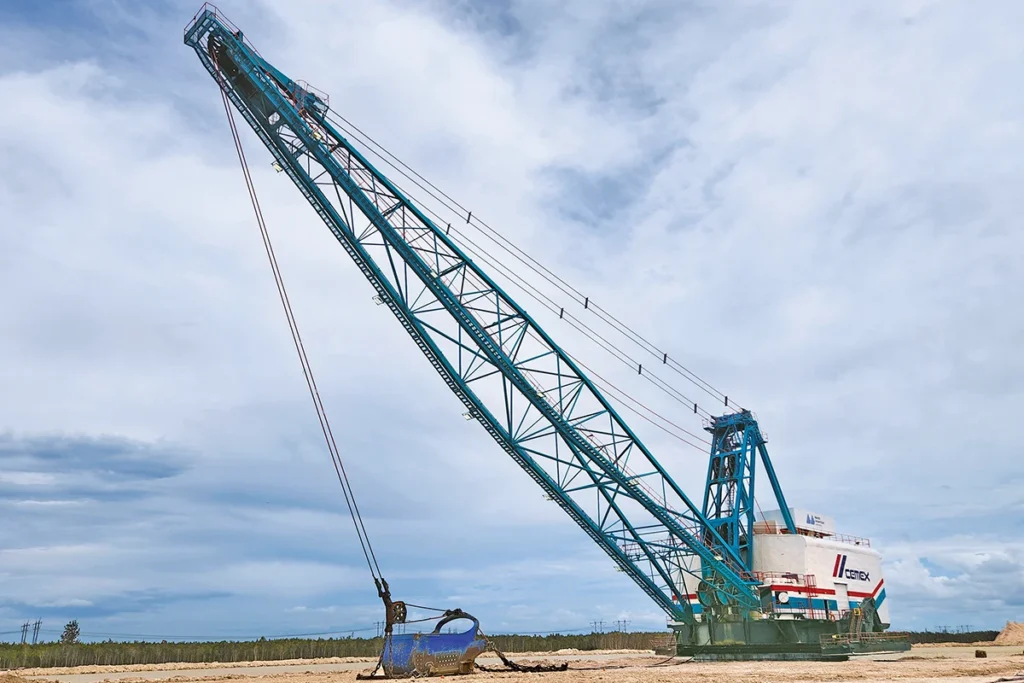
Mechanical dredges, meanwhile, remove bottom sediment through the direct application of mechanical force to dislodge and excavate material at almost in situ densities. Backhoe, bucket (such as clamshell, orange peel and dragline), bucket ladder, bucket wheel and dipper dredges are types of mechanical dredges. Sediments excavated with a mechanical dredge are generally placed into a barge or scow for transport to a disposal site.
The selection of dredging equipment and the method used to perform dredging depends on several factors, including:
- Physical characteristics of the material being dredged
- Material quantity
- Dredging depth
- Distance to the disposal area
- Physical environment of the dredging and disposal areas
- Contamination level of sediments
- Disposal method
- Production rate
- Dredge type
- Cost
Water quality at dredging and disposal sites is a particularly important consideration when selecting dredging equipment. Hydraulic dredging can virtually eliminate disturbance and resuspension of sediments at the dredging site, and it is often the first choice when dredging occurs in enclosed waterbodies or in locations near aquatic resources that would be especially sensitive to temporary increases in suspended solids or turbidity.
Still, because hydraulic dredging typically entrains additional water that is many times the volume of the sediment removed, water management and water quality must be controlled at the disposal site.
In contrast, mechanical dredging creates little additional water management concern at the disposal site because little additional water is entrained by mechanical dredging equipment. Therefore, mechanical dredging is usually the first choice when disposal site capacity limitations are a primary concern. Typical mechanical equipment often creates more disturbance and resuspension of sediments at the dredging site.
In terms of processing dredge materials, aggregate operations do so either by transporting it to a nearby plant on land or by utilizing a processing facility on the dredge itself.
Technology developments
Dredging evolved tremendously over the last decade with the development of sonar, which allows operators to see where they’re dredging, how deep they are, how close they are to permitted limits and more.
Now, permit limits can be pre-programmed so dredge operators don’ overdig slopes, leave material behind or dig holes where they’re not supposed to. Prior to sonar becoming widely available, operators were, in a sense, dredging “blind.” It will be critical to further move automation forward in dredging.
But even then, sonar is just one part of dredging’s automation puzzle.
Because automation gathers data at an exponentially higher rate than a human, the ROI is very short.
For example, an operation panel with many gauges on it might require an operator sitting in a control cab to look at that gauge periodically – once every several seconds or, perhaps, every few minutes. Automation, on the other hand, looks at the value of that gauge 60 times a second – making decision-making very quick.
Autonomous dredging is on the way, as well.
Deeper digging
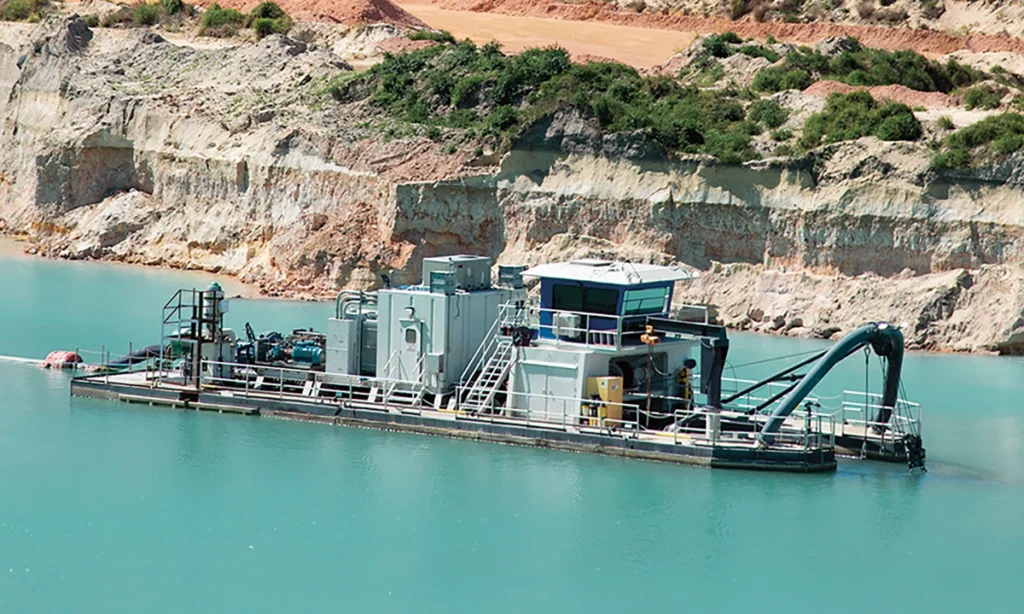
Another dredging trend is the movement to dig deeper into mineral reserves.
While permits outline the physical boundaries dredging operations must abide by while collecting material, a boundary receiving increased attention is the depth to which operators can dig. In other words, operators are beginning to value the reserves “under their reserves.”
Of course, dredge operators deal with similar issues as traditional quarries on the permitting front. Whereas a stone quarry contends with issues like vibration and truck traffic, sand and gravel dredge operators faces blowback regarding their water use.
Permitting challenges are amplified in areas where material reserves are dwindling, with some states reportedly not issuing new permits for dredging.
&uuid=(email))
SOURCES
Case Construction Equipment
casece.com
Caterpillar
cat.com
Troy Hitchcock
Develon
na-develon-ce.com
Jacob Sherman
Develon
na-develon-ce.com
Bill Zak
Develon
na-develon-ce.com
John Deere
deere.com
Komatsu America Corp.
komatsuamerica.com
Rockland Manufacturing
rocklandmfg.com
San Francisco Bay Conversation
& Development Commission
bcdc.ca.gov
Allison Grettenberg,
Two Rivers Marketing
tworiversmarketing.com
Ryan Johnson
Two Rivers Marketing
tworiversmarketing.com
Volvo CE
volvoce.com
Eric Yeomans
Volvo CE
volvoce.com
The Pit & Quarry University Handbook is an educational resource that offers comprehensive lessons covering the entire aggregate production process from start to finish, highlighting new technologies and enhanced procedures within each branch/category of the aggregates industry.
FULL HANDBOOK
Chapter 1: Industry Overview
Chapter 2: Geology & Site Selection
Chapter 3: Drilling & Blasting
Chapter 4: Excavating & Loading
Chapter 5: Hauling
Chapter 6: Crushing & Hydraulic Breaking
Chapter 7: Screening
Chapter 8: Washing & Classifying
Chapter 9: Conveying & Material Handling
Chapter 10: Loadout & Weighing
Chapter 11: Safety & Health