

Dust management may not be glamorous, but it plays a role in nearly every dry crushing and screening application.
With the Mine Safety & Health Administration (MSHA) planning to enforce its final rule on respirable crystalline silica at all mining operations starting in April, producers should begin thinking about control measures now.
A discussion with an equipment manufacturer or dealer is a good place to start.

“We got into load and dust containment without really looking at the MSHA regulation,” says Joe Gibson, conveyor applications specialist at Superior, whose company developed a suite of conveyor solutions over the last several years with the intent of mitigating dust. “From the component side, Superior has always been strong in load support, belt support and power transmission. But we didn’t really offer any load containment solutions, meaning things like skirting, skirt clamp and wear liners.”
Although Gibson characterizes technologies like these as “passive dust control,” they’re off-the-shelf items that can serve as simple dust control solutions.
“It’s kind of like buying an idler and not engineering a special idler,” Gibson says. “That makes it a lot more cost competitive and user friendly to the extent that you’re not paying $60,000 in engineering fees but buying a product that’s designed to fit the vast majority of applications.”
Poor dust control
Almost every operation is a contender for dust controls, according to Gibson. Of all operations, he estimates 1 percent or less do a good job of controlling dust.
“It’s really because they haven’t had to think about it before,” Gibson says. “When you look at it and see a little bit of dust rising, it’s usually not that big of a concern. But over time it accumulates.”
Consider how much time your site spends on cleanup. Also, keep in mind that airborne dust damages critical moving parts.
“If you have airborne dust and it goes into the return side of your conveyor and cycles through the tail pulley, it’s causing accelerated wear on the tail pulley,” Gibson says. “It’s causing accelerated wear on any moving component – idlers included.”
Gibson contends dust could also be contaminating finished products.
“These are all things you can look at,” he says. “Look at the ways it’s costing you money that they’re not really even thinking about.”

Complete dust strategy
Determining the right dust control solutions for an operation may require a manufacturer or dealer’s assessment. The answer may not be one solution, however, but many.
“All the parts on the conveyor play together to create a good seal, contain the airflow and contain the dust,” Gibson says. “If you’re not sealed, the air is going to come out somewhere. So, the goal is to contain everything, seal everything and control the air.
“Once you’re controlling the airflow, then you can start regulating its speed, direction and cause the dust to settle,” he adds.
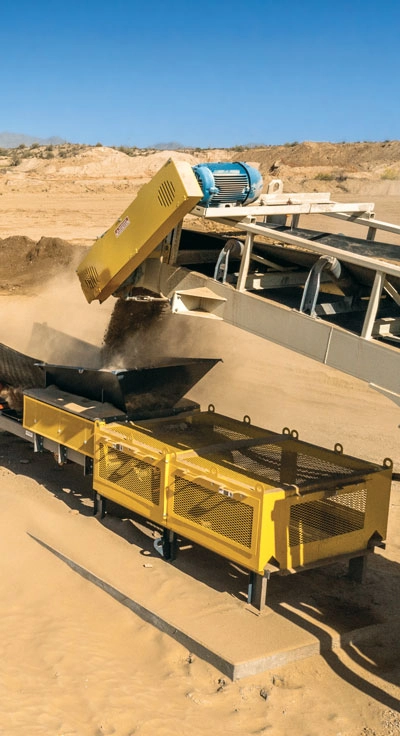
Discussions around dust containment solutions often lead to skirting systems.
“With belt-to-belt transfers where you’re getting visible dust coming out, we can handle that no problem with our skirting system with our stilling box,” Gibson says.
The same goes for several crushing arrangements.
“Coming out of cone crushers – even a dual-cone setup – we have that dialed in where we have a setup for it,” Gibson says. “We have a solution for jaw crushers, as well.”
In many cases, a skirting system with a stilling box is a good starting point for dust control. Truly mitigating dust typically calls for additional measures, though.
“If I put in a skirting system and a stilling box but I don’t have good load support under it, I’ll get a lot of belt sag and the dust will come out underneath,” Gibson says. “So, you need to have an impact system and good belt support going up through it.”
Tail pulleys play a role in dust management, as well.
“If someone is using a wing tail pulley rather than a chevron wing or a drum, it puts a lot of vibration on the belt,” Gibson says. “We call it belt flutter. If it’s got belt flutter going through the load zone, you end up not getting a good seal.”
Beyond compliance
Although Gibson estimates that only about one in 100 operations currently utilize passive dust control solutions effectively, he expects adoption to increase as MSHA enforcement begins. Still, the benefits of dust control solutions go beyond regulatory compliance.
“It’s being pushed by the government as a regulation, but in reality, it’s a money-saving item for the end user in the long run,” Gibson says. “If they’re setting up a system and they’re not controlling their dust, they’re going to have component failure, as well as cleanup and environmental issues. It’ll pay for itself relatively quickly.”
Related: Closing the gap on guarding