

FULL HANDBOOK
Chapter 1: Industry Overview
Chapter 2: Geology & Site Selection
Chapter 3: Drilling & Blasting
Chapter 4: Excavating & Loading
Chapter 5: Hauling
Chapter 6: Crushing & Hydraulic Breaking
Chapter 7: Screening
Chapter 8: Washing & Classifying
Chapter 9: Conveying & Material Handling
Chapter 10: Loadout & Weighing
Chapter 11: Safety & Health
Blasting Execution
Blast design means nothing without proper execution.
A well-engineered pattern, if poorly drilled, improperly loaded or sloppily fired, will underperform or fail outright. Execution is where design meets geology, timing meets burden and every decision made on paper must prove itself in the field.
The blasting process is high-consequence work. It requires coordination, discipline and a deliberate sequence of steps that must be followed without exception. From pre-blast inspection to post-blast assessment, each stage is critical. Shortcuts in drilling QA, misplacement of primers, rushed hookup or lax clearance procedures can result in flyrock, misfires, poor fragmentation or worse – injury and regulatory action.
The goal is simple: execute with precision. In blasting, there are no redos. Once the button is pushed, the quality of everything that came before is revealed in an instant. A safe, efficient and well-executed blast doesn’t happen by accident; it’s the result of process, training and attention to detail at every stage.
Pre-blast inspection
Pre-blast inspection is where safety and performance begin.
Before a single hole is loaded, the face, pattern and conditions must be verified against design – and against reality. No matter how well a blast is planned, ground truth must confirm it.
The inspection starts at the blast face. The blaster-in-charge must evaluate for loose rock, overhangs, slabbing or highwall instability. In many operations, visual inspection is augmented by drone-based photogrammetry or lidar, which captures a high-resolution 3D model of the face.
These tools allow the blast to be modeled digitally in specialized software platforms that calculate burdens, map structural features and simulate detonation sequences. By analyzing the 3D burden before drilling, teams can correct for irregular geometry and avoid under- or over-burdened holes that lead to flyrock or misfires.
Next is burden measurement and profile checks. Using face profilers, burden poles or drone-derived models, teams must confirm that the planned burden is achievable and consistent. Where geometry has shifted since layout, adjustments must be made before loading begins.
&uuid=(email))
Drill logs are reviewed to confirm hole depth, alignment and geology. Any deviation, voids or unplanned structure must be evaluated and accounted for in the loading plan.
Environmental and design variables must also be checked:
- Scaled distance calculations for vibration and airblast limits
- Wind direction, weather forecasts and lightning risk
- Community proximity and regulatory setback requirements
Modern blast planning software allows teams to simulate the shot, optimize timing and export the design directly to GPS-enabled survey systems for precise field layout. This integration improves not only accuracy but safety, ensuring every hole is placed and fired with known burdens and verified conditions.
A comprehensive pre-blast inspection sets the tone for execution. It confirms the plan is still valid or gives the team time to adjust before energy is introduced into the rock.
Drilling QA/QC
Drilling is where design becomes physical. Any errors made during this step will be amplified when the blast is fired.
That’s why rigorous drilling QA/QC is essential before loading begins. This is the last opportunity to ensure the blast geometry matches the plan.
Start by confirming hole count, pattern layout and collar positions. Whether laid out manually or via GPS, the drill pattern must align with the design burden and spacing. A single misplaced hole – too close to the face or off pattern – can create flyrock, overbreak or uneven fragmentation.
Hole depth is equally critical. All holes should be checked for depth versus design, and holes that are over- or under-drilled must be flagged and reviewed. Under-drilled holes lead to poor floor control; over-drilled holes can cause excessive subdrill, increased cost or unwanted floor breakage.
Hole deviation is more difficult to assess but should be considered especially in long holes or jointed rock. In high-consequence blasts, downhole deviation tools or gyroscopic probes may be used.
For most operations, review of drill logs and observed geological conditions will guide decision-making. Drill logs must be reviewed to identify:
- Voids or seams
- Water inflow
- Major hardness transitions
- Structural features affecting loading
Any significant findings must be relayed to the blaster for design adjustments, such as decking or timing changes.
Loading procedures and on-bench practices
Loading is the most sensitive phase of blasting execution. Every action on the bench during this stage affects the safety, performance and legality of the blast. A controlled loading process, governed by strict procedures and enforced QA/QC, is essential to preventing misfires, flyrock and underperformance.
SAFETY TIP
Separate detonators from bulk explosives: Never stage or transport them together unless in approved containers.
All loading must be conducted under the supervision of a licensed blaster-in-charge. No unauthorized personnel should be present on the bench, and an established exclusion zone must be maintained at all times. Detonators and boosters must remain separated until immediately prior to loading, and no hole should be primed until it is ready to be fired within the planned time window.
Primer placement is critical. The primer must be in direct contact with the explosive column and properly positioned, typically at the bottom of the charge, to ensure complete detonation. For decked or voided holes, accurate placement is even more important.
SAFETY TIP
Enforce exclusion zones: Only authorized personnel should be near the bench during loading and firing.
Column loading should match the design for explosive type, loading density and column height. QA/QC measures must verify:
- Correct product is used
- Quantity loaded matches the design
- Column is continuous (no slumps or bridging)
- Decking is placed as specified
Stemming must also be installed to specification using the correct material, amount and placement. Poor stemming is a leading cause of blowouts and flyrock.
Documented on-bench QA/QC should include:
- Hole-by-hole logs of product used
- Booster placement and initiation system
- Stemming installed
- Any deviations from plan (i.e., voids, wet holes, substitutions)
In electronic systems, detonator programming and system diagnostics must be verified before the circuit is closed. The blaster must also perform a final sweep to confirm all personnel are clear, all holes are loaded and the bench is secure.
Firing the shot
Firing the shot is the final step in the blasting process, but it carries the highest consequence.
At this stage, all energy is in place and every variable has been set. The only thing left is execution, with total control, full communication and no margin for error.
The blaster-in-charge assumes full responsibility for the shot once loading begins and must ensure the entire pattern is secure, the crew is clear and all firing protocols are followed. Pre-firing procedures include:
- A final safety sweep of the blast area
- Confirmation that all roads, haul routes and adjacent work zones are cleared
- Notification of all personnel, including guards, scale house operators and dispatch
- Warning systems must be activated:
- A standard warning horn sequence (five short, one long)
- Radio or communication confirmation that the area is clear
- Final visual confirmation of exclusion zone control
- Firing must occur from a designated, protected location using either:
- An electric blasting machine (for electric caps)
- A non-electric initiator (such as a shock tube igniter)
- An electronic system controller with circuit diagnostics and firing control
No shot should be fired unless all safety conditions are met, and communication is two-way confirmed with all blast guards. Once fired, no one should approach the blast site until fumes have dissipated and the blaster-in-charge has inspected and gives clearance.
If any issues occur – misfires, unusual delays or structural collapse – the area must remain secured until a full assessment is performed and typically left for at least 60 minutes to ensure no late initiation of explosive occurs. Under no circumstances should mucking or inspection begin before the area is cleared.
Post-blast inspection
Post-blast inspection is the final step in the blasting process and the first opportunity to evaluate performance. A thorough inspection not only confirms that the blast was safe and successful, but provides the data needed to improve future designs. This step must be completed by the blaster-in-charge before any personnel or equipment are allowed back on the bench.
The first priority is safety clearance. The area must be evaluated for:
- Misfires. Any unexploded charges, disconnected leads or unexpected behavior during detonation must be treated as live and hazardous. The site must remain secured until a controlled investigation and disposal is completed. In the event of a misfire, the recommendation is for no personnel – including the blaster-in-charge – to enter the area for 60 minutes. After 60 minutes, the blaster-in-charge can enter and begin the investigation or re-hook up the blast.
- Flyrock and damage assessment. Check for signs of throw beyond the designed perimeter. Damage to equipment, structures or the highwall must be documented.
- Fume clearance. Ensure that all visible gases have dissipated, particularly in low or wind-blocked areas.
Once the area is safe, the blast can be evaluated for technical performance:
Face condition. Look for backbreak, overbreak or scarring that may indicate overconfinement, poor timing or geology not accounted for in the design. - Floor condition. A clean, level floor suggests effective subdrill and tension control. Irregularities often point to drilling error or insufficient subdrill.
- Fragmentation and muckpile shape. Visually assess for oversize, fines and pile distribution. A well-executed shot produces consistent fragmentation, proper throw and a uniform pile height.
Where vibration and airblast monitors are used, data should be reviewed promptly to compare actual values with predicted or regulatory limits.
All findings must be documented in the blast report – including photos, any noted issues and performance feedback. If deviations from expected results are found, they should be crosschecked with drilling records, timing plans and initiation logs to identify root causes. Post-blast inspection closes the loop between design and result, and is essential for safe, accountable and continuously improving blasting operations.
Environmental & Community Considerations
Blasting is one of the most visible – and most misunderstood – activities in aggregate operations.
While many aspects of quarrying occur out of sight, a blast is felt, heard and often watched by the surrounding community. Because of this, even a well-controlled blast can create public concern if it’s not properly managed, monitored and communicated.
The environmental impacts of blasting are not limited to flyrock. Ground vibration, air overpressure, dust, fumes and noise all contribute to how blasting is perceived both by regulators and nearby residents. Many of these effects fall within technical or legal limits but still generate complaints due to perception, proximity or inconsistency.
In this context, regulatory compliance is not enough. Public trust must be earned through discipline and transparency.
This section outlines the key environmental and community-facing aspects of blasting. It covers the fundamentals of vibration and airblast control, flyrock risk management, dust and fume mitigation and public communication. The section also highlights the growing importance of sustainable blasting practices.
As environmental, social and governance (ESG) metrics gain prominence across the industry, blasting must align with broader expectations for environmental responsibility and community engagement.
Blasting may be technical, but its impact is personal. The difference between complaint and acceptance is not just performance; it’s how that performance is understood by those outside the gate.
Ground vibration and air overpressure
Ground vibration and air overpressure are the primary concerns for the public when it comes to blasting. While flyrock is more dangerous, vibration and airblast are more common, more noticeable and more likely to result in complaints, litigation or regulatory involvement – even when blasts are well within legal limits.
Ground vibration is the low-frequency energy that propagates through the earth from the blast. Air overpressure (or airblast) is the high-pressure wave that travels through the air, typically perceived as a “boom” or sharp pressure pulse. Both are byproducts of energy release during detonation and are influenced by explosive type, burden, confinement, timing and site conditions.
The industry standard for estimating and controlling vibration is the scaled distance equation, which relates the maximum charge weight per 8-millisecond delay to the distance from the blast. This model assumes a uniform delay system and is widely used in design and permitting.
It has limitations, though, and does not account for site-specific geology, structure type or cumulative energy effects.
Today, best practice is to use seismographs to monitor every sensitive structure within the potential impact zone. These instruments provide real data – peak particle velocity (PPV), airblast pressure, waveform and frequency that allow the operator to validate compliance and refine timing or charge design.
While some states still allow operators to rely on scaled distance to determine whether monitoring is needed, this practice is increasingly seen as outdated. Monitoring should be the standard, not the exception.
Delay timing – both hole to hole and row to row – has a significant impact on vibration and airblast. Short delays can cause multiple holes to fire nearly simultaneously, increasing the effective charge weight per delay and elevating ground vibration. Improperly sequenced blasts can also create reflected airwaves that compound and intensify overpressure levels. Best practices for mitigation include:
- Delay timing control (electronic systems offer better accuracy and lower scatter)
- Decking techniques to reduce effective charge per delay
- Burden verification to ensure energy is properly confined and directed
- Face profiling to detect zones of overburden or voids
- Consistent stemming practices to prevent premature blowouts
Ultimately, poor blast execution, such as overloaded holes, poor confinement or inaccurate timing, will elevate vibration and airblast even in small blasts. Consistent control, proper instrumentation and site-specific design are key to minimizing both public concern and regulatory exposure.
Flyrock
Flyrock is the most dangerous aspect of blasting in terms of public safety and potential for serious injury or death.
While ground vibration and air overpressure may cause cosmetic or structural damage at high levels, flyrock can kill. It poses a direct risk to both quarry personnel and members of the public, especially when exclusion zones are not properly enforced.
Flyrock occurs when broken material is projected beyond the intended blast zone. It is most often caused by improper burden, insufficient stemming, unaccounted voids or poorly timed hole interaction.
Bad blast design, or the failure to adjust that design for geologic conditions, leads to unconfined explosive energy, which launches rock with unpredictable velocity and distance.
Preventing flyrock begins with proper engineering. Blast patterns must be adjusted based on bench geometry, face condition and structural features. Today’s 3D face profiling, drone-based modeling and blast simulation software allow for more accurate burden measurement and better prediction of energy pathways. These tools have significantly improved the industry’s ability to reduce flyrock risk, but they only work when integrated into a disciplined design and execution process.
The second and equally important control is the exclusion zone. Every blast must have a clearly defined and guarded perimeter based on the expected throw and site-specific risk. These zones must be established before loading begins, communicated to all personnel and physically monitored during the blast.
One of the leading causes of flyrock-related injury is unauthorized access – people reentering or never clearing the zone without being noticed. Advanced monitoring tools like drones and remote surveillance can help detect breaches and improve situational awareness, but technology is no substitute for trained personnel enforcing protocols.
Dust and fumes
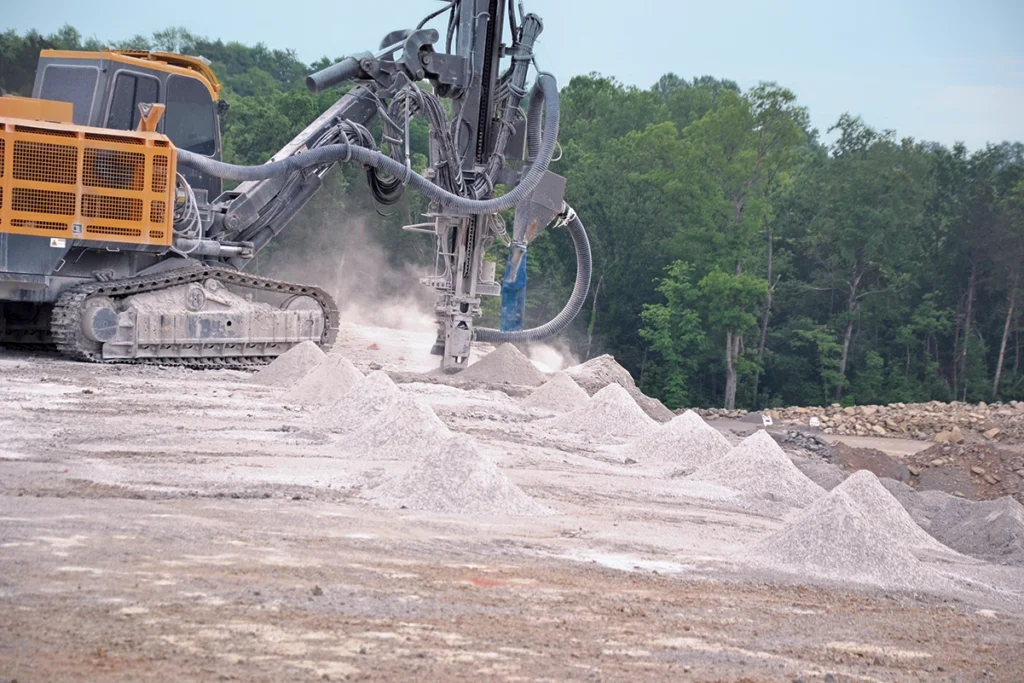
While often less discussed than vibration or flyrock, dust and post-blast fumes are two of the most visible consequences of blasting and must be actively assessed for both public perception and operational safety.
The primary source of airborne dust for the public is the blast event itself. The energy released during detonation propels fine particles into the atmosphere, creating a highly visible cloud that may linger or travel depending on weather conditions.
Unlike other environmental impacts, there are few effective means of suppressing this dust during the event. For this reason, it is essential to evaluate wind direction, speed and atmospheric stability prior to firing.
Blasts should never be initiated when wind is blowing toward sensitive receptors such as homes, schools or public roads – especially during dry weather conditions. While dust may not present a health hazard in typical open-pit aggregate settings, its visual presence alone can generate complaints or negative public perception if not accounted for.
Post-blast fumes, typically reddish-brown NOx gases, are a separate concern. These are produced when detonation is incomplete, often due to underloading, wet conditions or poor column integrity. In well-designed blasts with quality explosives, fumes are rarely a significant issue in open-pit aggregate operations. However, they must still be monitored and watched.
Operators must visually assess the movement and dispersion of the fume cloud after every shot. If fumes appear to be traveling off-site or toward nearby homes, immediate calls should be made to notify affected neighbors and reassure them that the situation is being observed and managed.
Public communication and complaint management
Effective public communication is one of the most important tools a blasting program can have – especially when operating near residential or developed areas.
While technical compliance with vibration or airblast limits may satisfy regulatory agencies, it does not guarantee public acceptance. What builds long-term trust is transparency, responsiveness and consistent communication.
Every operation near the public should offer proactive blast notifications to neighboring properties. Giving residents the option to receive a phone call prior to each blast allows them to prepare, reduce surprise and foster a sense of consideration.
Just as important, every neighbor should have a direct contact number to reach the mine or blasting supervisor. This single step can deescalate most concerns before they grow into formal complaints.
&uuid=(email))
When complaints do arise, response speed is critical. The most effective way to mitigate tension is to respond within minutes – not hours or days. This means having someone available to listen, document and investigate every concern. Even if no technical issue is present, a timely and professional response builds credibility.
Operators must also be equipped with the tools to verify performance:
- Proper seismograph placement at critical structures
- Third-party vibration consultants to validate and interpret data
- Pre-blast and post-blast inspections when concerns arise or new construction appears nearby
These practices demonstrate good faith and give operators the ability to defend their blasting program with data – not opinions. Public perception is shaped not just by what happens during the blast, but by how the operation handles the aftermath.
When the public sees that complaints are taken seriously, measurements are being made and operators are willing to inspect and explain their work, resistance fades.
Sustainable blasting practices
Sustainability in blasting is not about reducing energy for its own sake, it is about applying energy efficiently, with precision and only where needed.
In construction aggregates, sustainable blasting aligns with the broader goals of minimizing environmental impact, reducing waste and improving downstream efficiency.
The most effective sustainable practice is getting the blast right the first time. A poorly executed blast leads to increased equipment wear, excess fuel consumption in excavation, additional processing time and rework – all of which compound environmental impact. Good blast design minimizes oversize, reduces fines generation and improves crusher throughput, which, in turn, lowers the site’s overall energy use.
From a product standpoint, the use of modern emulsions and blend technologies enables more accurate energy distribution, better confinement and less overbreak. Some manufacturers have also developed low-fume and reduced-nitrogen explosives, helping to decrease NOx emissions and environmental residue in sensitive areas.
New technologies – including drone-based 3D modeling, electronic detonators and digital blast simulation – also contribute to sustainability. These tools allow engineers to tailor energy to geology, reduce overloading and minimize air overpressure and flyrock. Fewer surprises mean fewer corrections, fewer complaints and more consistent performance.
Sustainable blasting is also about community integration. When operations proactively manage dust, vibration and noise, they preserve their social license to operate and reduce costly disruptions caused by public opposition.
Blasting can never be zero impact, but with disciplined design, controlled execution and modern tools, its footprint can be reduced without compromising performance.
FULL HANDBOOK
Chapter 1: Industry Overview
Chapter 2: Geology & Site Selection
Chapter 3: Drilling & Blasting
Chapter 4: Excavating & Loading
Chapter 5: Hauling
Chapter 6: Crushing & Hydraulic Breaking
Chapter 7: Screening
Chapter 8: Washing & Classifying
Chapter 9: Conveying & Material Handling
Chapter 10: Loadout & Weighing
Chapter 11: Safety & Health
Use the page numbers to continue reading, or select a section / chapter above.