

FULL HANDBOOK
Chapter 1: Industry Overview
Chapter 2: Geology & Site Selection
Chapter 3: Drilling & Blasting
Chapter 4: Excavating & Loading
Chapter 5: Hauling
Chapter 6: Crushing & Hydraulic Breaking
Chapter 7: Screening
Chapter 8: Washing & Classifying
Chapter 9: Conveying & Material Handling
Chapter 10: Loadout & Weighing
Chapter 11: Safety & Health
Blast Design
Blasting is not a one-size-fits-all process.
While early approaches relied on fixed “recipes” – treating burden, spacing, timing and powder factor as independent, repeatable inputs – modern blasting demands a multivariate, performance-driven design.
Today’s blasting programs must be tailored to site-specific conditions and optimized to meet defined objectives across the entire mine-to-mill sequence. This includes fragmentation, muckpile shape, diggability, crusher throughput, safety and environmental control.
A properly designed blast is not just about breaking rock; it is about matching explosive energy to geologic conditions and downstream performance needs. The operator must consider not only production goals, but geological structure, bench geometry, equipment limitations, regulatory vibration limits and material specification targets. Balancing these sometimes-competing constraints requires an understanding of both the site and the mechanisms by which rock is actually broken.
All fragmentation mechanisms in blasting originate from gas pressurization of the borehole – not from shock. The longstanding theory of shock-induced breakage has been thoroughly debunked in modern research and field data. Instead, two primary breakage modes govern how a blast performs: radial fracturing and flexural failure.
Radial fracturing is the first mechanism to occur. As the detonation gases pressurize the borehole, a hoop stress field forms around it. This generates radial fractures – parallel to the borehole – which extend outward in all directions.
These fractures concentrate toward the free face when proper burden is maintained. When burden is too large or irregular, the fractures extend in a more uniform, 360-degree arc, wasting energy and decreasing fragmentation control. The burden essentially determines whether this fracture field is channeled (productive) or dispersed (inefficient).
&uuid=(email))
Once the radial fractures reach and begin to open at the free face, flexural failure begins. This is a slower process. As gas moves through the newly formed fracture network, it pushes outward and upward. When it reaches about two-thirds of the burden distance, the energy begins to bend the rock mass, creating horizontal tension fractures.
These flexural breaks form perpendicular to the face and result in blocks being pushed forward, creating the heave and final muckpile geometry.
Both mechanisms, radial fracturing and flexural failure, are entirely dependent on gas pressure, confinement and burden control. Each design choice made by the engineer or blaster influences how these fracture modes initiate, propagate and interact.
Burden design
Burden is the first and most critical control variable in any blast. It defines the distance from the blasthole to the free face and serves as the primary constraint for both energy confinement and fragmentation control.
If burden is incorrectly designed – either too large or too small – the entire blast will suffer, often irreparably. It is the starting point for every blast design and should be the first parameter verified when problems arise in the field.
Burden determines how the radial fractures propagate from the borehole and how gas energy interacts with the rock mass. A useful analogy is a copper pipe filled with water. As the water freezes, it expands and creates hoop stress that fractures the pipe. In blasting, the explosive pressurizes the borehole in a similar way, creating hoop stress that fractures the rock outward. The “thickness” of that copper pipe is equivalent to the burden; the thinner it is, the easier it breaks.
However, blasting isn’t governed by radial fracturing alone. Flexural failure also occurs as gas flows through the fracture network, pushing the rock mass forward. If the burden is too small, this flexural action can result in violent heave and dangerous flyrock. If too large, it causes poor fragmentation and high toes. Smaller burdens increase fragmentation and improve muckpile distribution, but they also raise cost and risk.
Burden must be matched not just to hole diameter and rock type, but to bench height, face geometry and desired performance. Using the same burden across varying bench heights – even in the same rock – ignores key geometric differences that affect how energy behaves. A 4-in. hole in a 15-ft. bench cannot carry the same burden as in a 100-ft. bench.
In aggregate operations, slightly reduced burdens often result in better fragmentation and plant performance – even at marginally higher cost. Rather than designing to maximize spacing or reduce powder use, burden should always be chosen based on outcome. In most operations with persistent blast issues, burden is the first – and often best – place to start corrective action.
Stemming design
Stemming is one of the most important yet misunderstood variables in blast design, yet it is simple in application with the process of stemming a blasthole simply being putting inert materials – normally gravels – on the top of a blasthole, above the explosive.
It is one of the only parameters that directly improves explosive efficiency. The purpose of stemming is to retain borehole pressure long enough for both radial fracturing and flexural failure to occur fully and effectively. If stemming fails prematurely, energy is lost, breakage is incomplete and blast performance is compromised.
The goal of all stemming design is retention time, how long the stemming can hold back the detonation gases before it is ejected. If the stemming blows out during the radial fracturing phase, the hoop stress field around the borehole collapses early, and the fractures fail to reach the free face. If it fails during flexural failure, gas escapes before full heave and horizontal fracturing can develop. In both cases, fragmentation suffers and the muckpile is degraded.
Stemming design is governed by burden – not hole diameter. While hole diameter may influence the size of stemming material used, it does not determine how much stemming should be placed.
Burden dictates the confinement needed to hold gas pressure, as the burden dictates the retention time for the fracturing process to be completed. The smaller the burden, the faster the radial fracturing and flexural failure process occurs, requiring less retention time.
This means that stiffness ratio also affects the stemming design, as short benches have more resistance to movement and require additional retention times. Excessive stemming reduces column length, decreasing available energy and degrading performance. The best stemming design uses just enough material to contain the gases through both breakage phases; no more, no less.
In aggregate operations, stemming is typically made of clean, crushed stone. For most bench applications, 3/8-in. to 1/2-in. clean rock provides optimal interlock and friction. For large diameter holes over 7 to 8 in., 3/4-in. clean stone may be used. The material must be dry, angular and free-draining – not rounded or moist fines.
PRO TIP
Check stemming quality every shot: Poor stemming lets gas escape early, wasting energy and hurting fragmentation.
Ultimately, stemming is not just a safety measure; it is a performance tool that directly impacts explosive efficiency. It must be designed as a retention system, not a volume filler. Engineers should adjust stemming height based on burden, stiffness ratio, face conditions and any weak geologic zones near the collar. Proper stemming ensures that the energy invested in the blast is not lost up the borehole, but driven into the rock where it belongs.
Subdrill design
Subdrill is the process of drilling and loading explosive below the final grade elevation to bring the maximum tension zone of the blast down to floor level.
Along with stemming, it is one of only two variables that directly influence explosive efficiency. Where stemming controls energy retention, subdrill controls breakage location and floor control by shifting the tension zone deeper into the rock mass.
In a typical blast without subdrill, the maximum tensile zone occurs about half a burden above the floor, which often results in poor fragmentation at grade, uneven floors and increased equipment wear. Proper subdrill shifts that tension zone downward, improving breakage at the bottom of the blast and delivering a cleaner, more level working floor.
Although flexural failure does not propagate below grade, the subdrill area is still affected by radial fracturing, which weakens the rock in a 360-degree pattern around the borehole. While this doesn’t produce full fragmentation, it assists in loosening material at grade and improving shovel and loader performance.
However, subdrill must be optimized and not overused. Excessive subdrill does not improve floor control. It simply adds cost and additional radial cracking where it may not be needed.
In some cases, such as when a hard bedding plane or mud seam lies exactly at grade, subdrill may provide little or no benefit. Still, in most quarry environments, some amount of subdrill is essential to ensure clean floors, maintain equipment efficiency and control grade elevation.
Powder factor
Powder factor has long been misunderstood in blasting.
Originally introduced in the 1600s, it was one of the first attempts to quantify explosive use during the early evolution of blasting technology. By the 1700s, the concept was largely abandoned due to its lack of practical utility. It reemerged in the early 1900s – not as a design tool, but as a cost-tracking metric – a way for operations to evaluate how much explosive was used relative to rock broken.
Later, as shock breakage theories gained traction, powder factor was mistakenly promoted as a design parameter. If rock could be broken by shock alone, then theoretically, more shock (i.e., more explosive) should equal better fragmentation.
Today, we know this is false. Modern understanding confirms that gas pressure, confinement and timing – not shock – are responsible for effective breakage. As a result, powder factor is a poor design tool and has not been used in the last 15 to 20 years by modern engineers.
Powder factor design involves choosing a target (i.e., 1.1 lbs./cu. yd.) and then manipulating burden and spacing to hit that number – regardless of geology, bench geometry or performance requirements. This is backward thinking, as it results in poorly performing blasts that only meet arbitrary numerical targets.
The only valid use of powder factor today is as an economic tool, helping operations track explosive efficiency after a blast is complete. A blast with 0.8 lbs./cu. yd. may outperform one with 1.2 when it’s properly engineered. Design must drive powder factor – not the other way around.
Spacing design
Spacing design determines how blastholes interact laterally – how they share energy and create inter-hole breakage.
While burden controls energy movement toward the free face, spacing governs how well the rock fractures between holes. Incorrect spacing leads to uneven fragmentation, oversize and erratic muckpile shape. It is a critical design variable, and it must be adjusted in response to several other factors, starting with stiffness ratio.
&uuid=(email))
Stiffness ratio is defined as bench height divided by burden. In aggregate blasting, an effective stiffness ratio typically falls between 3.0 and 5.0, with an ideal target around 4.0. This ratio directly influences spacing because taller benches (higher stiffness ratios) allow for greater spacing between holes without sacrificing breakage.
Conversely, short benches with the same burden require tighter spacing to maintain inter-hole interaction. This adjustment generally stops being beneficial beyond a stiffness ratio of 4. Beyond that point, additional spacing gains are minimal while cost are typically higher than with a larger hole for reduced stiffness ratio.
Hole-to-hole timing also plays a key role in spacing design. Faster hole-to-hole timing allows for slightly wider spacing, as the holes interact more dynamically and create better lateral energy overlap. Longer delays reduce that interaction window, requiring tighter spacing to avoid dead zones or oversize pockets between holes. Therefore, spacing cannot be designed in isolation; it must be balanced with the timing strategy.
Other influencing factors include:
- Burden (which defines energy direction)
- Explosive type and density
- Stemming and subdrill design
- Desired fragmentation and muckpile outcome
If spacing is too wide, radial fractures from adjacent holes do not meet, leading to oversize and poor breakage between holes. If spacing is too tight, the holes may act as one, producing excessive fines between holes and pushing the burden forward without breaking it, leading to oversize at the face and fines at the row center.
Spacing must be tuned to ensure each hole breaks rock uniformly across its influence zone. Muckpile shape, throw and diggability are all affected by lateral spacing. Poor spacing design creates localized inconsistencies such as tight pockets of fines, random oversize or uneven heave – all of which reduce downstream efficiency.
Proper spacing design doesn’t just fill a pattern; it connects every hole into a functioning system.
Hole-to-hole timing
Hole-to-hole timing determines how energy is released along each row of a blast.
There are two fundamental approaches: firing all holes simultaneously or delaying each hole individually.
While simultaneous firing – either full-row or by panels – was once common, most modern blasts use delayed hole-to-hole timing. This shift is largely driven by the need to control air overpressure and ground vibration – both of which decrease with staggered initiation.
Still, in remote or vibration-tolerant sites, simultaneous firing can offer advantages, including wider spacing and reduced costs, albeit at the tradeoff of slightly coarser fragmentation.
When using delayed firing, timing must be carefully tuned to the geology and pattern geometry. The optimal hole-to-hole delay varies based on rock type, structure, spacing and burden. Too fast a delay reduces fragmentation in the blast. Too slow a delay causes each hole to act independently, reducing the interaction between holes and increasing the likelihood of oversize between holes.
Properly tuned hole-to-hole timing promotes better fragmentation, improves heave and creates more uniform muckpiles. In fact, small adjustments to intra-row delay can triple fragmentation performance, while excessive delays result in diminished returns.
Because timing and spacing are so closely linked, these variables are often adjusted iteratively. A wider spacing may require faster timing; a tighter spacing can tolerate slightly slower delays.
Ultimately, hole-to-hole timing is a key tool in balancing explosive interaction and control. Each row must be timed to match the rock’s ability to respond to energy, neither too fast to risk cutoffs nor too slow to lose synergy.
Row-to-row timing
Row-to-row timing is the primary control for burden relief across the entire blast.
It ensures that each hole has a valid free face when it fires. If this timing is wrong, no other design variable can compensate. In essence, row-to-row timing determines whether each hole is breaking against rock, or against open space.
The simplest way to understand this is to consider two blasts fired a week apart. The final row of one becomes the free face for the first row of the next. That works fine, as there’s nothing inherently wrong with long row-to-row timing. In fact, slower row delays allow time for the burden to clear, which reduces confinement and improves fragmentation, heave and safety.
Historically, row-to-row timing was constrained by older electric systems that required full pattern activation with limited delay options. This forced contractors to shoot quickly between rows, leading to designs with insufficient burden relief.
Unfortunately, that mindset still persists in some operations. Today, with electronic detonators, we can select accurate, longer delays that are better aligned with rock movement and structural conditions.
Signs of too-fast row-to-row timing include:
- Good movement and fragmentation in the first row, followed by stacked, poorly fragmented rows behind it
- Violent vertical cratering in the back of the shot while the front moves smoothly forward
These are indicators that later rows were over-confined and fired before the burden in front had moved sufficiently.
While concerns about cutoffs or column shifts with long delays are often raised, they’re rarely valid in well-designed blasts. Column shift can occur, but typically only in badly structured rock, in voided zones, or when burden is already poorly controlled.
In high-structure or void-heavy geology, fewer rows with more holes per row may be preferable. But in most cases, modern row-to-row timing should be longer – not shorter – than legacy designs.
With the precision of electronic systems, row timing is no longer about detonation limits; it’s about engineering burden relief for optimal performance.
Safety & Regulations
Blasting is one of the highest-risk activities in any quarry operation.
Unlike other production processes, a single lapse in attention, communication or execution can result in injury, structural damage or regulatory shutdown. Safety in drilling and blasting is not just about compliance; it is about building a system where failure is not tolerated and risk is actively engineered out of the process.
Too often, safety is treated as a checklist. While regulatory compliance is necessary, it is the bare minimum standard. A truly safe blasting program is built on a foundation of understanding how energy moves, how materials behave and how people interact with both. When that understanding is missing, even a compliant program can produce dangerous outcomes.
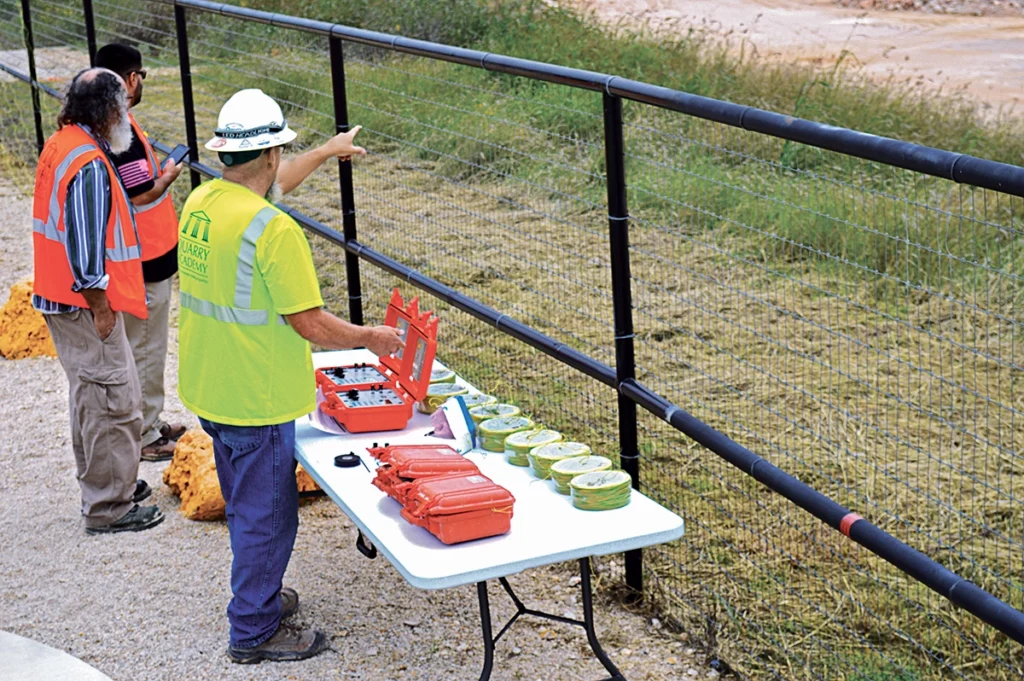
This section outlines the critical safety principles in drilling and blasting, from storage and handling of explosives to personnel training and site security. It also reviews the regulatory requirements that govern these activities, including the Mine Safety & Health Administration (MSHA) and Bureau of Alcohol, Tobacco, Firearms & Explosives (ATF) standards. But more importantly, it emphasizes why these rules exist and how good operations move beyond them.
Blasting safety is not just about avoiding accidents. It’s about designing, training and operating in a way that prevents them from ever becoming possible.
Explosive storage, transport and handling
Explosives are highly regulated for a reason – they pose inherent risks if mishandled, misused or unsecured.
In aggregate operations, compliance with ATF and Department of Transportation (DOT) regulations is mandatory, but effective management requires more than just meeting the legal minimums. A well-run operation treats explosives as controlled materials at every stage: storage, transport, handling and inventory.
Storage: ATF magazine regulations
Explosive materials must be stored in ATF-approved Type 1 or Type 2 magazines, depending on the classification.
These magazines must meet specific criteria for construction, locking mechanisms, weather resistance and fire safety, and they must be located at proper separation distances from occupied buildings, highways and other magazines, known as the Quantity-Distance table.
Magazines must be:
- Constructed of non-sparking, theft-resistant materials
- Clearly marked with “EXPLOSIVES – KEEP OUT”
- Locked with two padlocks (or one high-security hasp and lock)
- Inspected daily (when unattended) and recorded in a log
- Maintained free of combustibles and water intrusion
Temporary jobsite magazines (i.e., Type 3 “day boxes”) may be used for active operations but must also comply with storage separation and locking rules. All explosive products, boosters, detonators, bulk agents and accessories must be stored separately by compatibility group to avoid triggering cascading detonation scenarios.
Transport: DOT hazardous materials regulations
Transport of explosives falls under 49 CFR, the federal regulations enforced by the DOT and the Pipeline & Hazardous Materials Safety Administration. All transport vehicles must be:
- Placarded according to UN/ID classification codes
- Operated by CDL drivers with a HazMat endorsement
- Equipped with spill kits, fire extinguishers and shipping papers
- Properly segregated by material class (i.e., detonators must not be transported with bulk explosives unless using approved containers)
Daily pre-transport inspections must include checking locks, seals, signage and paperwork. Vehicles carrying explosive materials may not be left unattended, and drivers must be trained in HazMat response protocols. State and local regulations may impose additional routing or timing restrictions, particularly near sensitive areas.
Handling and on-site control
Explosives handling requires discipline and clear protocols. No material should be issued, staged or loaded unless a licensed blaster is present. Only authorized personnel should be allowed within the blasting area, and a clearly defined exclusion zone must be established and enforced during loading and firing activities.
SAFETY TIP
Ground equipment during loading: Static discharge is a common but preventable ignition source.
Standard safety practices include:
- Grounding all vehicles and equipment during loading to prevent static discharge
- Using non-sparking tools when opening or adjusting packaging
- Keeping detonators and boosters separated until immediately before loading
- Never cutting, deforming or altering commercial explosives
- Removing unused materials promptly and returning them to secured storage
SAFETY TIP
Handle unused product promptly: Return leftover explosives to secure storage — don’t leave them at the bench.
Inventory and recordkeeping
The ATF requires all explosive users to maintain accurate inventory records. This includes:
- Acquisition logs (date, quantity, supplier)
- Usage logs (date, amount, location and blaster responsible)
- Magazine inventory reconciliations (daily/weekly)
- Theft/loss reporting within 24 hours
SAFETY TIP
Inspect magazines daily: ATF rules require logs and checks to prevent theft, intrusion or water damage.
Most violations in ATF audits stem not from misuse, but from incomplete or inaccurate records. Sites should use standardized logbooks or electronic tracking systems to reconcile what was ordered, what was used and what remains. Discrepancies must be investigated and resolved immediately.
Drilling and blasting safety
Blasting work carries a unique set of risks that must be managed through both procedural discipline and design integrity.
While proper storage and transport control explosive risk off the bench, the bench itself presents the most immediate hazards to personnel, equipment and surrounding infrastructure. These risks arise during drilling, loading and firing, and failure to manage them can result in injury, equipment damage, misfires or flyrock events.
Flyrock
Flyrock is one of the most dangerous and visible hazards in blasting.
It occurs when rock is ejected beyond the blast perimeter, often due to inadequate burden, improper timing or structural weakness. It can also be caused by loading too close to open voids, insufficient stemming or poor drilling practices that leave a hole too close to the face.
Flyrock can travel hundreds, or even thousands, of feet. It presents not only a risk to personnel but to nearby structures, power lines and public roads.
Flyrock is also the most likely cause of regulatory violations or community complaints. Controlling flyrock requires proper burden design, stemming, timing and the identification of geologic features like seams or caves that reduce confinement.
Misfires
Misfires present both a safety and operational hazard. Causes include:
- Faulty initiation systems (damaged shock tube, broken leg wires)
- Poor primer coupling
- Slumped or bridged explosives
- Water degradation in ANFO
- Cutoffs from fast timing or structural shift
Misfires must be treated with zero tolerance. Unexploded material poses a latent risk for secondary detonation during mucking, excavation or future blasting. Sites must have formal misfire protocols, including how to identify, mark and report them; who is authorized to investigate or reinitiate; and what equipment restrictions are in place near suspect holes.
Drilling hazards
Drilling operations carry their own risks:
- Highwall stability is a constant concern. Working too close to the edge can lead to equipment rollover or rockfall.
- Hole deviation not only affects blast performance but can result in loading a hole that intersects another – increasing the risk of unintended detonation paths.
- Penetrating voids or water zones without logging them introduces major hazards if those holes are loaded without correction.
- Dust exposure, especially from dry drilling without effective suppression, poses long-term respiratory risks.
- Operators must ensure that all drillers are trained to recognize unsafe conditions, stop work when needed and properly log ground conditions. Daily inspections of highwall integrity and windrow edge stability are mandatory.
Initiation system hazards
Each initiation method brings different risks:
- Electric detonators are susceptible to stray current and must be tested and shunted at all times.
- Shock tube systems can be damaged during stemming or equipment movement, leading to partial detonation.
- Electronic systems are highly reliable but must be properly programmed and tested before use.
Only authorized personnel should handle initiation systems, and all circuits should be verified with appropriate testing equipment before connection to any firing source.
Lightning
Lightning is one of the most underestimated hazards in blasting operations, and it poses a lethal threat to both personnel and stored or loaded explosives.
All commercial explosives, including non-electric, electric and electronic detonators, are susceptible to detonation from a lightning strike. No initiation system is immune.
The risk is not limited to direct strikes. Lightning-induced electromagnetic fields and ground currents can travel hundreds of feet and discharge into a loaded pattern, into wiring – or even into a magazine or day box, causing a premature and uncontrolled detonation. In high-energy weather systems, the ground itself can carry lethal current.
Non-electric systems, while more resistant to stray current than electric caps, still contain metal components and reactive powders that can be affected by indirect energy. Electronic detonators, though robust in circuitry, are also vulnerable. If any part of the system, wiring, leads or detonator body is exposed or connected during a lightning event, detonation risk is real and immediate.
As a result, best practice is nonnegotiable: all blasting operations must be suspended at the first sign of lightning within seven to 10 miles. This includes not only delaying initiation but clearing all personnel from the blast area – including drillers, loaders and guards. The entire pattern must be treated as if it could detonate at any moment, regardless of the explosives or detonators being used.
Operations should maintain a weather monitoring system, whether radar-based, lightning detection tools or reliable field observation. Lightning can travel ahead of storms or strike in otherwise clear conditions.
Once lightning is within the exclusion zone:
- Stop all loading and hook-up work immediately
- Evacuate the blast area to a predesignated safe zone
- Secure the site from unauthorized access
- Treat the loaded pattern as live and guarded – until the threat has passed
Resuming work must only occur when lightning has fully cleared the area and no activity has been detected within a minimum 30-minute window from the last visible strike or detection event.
Site security
No blast can be considered safe unless the area is secure and the personnel are trained to execute it.
This is not just about guarding the shot; it’s about controlling every point of contact with explosive materials and ensuring every person on site understands their role in preventing accidents. Site security protocols must include:
- A clearly defined blast exclusion zone
- A single point of access controlled by designated guards or supervisors
- Communication procedures (radio, horn or warning system) to clear the area
- Perimeter checks before and after loading
- A lockdown protocol once the pattern is ready for initiation
Unauthorized access by contractors, vendors or even distracted equipment operators poses a direct safety risk. The exclusion zone must be treated as hot once loading begins, and no one without explicit clearance should reenter until the shot is fired and the area is reinspected.
Personnel training must cover:
- Hazard recognition (flyrock zones, misfires, loose ground)
- Safe handling of explosives and detonators
- Initiation system identification and procedures
- Misfire identification and response
- Lightning and weather-related evacuation procedures
- Drilling hazards and blast area protocols
All training must be documented – including initial training, task training and annual refreshers. This is not just for compliance; it’s for protection.
In the event of an incident, your training records will be the first documents reviewed by MSHA, the ATF and internal investigators.
Blast reports
A well-maintained blast report is more than a regulatory requirement. It is the operational record that validates the design, execution and performance of every shot.
The true value of a blast report is its use as a technical audit and performance benchmark, along with a tool for investigation of a blast’s performance after the blast. At minimum, each report should include:
- Date and time of blast
- Blast location and bench details
- Blaster-in-charge and crew names
- Hole count, burden, spacing, depth and subdrill
- Type and quantity of explosives used
- Initiation system and delay sequence
- Weather conditions, including wind direction and temperature
- Vibration or airblast monitoring data (if applicable)
- Notes on flyrock, misfires or other anomalies
The report should also include a sketch or digital plan of the blast layout, showing rows, holes and timing if not stored separately. Many operations use digital logging systems tied to blast design software, but even handwritten reports are acceptable if complete and legible.
Blast reports serve three purposes:
- Compliance. Proves adherence to regulatory and site standards.
- Troubleshooting. Helps diagnose poor fragmentation, flyrock or vibration issues.
- Continuous improvement. Supports pattern refinement based on historical data.
Without consistent, accurate reporting, patterns can’t be evaluated and lessons can’t be applied. A good blast report closes the loop between design and outcome, and it becomes the foundation for better future performance.
FULL HANDBOOK
Chapter 1: Industry Overview
Chapter 2: Geology & Site Selection
Chapter 3: Drilling & Blasting
Chapter 4: Excavating & Loading
Chapter 5: Hauling
Chapter 6: Crushing & Hydraulic Breaking
Chapter 7: Screening
Chapter 8: Washing & Classifying
Chapter 9: Conveying & Material Handling
Chapter 10: Loadout & Weighing
Chapter 11: Safety & Health
Use the page numbers to continue reading, or select a section / chapter above.