

FULL HANDBOOK
Chapter 1: Industry Overview
Chapter 2: Geology & Site Selection
Chapter 3: Drilling & Blasting
Chapter 4: Excavating & Loading
Chapter 5: Hauling
Chapter 6: Crushing & Hydraulic Breaking
Chapter 7: Screening
Chapter 8: Washing & Classifying
Chapter 9: Conveying & Material Handling
Chapter 10: Loadout & Weighing
Chapter 11: Safety & Health
Geology & Rock Characteristics
Understanding geology is not optional in drilling and blasting, it is the foundation on which every design must be built. While rock type plays a role in overall blastability, the most critical factors affecting blast performance are the structural features within the rock mass: joints, bedding planes, faults, seams and other discontinuities. These dictate how energy moves, how rock fractures and ultimately how effective the blast will be.
In the construction aggregate industry, operators regularly work in limestone, sandstone, granite and basalt. Each presents its own set of challenges, but most can be effectively managed when their structural behavior is understood. The problem isn’t usually the lithology – it’s the geology. Poorly mapped or ignored structural features lead to backbreak, flyrock, oversize and inconsistent fragmentation, all of which degrade downstream performance.
Rock types
While rock type plays a role in blasting, it is often misunderstood or overstated in importance.
In the construction aggregate industry, the most common rock types encountered – limestone, sandstone, granite and basalt – each exhibit different behaviors during blasting, but none are inherently difficult to break when properly approached.
Granite is typically harder and more uniform, especially at depth. Despite its strength, granite often breaks cleanly and predictably due to its consistent structure. The real challenge in granite is the weathered cap at the top of the deposit, which can be highly fractured and difficult to manage, or the structures and intrusions in the deposit.
&uuid=(email))
Limestone, by contrast, is generally softer but far more variable. It often contains seams, karst features, voids and inclusions of varying strength, which reduce confinement and create uneven fragmentation.
Sandstone tends to behave similarly, with structural weaknesses and bedding planes causing delayed or irregular breakage.
Basalt can range from very blastable in its massive form to extremely difficult when columnar structures are present, where the rock resists breakage not because of its strength, but because of its structure.
One of the most persistent misconceptions in the industry is that harder rock requires more explosives. In reality, soft rock is often more difficult to blast due to misconceptions in the blast design and the generally high variability of its structure. Harder, more massive rocks – like competent granite – generally respond more efficiently to well-timed explosive energy. Softer, weathered or bedded formations often absorb and diffuse energy unevenly, requiring careful timing and pattern adjustment to achieve acceptable results.
Definition
Blastability: The ease of fragmenting a rock mass, governed more by structure (joints, voids, bedding) than rock type alone.
Blastability refers to the ease of fragmenting the rock mass, not just the intact material. True blastability cannot be assessed without considering structural conditions. Voids, joints and weathering have a much greater influence than compressive strength. The more massive and uniform the rock, the more predictable and effective the blast will be.
The idea that certain rock types must be matched with specific explosives – based on hardness, sonic velocity or so-called energy matching – is a relic of outdated sales literature. Modern practice shows that any commercial explosive can break any rock type. What matters is not the explosive; it is the blast design, the application of explosive energy, and an understanding of the structural properties of the rock mass. Blasters must adapt burden, spacing and timing to suit the rock mass.
Rock structure
In blasting, structure – not rock type – is the single-most important factor determining the success or failure of a shot.
While many operators focus on lithology, it is the presence, orientation and scale of structural features that most directly affect fragmentation, burden relief, explosive confinement, safety and muckpile consistency. Understanding the structural geology of a site is not optional; it is the foundational part of the rock mass to understand for the blasting process.
Definition
Drill Log: Record of subsurface conditions (seams, voids, penetration rate changes) made by the driller.
The blaster’s ability to read structure starts with one key input: the drill logs. Drillers are not just hole makers; they are the first line of geologic interpretation in the entire process. A competent driller must know how to translate what they feel – penetration rate changes, drill chatter, vibration and bit deflection – into an accurate picture of the subsurface.
They must recognize voids, seams and hardness changes as they drill. Drill logs are not paperwork; they are the blaster’s map and greatest tool for implementing a proper blast. Without them, a shot cannot be properly designed.
No cost savings from cheaper drilling justifies the risk of losing structural data. In most cases where blasts fail, through flyrock, poor fragmentation or high vibration, it is because structural features were either not logged or ignored.
Structural features can take many forms, but the most critical include:
Mud seams and voids. Often found in karstic limestones or weathered formations, these weak zones destabilize confinement, absorb explosive energy or act as conduits for unplanned detonation paths. Caves may link multiple holes or collapse during loading, increasing the risk of misfires or simultaneous firing.
Joints. These are natural fractures – vertical or inclined – that may be tight or open. Tight joints restrict energy flow but can redirect gas paths. Open joints may cause explosive slumping, premature detonation, connection of holes or excessive throw.
Bedding planes. These are typically horizontal or gently dipping planes of weakness formed during the deposition of sedimentary rock. Their influence on blasting depends heavily on their thickness, spacing and cohesion.
Blasts into or across bedding planes often result in uneven fragmentation or slabbing – especially when the energy travels along weak bedding layers. When beds are dipping toward the face or angled into the shot, they can promote sliding failures or sloughing, affecting highwall stability and post-blast muckpile shape. These planes can also redirect gas movement during detonation, increasing the risk of backbreak or inconsistent heave.
Faults and shear zones. These represent major mechanical discontinuities. These often generate unpredictable movement, gas venting or segmentation of the blast into non-interacting sections.
The distinction between tight and open joints is operationally critical. Tight joints may go undetected by drilling but still deflect energy. Open joints are more easily identified by the driller and should be addressed in the loading plan.
When not properly managed, these open features reduce confinement, direct explosive energy outward and significantly increase flyrock risk. Blasters must adjust loading in these areas, typically by inserting inert decking above, within and below the weak zone to contain the charge and control gas expansion. This may create a localized oversize region, but it preserves overall blast performance and dramatically reduces hazard.
These structural features directly affect burden relief. For example, a major vertical joint between two holes can interrupt radial cracking, creating isolated rock segments that resist breakage. This results in oversize along the face. In such cases, the solution may involve tighter burden spacing or reduced hole diameter to ensure energy is directed through each zone.
Conversely, a large open joint or void may create an artificial free face within the burden, leading to excessive throw or flyrock. Energy follows the path of least resistance – if that path is a cave or seam, the blast becomes unpredictable.
Structural features are also the most common cause of backbreak, where fractures run behind the last row and damage the highwall. In these cases, energy finds a weakness behind the blast; often a dipping seam, joint or gas-charged bedding plane and breaks backward. Properly identifying and isolating these features during design allows for control measures such as delay timing changes or loading adjustments to prevent this.
Every blaster must take responsibility for reading the face, interpreting the drill logs and adapting the shot design accordingly. It is unacceptable to rely solely on standard plans.
Designs must change based on real geologic conditions. This includes adjusting timing to control throw across a weak plane, reducing or increasing column loading, or shifting tie-ins to isolate problematic zones.
The interaction between timing and structure is especially important. Mistimed shots across joints or seams can create uncontrolled heave or directionality.
Ultimately, structural features must be identified through drilling, confirmed by visual inspection and factored into both design and execution. Operators who fail to enforce proper logging protocols – or who use drillers incapable of interpreting the ground – will face performance issues and safety risks that cannot be fixed downstream.
There is no substitute for structural awareness as in blasting. The rock mass determines the outcome, and the mass is defined not by what it’s made of, but by how it’s broken prior to the blast being detonated.
Bench design for geologic considerations
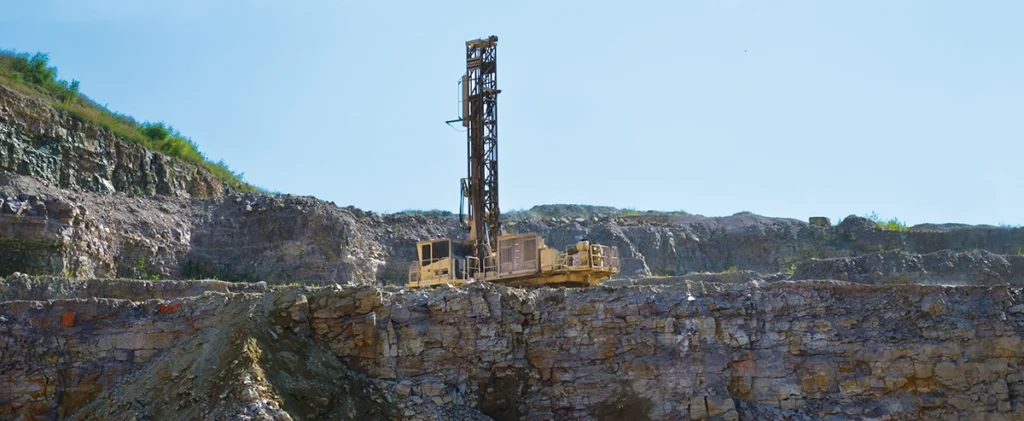
Bench design begins with understanding geology – not just what the mine is producing, but how the rock is structured and distributed across the deposit.
Every operation must first evaluate its current benching strategy against regional geologic variations to determine if the existing approach supports or hinders material control and blasting performance.
&uuid=(email))
In some operations, a known geologic boundary can be integrated into a single bench. For example, if a limestone deposit has a 5-ft. seam of chert above 50 ft. of clean limestone, the two may be blasted together by adjusting the stemming and timing. The chert can be kept relatively intact and fall to the back of the muckpile, while the limestone is projected forward.
This preserves the cleaner limestone for use in concrete aggregates and pushes the cherty material to a location where it can be blended for base or road gravel.
Still, when chert and limestone are interbedded through the upper 20 ft., followed by 30 ft. of chert-free, this level of control often isn’t possible and typically requires two separate benches to keep materials segregated.
Major structural features, such as thick mud seams or cave systems, also demand separate benches. A 5-ft. mud seam through the middle of a 40-ft. highwall may best be handled by splitting the bench, ensuring the seam lies at the top of the lower shot where its influence on burden and timing can be better managed.
The orientation of joints and bedding also plays a significant role. Mines should evaluate whether the direction of advance interacts favorably with the dominant structural planes. Adjusting the mining direction to intersect joint sets at an angle can reduce throw issues, high toes or face slabbing.
Where structural dip will dominate the final wall profile, angled or satellite holes may be required to control overbreak. In some cases, it may be better to design to the inevitable, matching blast profiles to geologic tendencies rather than fighting them every shot.
Although blast design elements like stiffness ratio and subdrill depth are essential, the geological context must always come first. Bench height and orientation should be driven by the deposit’s structure, not just production goals. Blasters cannot design effectively until the bench itself is built to respect the rock.
Integrating geology with the blast
Consistent blast performance is rarely limited by explosive selection. It is almost always the product of how well geology is understood and accounted for.
Variability in structure and rock type, when not recognized and adapted for, is the leading cause of inconsistent fragmentation, irregular muckpile shape and performance issues across the pit.
A successful blasting program begins with proper engineering and QA/QC: a sound general design, reliable product quality, accurate loading and confirmed hole positions. Once those are in place, the remaining variable and the one most often responsible for poor outcomes is the geology of the rock mass.
Structural features such as joints, bedding planes, seams and voids can either aid or obstruct fragmentation. In highly jointed or bedded rock, blasts may do little more than bump rock apart along preexisting weaknesses, limiting control and throw. Worse, these structures can interrupt radial cracking entirely, causing uneven breakage and leaving behind oversize.
In contrast, more massive deposits without structural barriers allow cleaner fracture propagation, enabling wider patterns and larger-diameter holes without compromising results.
These same geologic features directly influence muckpile shape. In structurally complex zones, the intended blast pattern geometry may be overridden by natural planes of weakness, resulting in uneven heave, thrown toes or stacked craters. Understanding this, and adapting to it is what separates skilled blasters from bench operators simply loading explosives to a fixed plan.
Structural weakness is also the leading geologic cause of lost explosive confinement. Gas leaks through seams and voids reduce local energy transmission, causing underbreak, while simultaneously projecting material farther than intended in the weakened zone. The result is a dual hazard: poor fragmentation in some areas and dangerous flyrock in others.
Explosive type plays a secondary role here. What matters most is hole condition and loading strategy. In highly weathered or jointed ground, borehole liners can help retain explosive energy, though they limit visibility into where explosive slump and venting occurs, making inert decking more difficult to target without great drill logs.
Ultimately, every good blast starts with good drilling and logging of the rock mass to understand the geologic conditions for the blast. Structural complexity isn’t a complication to be ignored; it is the first design variable a blaster must navigate. A good blaster must understand how to make necessary field modifications to overcome the structural geology on every blast, to produce the fragmentation and muckpile profile that the site requires.
FULL HANDBOOK
Chapter 1: Industry Overview
Chapter 2: Geology & Site Selection
Chapter 3: Drilling & Blasting
Chapter 4: Excavating & Loading
Chapter 5: Hauling
Chapter 6: Crushing & Hydraulic Breaking
Chapter 7: Screening
Chapter 8: Washing & Classifying
Chapter 9: Conveying & Material Handling
Chapter 10: Loadout & Weighing
Chapter 11: Safety & Health
Use the page numbers to continue reading, or select a section / chapter above.