
FULL HANDBOOK
Chapter 1: Industry Overview
Chapter 2: Geology & Site Selection
Chapter 3: Drilling & Blasting
Chapter 4: Excavating & Loading
Chapter 5: Hauling
Chapter 6: Crushing & Hydraulic Breaking
Chapter 7: Screening
Chapter 8: Washing & Classifying
Chapter 9: Conveying & Material Handling
Chapter 10: Loadout & Weighing
Chapter 11: Safety & Health
Stationary, Portable & Mobile
While crushing’s stages detail how material is reduced step by step, operators must also decide where and how stages are carried out.
Plant design is critical to overall efficiency. One key decision is whether to use a stationary crushing system or a portable one. For operators, the decision depends on factors such as flexibility, productivity, cost and their long-term goals.
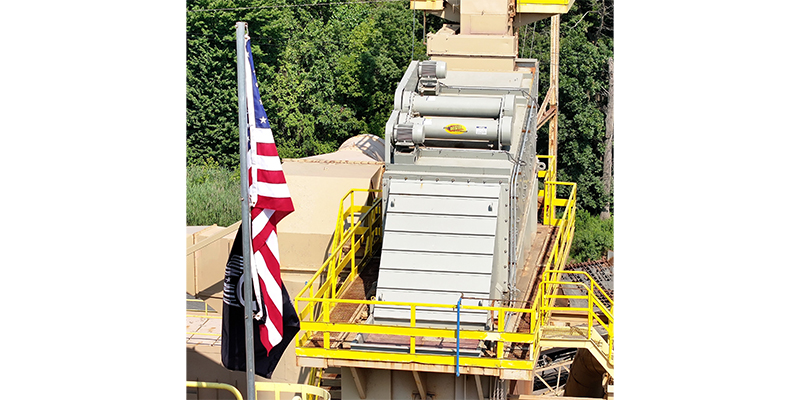
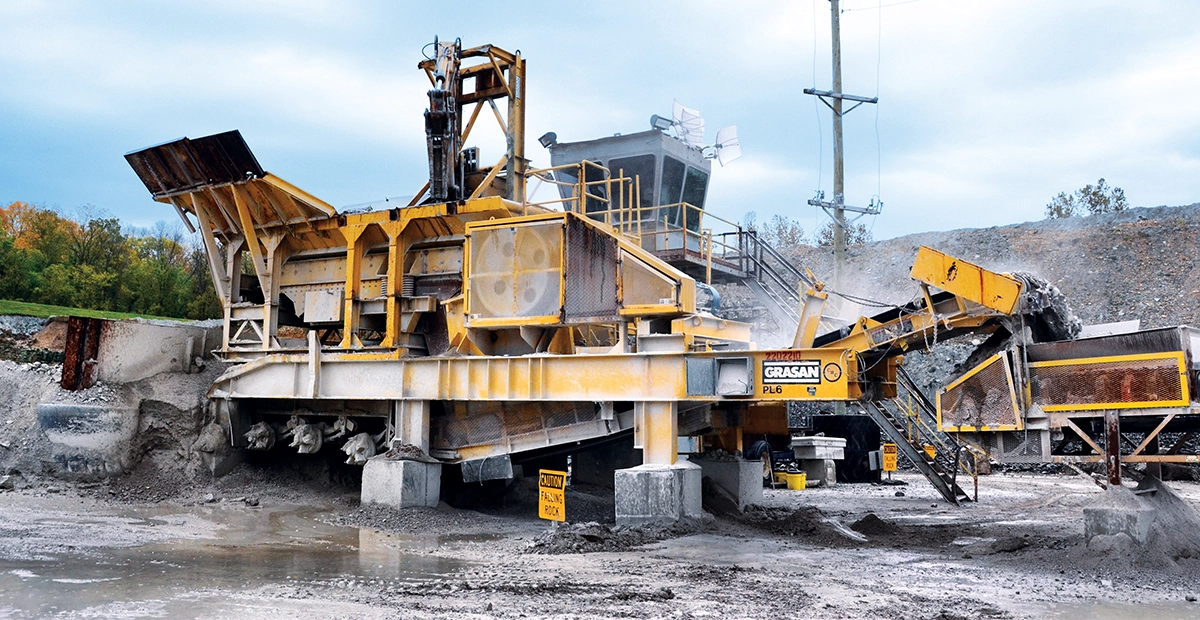
Stationary crushers, which are fixed in one location and integrated into permanent plant layouts, are ideal for high-volume, long-term operations with consistent feed material. Among their other advantages are:
- Higher capacity and throughput. They’re generally capable of handling larger volumes of material with less downtime.
- Durability. Stationary crushers are built to operate continuously in tough conditions with longer service intervals.
- Lower long-term operating costs. These are more energy-efficient and feature a lower wear part consumption due to consistent operation.
- Integration. Stationary crushers are easier to incorporate into comprehensive processing systems with breakers, feeders, screens and conveyors.
&uuid=(email))
Of course, stationary crushers have a downside. Among their disadvantages are a:
- High upfront investment. They require concrete pads, structural steel and potentially complex permitting.
- Lack of mobility. Once installed, relocation is difficult and costly.
- Longer lead times. Engineering, installation and startup take more time compared to portable setups.
- Potential increased reliance on haul trucks or conveyors. If the distance from the quarry face increases over time, material handling needs increase.
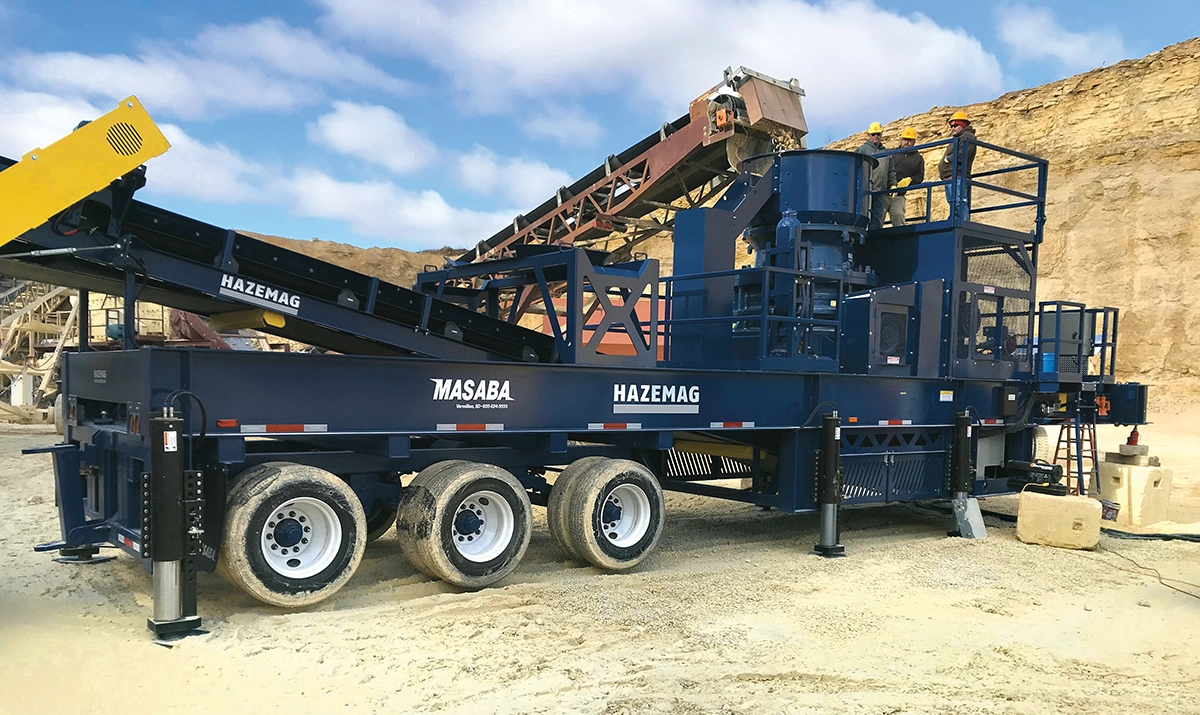
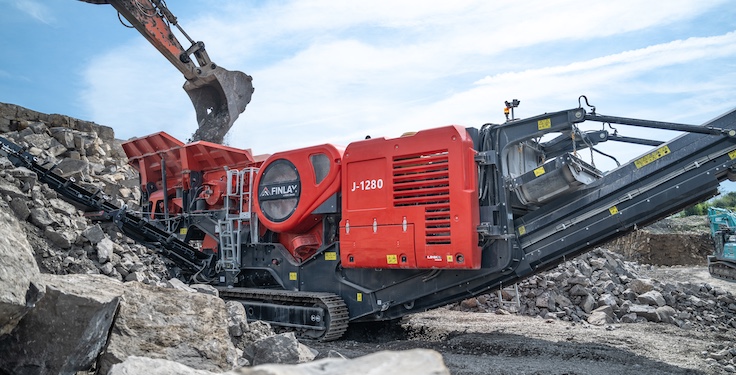
Wheel-mounted portable crushers or mobile tracked crushers, meanwhile, can be easily moved from site to site or around a jobsite. They are commonly used in temporary pits, remote locations or operations that frequently change sites.
Portable and mobile crushers offer several advantages, including:
- Mobility. They’re easily relocated to new pits or jobsites, reducing haul distances.
- Quick setup. Portable and mobile crushers are ideal for short-term or seasonal jobs where production needs are time limited.
- Lower initial infrastructure cost. Often, they don’t require concrete foundations or extensive permitting.
- Flexibility. Portable and mobile crushers can be configured into a mobile crushing flow with screens and conveyors for complete processing flexibility.
Still, portable and mobile crushers have several key disadvantages such as:
- Lower throughput. Large stationary equipment typically offers greater tons per hour.
- More wear and tear. Frequent relocation and road travel can take a toll on portable equipment.
- Higher operating costs per ton. This can happen if the unit is undersized or underpowered for the material.
- More frequent maintenance. Vibration and mobility-related stresses can lead to higher maintenance needs compared to stationary crushers.
Key considerations
- Longevity of operation. Portable and mobile crushers are better for short-term or temporary projects, while stationary crushers are better suited to long-term sites with consistent production needs.
- Production volume. High-tonnage operations typically require the durability and efficiency of stationary systems.
- Site layout and mobility. If the face of the quarry or pit moves frequently, portable or mobile equipment may be a better solution to reduce material handling and trucking needs.
- Cost and ROI. Portable and mobile crushers often have a lower initial investment but may incur greater cost per ton. Stationary crushers require more capital but can offer better long-term operational costs.
- Permitting and environmental impacts. While portable and mobile units may initially face fewer regulatory hurdles, stationary plants can be designed to provide more robust environmental controls.
Ultimately, the choice between stationary, portable and mobile crushers depends on an operation’s duration, scale, mobility needs and budget. Sometimes, producers can benefit from using a mix of both in different parts of the production process.
Crushing Automation
Automation is transforming the way aggregate producers operate crushing equipment, bringing new levels of safety, reliability and efficiency to quarries.
Whether it’s a stationary plant or portable circuit, modern crushers are now equipped with intelligent control systems that not only simplify operations but prevent costly breakdowns and maximize productivity.
Today’s automation platforms allow operators to start and stop equipment with a single touch on a screen – no manual sequencing required. These systems ensure motors and conveyors start and stop in the correct order, protecting the crusher from damage and keeping crews safe.
For example, a smart system will check the lubrication circuit for proper temperature and flow before allowing the crusher to engage. During shutdown, it will stop the feed first, then the crusher and, finally, purge the lubrication system to ensure all components come to rest safely.
Definition
Closed-side setting: The narrowest point between the mantle and concave (gyratory/cone) or jaws in a crusher, determining the final product size.
Advanced control platforms collect and display real-time data on everything from amperage draw to oil temperature and closed-side settings. This allows operators to monitor machine health continuously and respond quickly if operating conditions fall outside acceptable limits. Alerts for issues like excessive vibration, tramp metal or bowl float help crews take corrective action before damage occurs.
&uuid=(email))
One example is shutdown time tracking – from full rpm to a complete stop – which helps diagnose bushing wear. In older systems, such insights would have gone unnoticed until a failure occurred.
PRO TIP
Monitor shutdown times: Track how long it takes a crusher to coast to a stop. Changes in duration can indicate bearing or bushing wear.
Automation also enables on-the-fly setting adjustments, allowing operators to fine-tune performance based on changing material or production needs. Some systems include auto-feed functionality, which adjusts the belt speed to maintain optimal crusher cavity levels and motor load. This ensures consistent choke feeding and more uniform product gradation.
Definition
Choke feeding: Operating a crusher with a chamber kept full of material, ensuring consistent pressure, efficient reduction and cubical product shape.
In addition, newer platforms offer auto-wear compensation, which automatically adjusts the crusher’s settings as liners wear down, keeping production within spec and reducing the need for manual intervention.
While the word “automation” may sound intimidating, modern platforms are built to be user-friendly. Instead of complex wiring systems and steep learning curves, today’s controls often run on streamlined sensor networks with just a few standardized cables. Operators can perform diagnostics, check logs and even make adjustments while the crusher is running – without opening control boxes or interrupting production.
PRO TIP
Leverage automation alerts: Don’t ignore diagnostic alarms. Vibration, amperage and oil temperature warnings are early signs of trouble.
The next wave of crushing automation is already taking shape. Forward-looking systems are beginning to harness AI-powered algorithms that dynamically adjust crusher settings based on material properties and throughput demands. Virtual models of crushing systems are being tested to simulate performance, streamline maintenance and predict wear before it causes problems. As part of broader smart quarry initiatives, IoT-connected sensors are feeding data into platforms that offer remote monitoring, diagnostics and optimization.
And while today’s control systems are built for simplicity, the future promises even more intuitive dashboards, deeper integration with plant-wide systems and automation that not only reacts to change but anticipates it.
FULL HANDBOOK
Chapter 1: Industry Overview
Chapter 2: Geology & Site Selection
Chapter 3: Drilling & Blasting
Chapter 4: Excavating & Loading
Chapter 5: Hauling
Chapter 6: Crushing & Hydraulic Breaking
Chapter 7: Screening
Chapter 8: Washing & Classifying
Chapter 9: Conveying & Material Handling
Chapter 10: Loadout & Weighing
Chapter 11: Safety & Health
Use the page numbers to continue reading, or select a section / chapter above.