
Hoppers and silos may be engineered for a quarry’s conditions at the time of construction, but today’s production demands and shifting climates are pushing designs to their limits.
Even modest changes in moisture content can cause adhesion to hopper and silo walls. Low temperatures and changes in atmospheric pressure – especially when silos remain stagnant for long periods – can quickly alter material flow.
In the past, when material buildup became a recurring issue, processors often pushed through until the next scheduled shutdown. But waiting can cost hundreds of thousands of dollars per day in lost production.

Once coarse material adheres, the buildup is generally fast and dense – and eventually results in downtime to remove it. Seeking ways to address buildup quickly – without the proper tools or training – can also degrade workplace safety.
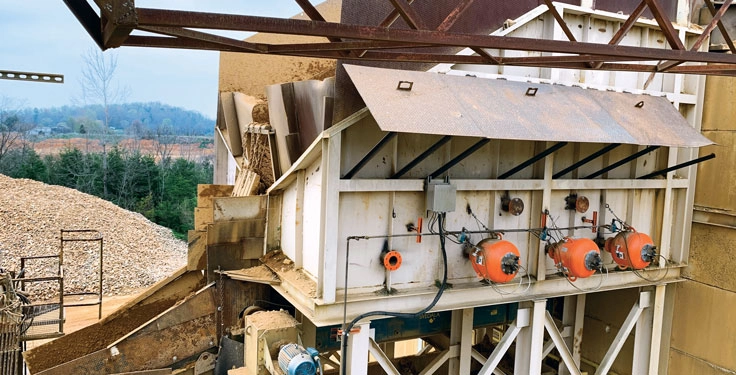
Today, operators have access to tools designed to clear blockages before they escalate, including air cannons that are engineered to safely clear and prevent clogging, promote material flow and help operators avoid costly downtime.
Before adopting any solution, a first step is to understand how, where, when and why clogs happen in any given silo. A second step is to eliminate worker involvement in clearing clogs, aside from pushing a button to activate a cannon when systems are not automated or software controlled.
Silo clogging and safety risks
Regardless of the cause, the types of clogs in a hopper can pose unique challenges for discharge and serious safety issues.
Several unsafe practices around silos too often result in serious worker injuries or fatalities – mainly sudden discharge of adhered material and entrapment. Poking or lancing from beneath a clog at the spout can result in a sudden surge of falling material, burying or crushing workers below and seriously damaging the receiving belt.
Beating vessel walls with mallets or other objects to loosen adhered material is a common practice. But operators who engage in this method find it worsens the situation over time, as the divots and ripples left from hammer strikes provide places for additional material accumulations to start.
If a worker enters a vessel and stands on the volatile bridge, a sudden discharge could pull the worker into the cavity. Sometimes, material buildup on the sides of the vessel reaches higher than the worker and falls from above, causing serious injury or burial.
Material behavior and silo flow
Silos are designed to hold a certain volume of a particular material, so awareness of maximum load is important.
Repeatedly filling and emptying silos makes load requirements especially important, because capacity is reached under many conditions. When working with bulk solids, environments with high moisture and freezing regularly experience clogging. Wide variations in the size and shape of the material can also affect flow, leading to buildup and clogs.
■ Arches. Arches form when material consistency changes during loading or the top material contains more moisture. Gravity alone can also trigger arching. Arches are very dangerous because material discharge has a long fall distance. The flat top surface can give workers a false sense of stable ground, so vessel entry is ill-advised. Air cannons placed at the upper point of where material begins to adhere keep material flowing toward the discharge spout.
■ Plugs. These are generally caused by compacted moist material or the contents that have been left for long periods. Strategically placed air cannons can help loosen material to get it flowing. Sometimes, the contents have hardened to such a degree that a silo cleaning service is needed, which utilizes the support of the air cannon system to resolve the issue faster, lowering the cost of the service.
■ Buildups. Several factors can cause these, including the weather, silo design, the way the silo is loaded, the horizontal grain of the metal on the side of the silo, the silica content of the material and other factors. Buildups can be cost-effectively mitigated using strategically placed air cannons at common collection points to keep material flowing toward the discharge spout.
■ Ratholes. These often form over time and reduce the capacity of the silo. Because material is flowing, ratholes are often ignored by operators, but they can severely impact production. The significant weight put on the thin walls of the silo and structural supports can pose a serious safety issue if buckling or a collapse occurs.
Breaking blockages
Low-pressure air cannon technology has advanced tremendously over the last half-century.
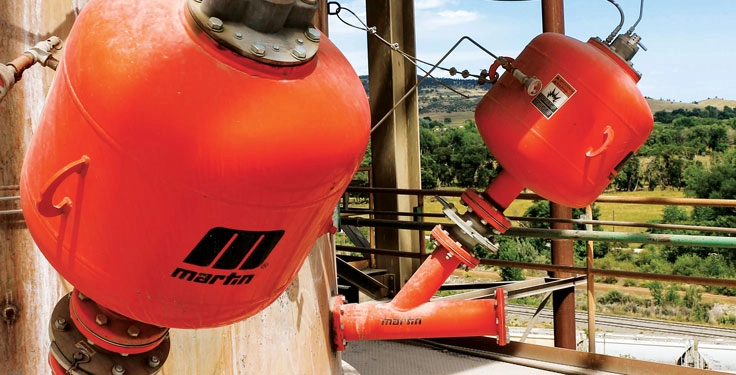
Air cannons use a plant’s compressed air system to deliver a powerful discharge to dislodge material buildup. Mounted on a pipe assembly, the basic components include an air reservoir, a fast-acting valve with a trigger mechanism and a nozzle to distribute the air in the desired pattern to effectively clear the accumulation.
Strategically positioned on the silo, when compressed air or another inert gas in the tank is suddenly released by the valve, it is directed through an engineered nozzle toward the specific or general location depending on the design of the nozzle. The air blasts help break down material accumulations and clear blocked pathways, allowing solids and gases to resume normal flow.
Often installed in a series and precisely sequenced for maximum effect, an air cannon network can be timed to best suit individual process conditions or material characteristics. Specific air blast characteristics can be achieved by manipulating the operating pressure, tank volume, valve design and nozzle shape to customize the air cannon installation to the service environment.
The valve in an air cannon is considered a wear part, but it is common practice to refurbish them rather than replace them with new ones. Because clearances and fits are critical to operation, valves should be rebuilt and repaired by the manufacturer – or specifically trained plant maintenance personnel.
Better flow, less downtime
Air cannons are not new, but the technology has progressed to the point that the footprint on the compressed air system of a plant is considerably lower.
Efficient silo flow is essential to plant production, so justifying the expense of installation and operation is typically straightforward once calculated against the cost of downtime and the importance of workplace safety.
Brad Pronschinske is global air cannon product manager at Martin Engineering.