
As we look to the year ahead, it’s worth taking an honest look at what the Mine Safety & Health Administration (MSHA) cites the most and what actually impacts the safety of our teams.
According to MSHA, its most frequently cited standard is the accumulation of inappropriate combustible material, with a recent 12-month datapoint revealing 3,412 citations. This area is an understandable enforcement target involving cluttered work areas – and it’s an easy one to spot during an inspection.
But here’s the truth: Combustible material citations rarely cost miners their limbs, careers or lives. Missing machine guards do. And missing machine guards were the second-most-cited infraction as of November 2025 at 2,897 citations.
Movement hazards
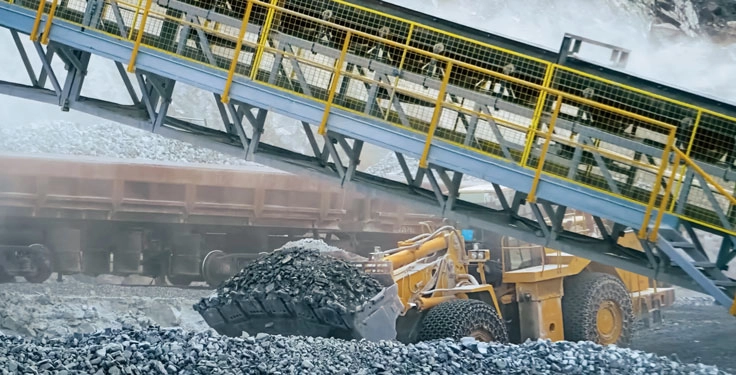
Moving machine parts (30 CFR 56.14107) violations have been issued for missing, damaged or bypassed guards around belts, pulleys, gears, flywheels, shafts, crushers and conveyors.

When a guard is missing, loose, cut away or not reinstalled following maintenance, we’re talking about amputations, entanglements, degloving injuries, crush points and fatal pulls into conveyors. These are the life-altering hazards we must focus on and ultimately eliminate.
MSHA’s fatality data from 2025 paints a consistent picture. Powered haulage events remain the No. 1 cause of fatal mine accidents, accounting for nearly half of the year’s deaths. Haul trucks over highwalls, equipment rollovers, collisions and visibility-related incidents dominated the fatality narrative.
Machine-guarding violations and powered-haulage fatalities stem from the same issue: our ongoing struggle to control hazardous motion – movement of belts, conveyors, trucks, material and machinery. If you want to understand where serious injuries originate, follow the movement.
Guarding pitfalls
Machine guarding issues aren’t usually born from neglect or indifference. They emerge for several reasons.
■ Guards are removed for maintenance and never reinstalled
■ Improvised “temporary” fixes become permanent
■ Worn guards get rattled loose and go unnoticed
■ Operators get comfortable around familiar equipment
■ A production focus can make “one quick adjustment” tempting
■ Legacy equipment often was not designed with the expectation of modern guarding
There’s also a cultural piece: guarding isn’t glamorous. Guarding doesn’t feel urgent – until it absolutely is.
Any organization can have a good machine-guarding policy, but actions are far more important than words. Here are five to consider in 2026 to strengthen your guarding performance:
1. Guarding must be verified – not assumed. Every time a piece of equipment is worked on, a supervisor or operator should verify the guard is reinstalled, secure and appropriate for the hazard.
2. Guarding should be designed for real humans. If a guard is difficult to remove, doesn’t fit right or interferes with work, it will be bypassed. Good guarding is practical, ergonomic and easy to maintain.
3. Treat guards as safety-critical components. If a machine won’t run without lubrication or a belt, it shouldn’t run without a guard, either. Build that nonnegotiable expectation into culture.
4. Empower operators to be the last line of defense. The people who spend the most time around moving parts know when something doesn’t look right. Train them to recognize guard deficiencies and address them early.
5. Audit like you mean it. A guarding audit isn’t a clipboard scavenger hunt. It’s a targeted examination of moving parts, pinch points and evidence of bypassing. Near misses, “temporary” fixes and cutout sections of guards need the same attention as missing ones.
If you want a single question to drive your 2026 machine-guarding and powered haulage strategy, here it is: “Where in our operation can movement hurt someone?”
The goal of compliance is avoiding citations, but the goal of safety is going home safely, every day. Stay safe, and please send any photos you’d like spotlighted to steve@stevefullercompany.com.
Steve Fuller has worked for the past 20-plus years with a variety of industries – including aggregates – in operational and safety leadership roles. Now representing Steve Fuller Company, he can be reached at steve@stevefullercompany.com.
Related: Controlling hazards more effectively with the hierarchy of controls