
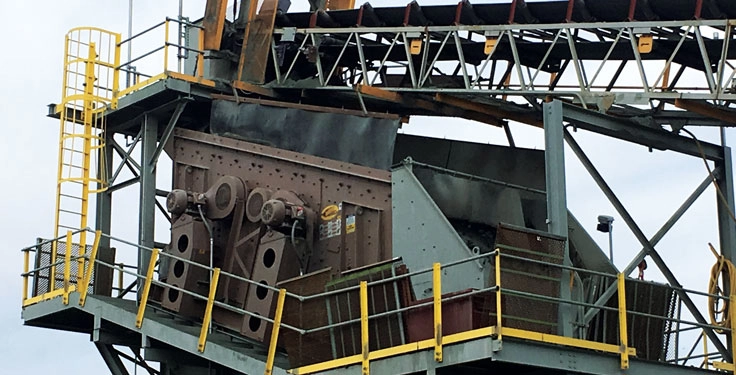
Maximum screening efficiency results from proper adjustments in speed, stroke, rotation (or throw) direction and angle of inclination – all of which influence one of the most important facets in screening: proper bed depth.
As feed material contains varying sizes, oversize will restrict the passage of undersize, resulting in material buildup on the surface of the screen. Bed depth diminishes as undersize material passes through screen openings. For efficient screening, the material bed should not reach a depth so great that it prevents undersize from stratifying before it is discharged.
An industry rule of thumb is this: In dry screening, depth of bed should not exceed four times the opening size at the discharge end of the screen. Consequently, with a 1/2-in. opening, the depth of bed at the discharge end should not, for example, exceed 2 in. Keep in mind that overloading a screen leads to a carryover problem and reduced screening efficiency.
When it comes to adjustments in screen operating parameters, there’s often a need to experiment to find the optimal balance. Consider the following:
Adjusting operating parameters
■ Increasing speed has its tradeoffs in both performance and wear. Speed may decrease bed depth, but it also raises the g-force, which decreases bearing life.
Using the proper opening size for the desired particle separation, combined with higher speed, will leave a minimal percentage of desired product size in the oversize. Alternatively, combining increased speed with a slightly larger opening size may allow a percentage of oversize in the desired product specification.
■ Increasing stroke delivers higher carrying capacity and travel rate while reducing plugging, blinding and enhancing stratification. Still, it can create inefficiencies when lightly loaded decks lead to material bouncing.
Generally, coarse separation requires increased stroke and less speed, while fines separation needs less stroke and higher speed.
■ Rotation direction can dramatically impact incline screen performance. Running counter flow or uphill increases material retention time and action on the screen, potentially giving the particles more opportunities to find an opening – and, ultimately, increasing efficiency. Direction of rotation has little effect on a linear-type horizontal screen.
■ Increasing the angle of inclination causes faster material travel. This can be advantageous in certain dry screening applications.
Of course, there’s a point where too much incline may hinder efficiency, as fines may roll right over the media rather than passing through. Consider adjusting both linear and triple-shaft horizontal screens for inclination when conditions allow. Operators can realize gains in capacity, rate of travel and productivity by adding some incline to their horizontal screen.
Information for this article courtesy of Deister Machine Co.
More Screening Content
The all-new Pit & Quarry University is now available, offering fresh insights on screen operation, maintenance and optimization. Learn more at pitandquarry.com/pqu.
Related: Crushing & Hydraulic Breaking | P&Q University Handbook