
When discussing screening efficiency, one claim comes up time and again: “Well, I can always get more capacity from an inclined screen.”
Ed Sauser, vibratory product specialist at Superior Industries, hears this comment all the time. But is it true? Do inclined screens always outperform horizontal screens? Is this a myth or, in fact, reality?
Sauser has some thoughts.
Screening priorities
When choosing screens, Sauser says producers are mostly concerned about throughput, product gradations and fines removal.

Some producers may assume that because inclined screens operate at a steeper angle (15 to 20 degrees) that a faster travel rate will lead to more throughput. This, he says, is not always the case – especially when the inclined screen is heavily loaded.
That’s a common scenario that leads to material carryover, recirculating loads and out-of-spec product.
“When selecting and sizing a screen, we’re focusing on what we can get through the deck openings – not over or across them,” Sauser says.
“More capacity” on an inclined screen often translates to “more conveying,” he adds, as more material often skips across the surface – not through the deck openings – due to the faster travel rate.
Plant operators often equate a faster material travel rate on an inclined screen with higher production. Sauser, however, says horizontal screens will consistently outperform a heavily loaded inclined screen when measuring saleable tons per hour.
Horizontal screens may appear slower, Sauser says, but producers must consider that the longer material remains on the deck, the more opportunities it has for proper material stratification. Without this, producers face higher costs per ton due to increased wear and material reprocessing.
In other words, Sauser says throughput equals efficiency.
Horizontal versus inclined
Sauser stresses that each screen type offers its advantages, and each has a place within the industry.
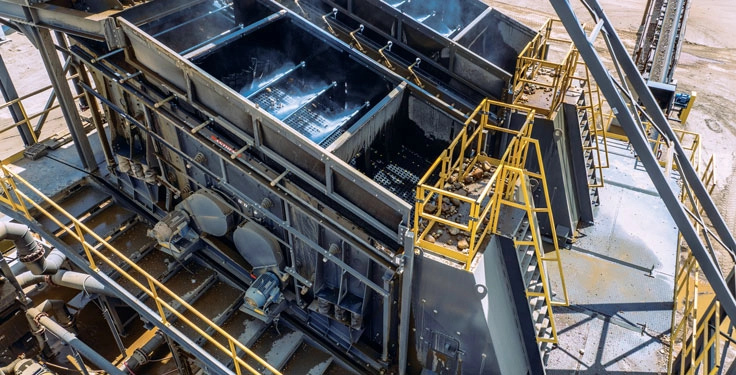
Elliptical-stroke horizontal screens have gained broader industry adoption in recent years, he says. These are high-energy machines with twice the horsepower and g-force of typical units.
According to Sauser, horizontal screens accommodate heavier bed depths with high g-forces while using an oval throw to move material on the deck. The high g-force units perform well in wet, sticky and high-moisture applications, he adds – or those where “precision screening” produces tight, exacting product specifications.
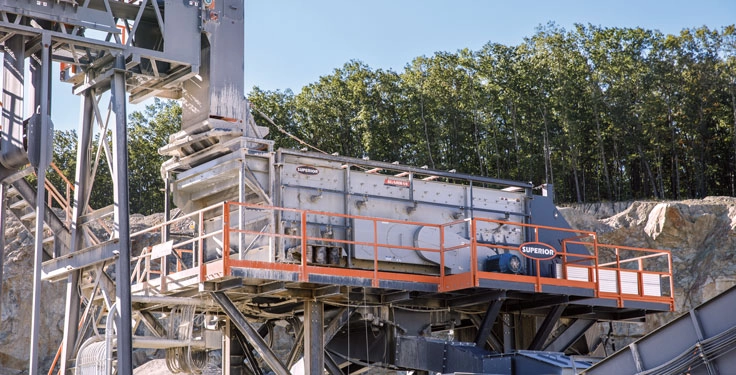
Alternatively, Sauser says inclined screens require less energy while making use of gravity. In his view, they are suited to higher-volume applications with less stringent specifications.
Finally
The common perception that inclined screens always outperform horizontal screens is a myth, according to Sauser.
Each screen type has its strengths, with a producer’s choice coming down to application, material parameters and production goals.
Inclined screens are ideal for speed and volume in general applications, Sauser says. For larger screen openings (i.e., those over 4 in.), he says inclined screens perform well because the sloped deck helps minimize potential material pegging in the larger openings.
Horizontal screens are best for precision stratification, fines recovery and overall efficiency, according to Sauser.
The bottom line: More tons across a screen deck does not always equal more high-quality, in-spec product.