

In a facility filled with million-dollar machines, it is often the smallest components that have the biggest effects on profitability.
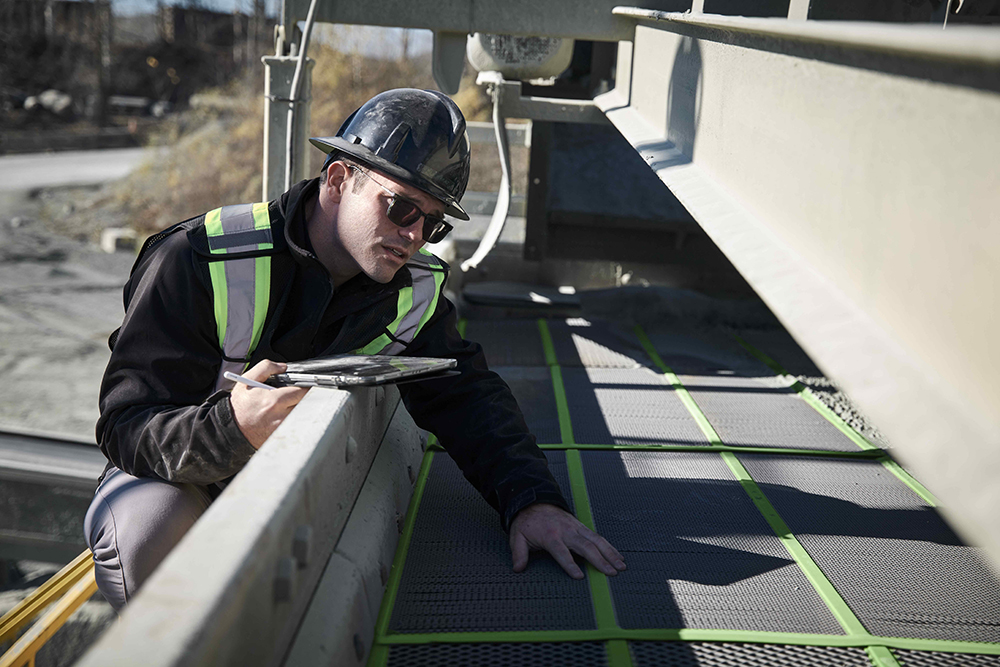
It can be tempting to opt for the cheapest option for consumable parts, such as screen media. However, many facility owners overlook the fact that the impact screen media has on productivity and material quality can be equal to that of the vibrating screen it sits on. The choice of screen media is important because it can cost – or save – an operation thousands of dollars.
Instead of focusing solely on upfront fees, quarry operators should consider the total lifetime cost of ownership when it comes to screen media. The final numbers include everything from the quality of screen media, the amount of product being produced, the amount of blinding and pegging prevented and the efficiency benefits high-quality screen media can offer.
Calculating ownership cost
The initial investment cost is often the first factor to consider when calculating the value of any piece of equipment. For screen media, many producers see a lower price tag and make a purchasing decision based solely on that.
However, this is just the initial investment. What is not immediately apparent is the lost production value associated with choosing the cheapest screen media available.
To accurately measure the value of screen media, operations should track the initial acquisition cost and the throughput for each type of media throughout its lifespan.
For example, say a mine paid $250 for a woven wire screen. The facility generally produces 300 tph at a rate of $8 per ton. In one eight-hour shift, that screen media will generate $19,200 worth of product.
However, if that same facility saw an increase in blinding and pegging because the woven wire screen trapped fines and had to be cleaned two or three times a day, each hour of downtime would equal a loss of $2,400. If cleaning takes 30 minutes each time it’s completed, this results in a loss of $2,400 to 3,600 per eight-hour shift.
By switching to a high-vibration screen media option fitted to the application, the facility would see a decrease in downtime and an increase in production. If the new screen media has an initial investment of $1,000, that same media would be paid for by negating just one hour of unexpected downtime.
Depending on the conditions, high-vibration screen media can require as little as one cleaning per eight-hour shift, meaning downtime can be planned for and executed more quickly. As a result, the same facility could make upward of $20,000 per eight-hour shift by adding high-vibration screen media to their screenboxes.
Tracking material production rate fluctuations at a mine or quarry is an effective way to track screen media efficiency. For example, a quarry producing 1 million tons of material annually could forego a $150,000-per-year, high-quality screen media option to save $30,000 on a cheaper option.
However, over time, the operation will find that the cheaper media is more likely to result in reduced production through increased blinding and pegging. In this example, a reduction of even 1 percent costs an operation 10,000 tons. If the product is sold at $8 per ton, that’s a loss of $80,000.
Selecting screen media
Choosing the right screen media for an application relies on a strong understanding of the material being sorted and the conditions in which it is being sorted. Consider the drop height, material size, abrasiveness, weight and volume. The more impact a material makes on the screen media, the higher the screen media durability needs to be.
Both synthetic and traditional woven wire screen media rely on the vibration of the screenbox and impact from material to promote stratification. The static movement of the screens limits vibration to between 800 to 900 cycles per minute.
While this does not hinder the facility from achieving adequate spec in most cases, it does mean the screening equipment is not utilized to its full potential. It also often results in blinding and pegging from more susceptible materials such as aggregates, coal, iron ore and other sticky or powdered products.
High-vibration screen media, on the other hand, amplify the vibration of the screening equipment. It features high-strength wire bonded by polyurethane or rubber strips to hold each wire in place. The wire vibrates independently to magnify the screening process and increase throughput by up to 40 percent.
This type of screen media can boost the work of the vibrating screen to between 6,000 and 10,000 cycles per minute.
The stratification and wear life of a screen media panel can increase when the quality of polyurethane and wire production remains consistent over time. Some manufacturers purchase their polyurethane and wire from outside vendors who substitute ingredients based on current pricing, resulting in an inconsistent product and inconsistent performance. Look for a manufacturer that produces both their polyurethane and wire in-house with a consistent formula to get the same quality of screen media every time.
Advanced technology
High-quality screen media also tends to be more technologically advanced than cheaper options, which can lead to time savings and better stratification.
Traditionally, to reorder or change out screen media, operators either read a sticker on the side of the screen panel or needed to physically measure the open area. The stickers, over time, often wear off and make it hard to read the text, so an operator expecting a quick glance to determine the screen media specifications may find themselves forced to climb down from the screenbox, fetch a measurement tool and climb back up.
Radio-frequency identification (RFID) technology featuring near-field communication can streamline these processes. The electronic tag is inserted into the polyurethane strip or frame for easy access. The tag can be scanned and read through an RFID reader or an app, where it transmits data – including inventory numbers, the sizing of the wire, the sizing of the wire openings and more. This reduces ordering errors, increases efficiency and results in less downtime overall.
Final thoughts
Before deciding which screen media to invest in, be sure to look beyond the initial sticker cost and consider the total cost of ownership.
While it’s true that screen media is just one small part of the overall production process, it does not have a small impact on operations. To really see the full benefit of investing in high-quality screen media, operations should take a long, hard look at their production practices, output and overall efficiency. That’s where high-quality screen media really shines.
Serge Raymond is a product specialist at Major.
Related: Selecting the right screen media for your operation