
Another season is on its way out, and in areas where the snow will be flying soon (if it hasn’t already), many pits and quarries are getting ready to undertake important seasonal maintenance.
While nothing is ever truly predictable in a pit or quarry, there is a cadence to the season that guides our work. When it’s time to shut down and repair or upgrade after a long, tough stretch, teams often face hazards they don’t see every day.
After spending the past decade in this industry, I want to spotlight three critical aspects of seasonal maintenance: What to look for, energy control and confined spaces.
What to look for
Aggregates environments get gritty. Equipment and plants endure relentless exposure to the elements and heavy run time during peak season.
A seasonal shutdown gives you the chance to bring your environment back to a solid “baseline.” Here are key questions to ask when the plant isn’t running:
• Guardrails. Are all walking and working platforms equipped with toe kicks, mid-rails and top rails?
• Signage. Over time, site signage fades or becomes unreadable, often without notice. Use shutdown periods to assess and replace what’s needed.
• Fall protection. Do you have enough? Is it stored properly in a clean, dry place? Is it in good condition and ready for use?
• Machine guarding. During busy seasons, guards sometimes get removed and inadvertently not replaced (Note: equipment should not be run without machine guarding in place). Shutdowns are a great opportunity to address missing or compromised guarding.
Energy control
Switching from operation mode to maintenance mode brings a different set of exposures and a different approach. Energy control is critical during seasonal maintenance.
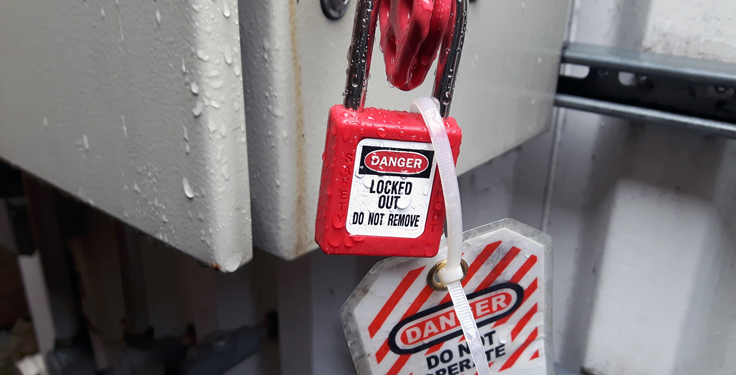
As we maintain different items, we need to make sure we are performing lockout/tagout. The essentials remain the same: de-energize and bring to a state of zero or controlled potential, apply the appropriate lockout/tagout procedures, verify and test to ensure zero potential.
Confined spaces
Another exposure that increases during maintenance is confined space entry. A confined space is generally defined by the Mine Safety & Health Administration (MSHA) as:
1. Large enough for a person to enter
2. Not designed for continuous occupancy
3. Limited or restricted entry/exit
4. Potentially hazardous atmospheres (oxygen deficiency, contamination, etc.), engulfment or other physical hazards.
Common examples of confined spaces include crushers, sumps, bins, silos, tanks and some underground pits.
In order to ensure safe entry into confined spaces, MSHA reinforces six essential best practices:
• Test the atmosphere
• Ventilate or purge to ensure safe air
• Control energy through lockout/tagout
• Rescue procedures must be in place prior to entry
• Retrieval systems (lifelines, harnesses, etc.) should be provided if entrapment is a risk
• Training is required for miners on confined space hazards and associated emergency response
Leadership Tip
The next time you walk a site – especially one in shutdown maintenance mode – keep an eye out for the following: guardrails, signage, fall protection and machine guarding. What gets measured gets done, but what leaders truly care about gets done well.
For our Northern friends, as a winter safety reminder, a crucial way to prevent slips, trips and falls during winter is to create a site plan for storms, snow/ice accumulation, sanding/salting and communicating the plan to all. With all the hazards in our industry, slips and trips remain the most common mishap.
Steve Fuller has worked over the past 20-plus years with a variety of industries – including aggregates – in operational and safety leadership roles. Now representing Steve Fuller Company, he can be reached at steve@stevefullercompany.com.
Related: Safety hazards to watch for during seasonal maintenance